
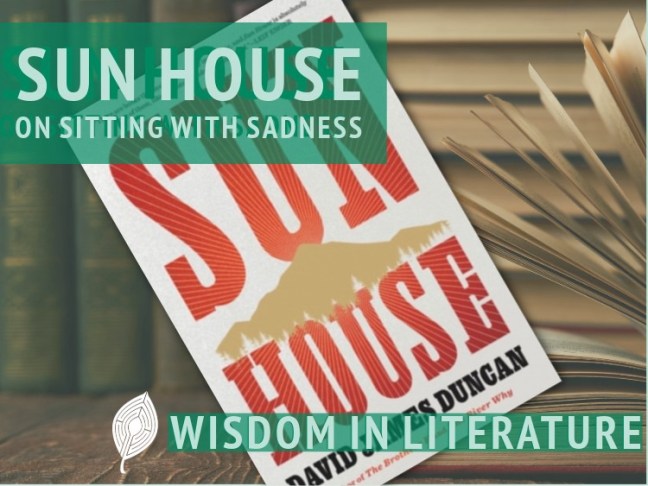
One of the most valuable things I’ve learned over the years as I’ve grappled with being human is the importance of taking perspective. This is a varied concept, including zooming out to better see one’s circumstances in the bigger context, putting oneself in others’ shoes, or zooming in to sit in one’s feelings about one’s circumstances. David James Duncan’s book Sun House, which is full of wisdom and insight even as it didn’t work super well for me as a coherent novel, offers an interesting way of looking at the third of these types of perspective taking.
In the story, one of the main characters, a college student who has been heartbroken by the world and trending towards cynicism has an epiphany while in her Sanskrit class — less to do with the language itself than with the way its transliteration interacts with English vocabulary:
Then came a day and definition that changed her life. On his same blackboard in the same pale blue chalk, Dr. Cool wrote the word ‘sad’…. Then he changed the situation entirely by adding a dot under the s, converting the English word sad into a Sanskrit syllable he pronounced ‘shad’. And with the same blue chalk, defined ṣad like so: ‘To sit down inwardly and breathe and attain the true.’ Dutifully writing down ‘sad’, ‘ṣad,’ … something more happened. As the English word ‘sad’ became the Sanskrit word ṣad, English and ‘skrit mated, the two words fused in a nonce word ṣadness, and she experienced an intuition she sensed might be profoundly true. … [O]ver the next few weeks, every time the sight of life’s cruelty, or humanity’s inhumanity made her sad … a transformative dot appeared beneath the cause of sadness, transforming it to ṣadness, and ṣadness caused her breath to come with a calm fullness, her mind embodied to fill with a serenity she hadn’t previously known how to summon, and interior doors to open in what had once seemed solid walls. … The serene inner peace she knew as ṣadness had not been born of an A-student’s mental process; it was born of an elemental process. Cream is a far cry from coffee, but dump a little in a hot black cup and the coffee turns tan and stays tan whether you want its blackness back or not. Ṣadness proved the cream in every subsequent cup of Risa’s sorrows.
As an aside, part of why I like this story is because I had a similar thing happen once with an intersection between English and Ancient Greek (though in my case, the words were at least etymologically connected!). In my story, a pastor was droning on about spiritual purity, and though I was still comfortably more conservative at the time, I’d already grown weary of so-called ‘purity culture’. I was doodling on my bulletin when I looked down and noticed that I’d spelled out the word ‘purity’ as ‘πυρity’, those first three words being the Greek word for fire. The dots connected in my mind and I realized that true purity isn’t about ‘spotlessness’ but about what is left on the other side of life’s refining fires. It revolutionized how I understood the idea, redeeming it from the prevailing culture-war nonsense, and would be an important piece for me years later when it came time to de- and re-construct my faith.
But getting back to Risa and her ṣadness, her epiphany was that by ‘putting the dot’ underneath her sadness about the world, she could transform it into something else. This wasn’t avoidance, it wasn’t wallowing, it wasn’t spiritual bypassing. It was a way of witnessing the world’s injustices and injuries and staying with her sorrow until it became wisdom: the wisdom of genuine empathy and witness, which can in turn to transformed into action.
If this all feels very ‘Eastern’, well it is. But that doesn’t mean it isn’t also profoundly Christian. As I like to say, if we dig into it, our idea of ‘repentance’ is not about confession of sins but about the transformation of the heart and mind so that we see the world through God’s eyes, as it really is. I think this is the essence of ṣadness. We live in a world that seems hell-bent on keeping us from truly experiencing the transforming power of sadness. It wants to distract us from it with entertainment and ‘content’, bypass it with pseudo-spiritual platitudes, and numb us to it through mood-altering substances. In order to truly repent, we need to sit with ourselves. We need ṣadness.

