
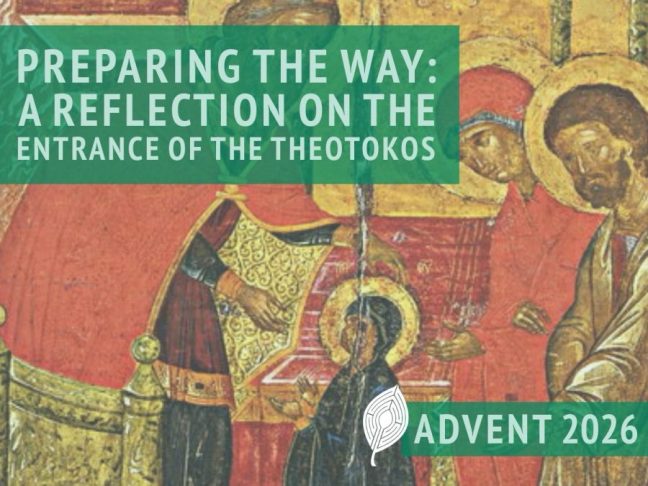
Yesterday was a feast day in many parts of the Christian world, known as the Presentation of Mary, or the Entrance of the Theotokos into the Temple. It tells a rather scandalous (and implausible) story from Mary’s childhood that nonetheless dates to the Church’s earliest traditions. Today I thought I’d reflect on the story, what it tells us about how ancient Christians understood our story, and use that as a springboard to talk about my plans here for Advent this year.
The story comes from the Protoevangelium of James, which dates to the second century — within mere decades of the final coalescing of the four Gospels. If you know your Greek and Latin, you’ll know that its title means something like “the story before the Gospel,” and the name is apt. It is most famous for telling the story of Mary’s parents, Joachim and Anna, and of Mary’s birth and childhood. It describes them as a holy couple, wholly dedicated to serving God. But, like so many couples in the Bible, they were childless and carried both the strong social stigma and associated feelings of abandonment by God that accompanied that state in their culture. But God hears their prayers and lamentations and gives them the joy of a baby, whom they name Mary. Now we come to the part of the story yesterday’s feast commemorates: So great were Joachim and Anna’s joy and gratitude that they bring Mary to the temple to consecrate her to the LORD at the age of three. There God fills her with such joy that she begins to dance on the very steps of the altar. She is taken in to be raised as a temple attendant until the age of twelve, when she leaves under the protection of Joseph. (In this version of the story, Joseph and Mary’s engagement was less a marriage as we think of it than a kind of long-term guardianship.) Now, much about this story would fit in better with what we known of Greek and Roman religion than it does ancient Jewish religion, so this reads as pious but perhaps poorly-informed fan fiction. But, we also don’t know much about how the temple in Jerusalem actually worked in the first century BCE, and by that time Judaea had been under Greek influence for hundreds of years, so it’s not inconceivable that a practice like having temple virgins could have made its way to Jerusalem.
But more interesting to me than questions of the story’s historicity are the questions of what it meant. What does it say about second-century Christianity that such a story would have been written down and incorporated fully into the Church’s traditions?
I’m going to take this from two directions. First, if you’ve read any patristic Christian poetry or hymnography, especially that of the East, you’ll know that the ancients loved to meditate on the paradoxes and parallels of the Jesus story. The master of this was St. Ephrem the Syrian (4th C), whose hymns are still sung in the Eastern Churches close to 1700 years after they were written. In one Christmas hymn, he described Jesus as:
The Great One who became small,
the Wakeful One who slept,
the Pure One who was baptized,
the Living One who died
the King who abased himself to ensure honor for all.
Similarly, the sixth-century hymnographer Romanos the Melodist, begin his great nativity hymn: “Today the Virgin gives birth to him who is above all being, / and the earth offers a cave to the Unapproachable One.”
The same thing happens in the ancient hymns for this feast:
Today the living Temple of the holy glory of Christ our God,
the pure Maiden who alone is blessed among women,
is offered in the Temple of the Law
that she may make her dwelling in the Holy Place.
Joachim and Anna rejoice with her in spirit,
and choirs of virgins sing to the Lord,
chanting psalms, and honoring His Mother.
The paradox being contemplated here is the idea of the Jerusalem temple, the place where God dwelt and was present with God’s people, receiving the one who would herself become the place where God dwelt and became present with God’s people in a new way. This hits at the core meaning of the feast: It’s the symbolic passing of the torch from the ‘Old’ Covenant to the New. In this, it emphasizes the incarnation and therefore the divinity of Jesus. Here we come to the real truth of all genuine ancient Christian devotion to Mary: It never sets Mary apart for her own sake or to glorify her, but is always about glorifying Jesus. Saying that she fulfills the temple by becoming the dwelling place of God demands that her son is in fact divine.
This focus on the parallels and continuities between God’s relationship with God’s people before and after Christ as much as on the differences also adds some much-needed nuance to how we theologically understand Christianity’s relationship with Judaism. When we take time to reflect on and rejoice in the parallels and the narrative ties that bind, we’re less likely to fall into the trap of supercessionism.
But there is a second, and I think equally important, strand here. And that’s the insistence that, as much as Jesus’ incarnation is a miraculous divine intervention, it also doesn’t come out of nowhere. They story the Protoevangelium tells is about preparation, goodness, and holiness. Joachim and Anna are faithful, and Mary is raised surrounded by not only their faith but within the whole life of the temple. God doesn’t pick a random girl to raise the Son, but one whose whole life has worked together to make her up to the challenge. Mary’s good beginning allows Jesus to have a good and safe beginning too. And so much depended on that.
These themes are true not just for Mary, Joachim, and Anna, but for the whole story of our faith. And so, my Advent series this year (which I’m starting a week early) will explore this idea, seeking the ‘good beginnings’ and all the ways the coming of Jesus was anticipated in and prepared by all the stories that came before in the lives of his ancestors in faith and in blood.
I hope you’ll join me on this journey on Sundays and Wednesdays throughout Advent.

