
Over the past couple years as I’ve been grappling with both the Kingdom teachings of Jesus and the vocal move of many Christians towards their exact opposite, I’ve taken to calling the gospel “the anti-religion of Jesus.” What I mean by this is that it seems there’s a generalized ‘spirit of religion’ within humanity that tends towards judgmentalism, legalism, and authoritarianism, a spirit that sneaks into spiritual movements of all kinds, no matter their actual teachings. In Christianity’s case, Jesus spent most of his teaching attacking such ‘religious’ attitudes. Despite that, they have reasserted themselves time and time again, with the result that a lot of people who have fallen out of favour with the Church appear, in hindsight, to have been among its most faithful members.
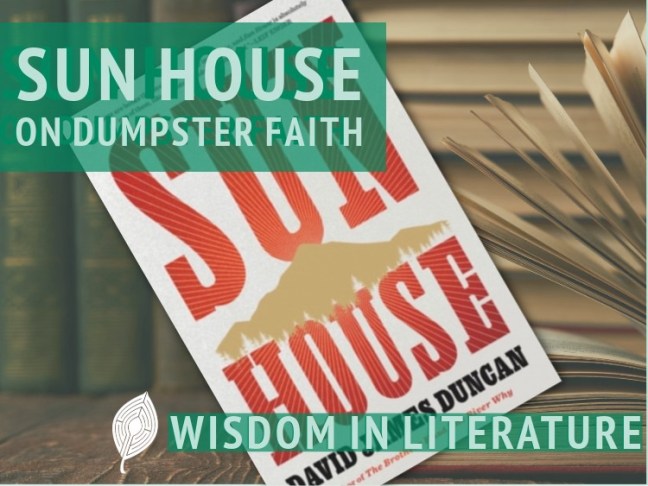
Reclaiming the figures of good faith who have been crushed by their own religious institutions is one of the major themes of David James Duncan’s sprawling book Sun House (2023). One of the characters adheres to what he calls “Dumpster Catholicism,” a kind of perennial (i.e, ‘catholic’ = ‘in accordance with the whole’) philosophy comprised of those ideas and people cast aside by institutional religion. As he describes it:
Dumpster Catholicism is just the gigantic old dumpster out behind Mother Church. … It’s the faiths and loves of every Church-violated or -scorned, or -robbed, or -raped, or -betrayed, or -erased person, and truth and tribe buried in that dumpster. And what great loves and truths they are!
There’s certainly an anti-institutional bent at work here — Duncan is a child of the ‘60s after all! — but there’s also a lot of truth to this idea. So many religious debates and controversies that were a matter of life and death in their day seem bizarre after the fact, and all of those debates and controversies had real victims. For example, far from the anti-grace bogeyman Augustine made him out to be, from everything we can tell about what he actually thought, Pelagius was simply trying to ensure that Christian adherence meant something in the new era of the ‘Christianized’ Empire. Turning to the East, one of Christianity’s greatest theologians, St. Maximus got his epithet ‘the Confessor’ because he was tortured for his faith — with the full support of the Church authorities. Questions of heterodoxy likewise plagued St. Francis’s life. The 14th-century movement known as the Beguines, women who devoted themselves to living in loose communities inspired by the teaching of Jesus, was declared heretical, mostly it seems because it didn’t take its marching orders from the Church hierarchy. And, Quietism, the movement from which the much-beloved spiritual writing Abandonment to Divine Providence seems to have emerged, was likewise judged heretical. The list goes on and on, in pretty much every age and stage and place.
As they say, the more things change, the more they stay the same.
It’s not that everything in the dumpster has value, but that religious communities have a tendency to err on the side of tossing out what doesn’t fit into the status quo. This is especially true when movements appear to undermine the authority of those making the decisions.
In all this, I’m reminded of what I’ve noted elsewhere about the value in the margins. While we humans and our systems and structures love clean lines, nature does not. And it’s precisely in the fuzzy areas where there’s the most energy and life:
God doesn’t do straight lines. Nature is full of in between spaces, like wetlands or scrublands, and outliers, like mammals that lay eggs or fish the bear live young. In fact, while we show incredible disregard for ‘in between’ spaces, they are generally the most diverse, creative, and important places in the natural world. …
These principles work on a human and culture level too. As much as human societies like black-and-white boundaries, there have always been and will always be those who don’t fit into them. And these people are often the most creative, interesting, and wise. Every single popular music trend of the past 150 years started among the marginalized (in the West, especially Black communities): from ragtime to blues to jazz to rock n roll, to rap. And there’s a reason we have a classic image of the artist’s garret and not the artist’s mansion, and why so many great writers and artists have been queer. There is something about not fitting in socially-defined categories that is very fruitful in the human spirit.
While maximizing edges and margins has little to do with Christian faith on the surface, on a human level, it’s an idea both Jesus and Paul understood well and implemented in their ministries. Jesus spent much of his time with those on the margins of society, including the sick and disabled, women, and ‘sinners’ like sex-workers and notoriously crooked tax-collectors. He even used a Samaritan — someone looked upon by ‘good’ Jews as a half-breed and heretic — as a hero in one of his most defining parables. In a similar way, Paul spent a lot of his time working at the edges between Judaism and Gentile culture, to great effect. The edge is also literally used in Jewish Law, as farmers were instructed to leave the edges of their lands unharvested so the poor could glean them.
So while sorting through the dumpster of faith takes a lot of discernment, it’s also very much in line with the spirit of Jesus’ ministry, and therefore of God’s heart.
We could all benefit from some time in the dumpster.

