
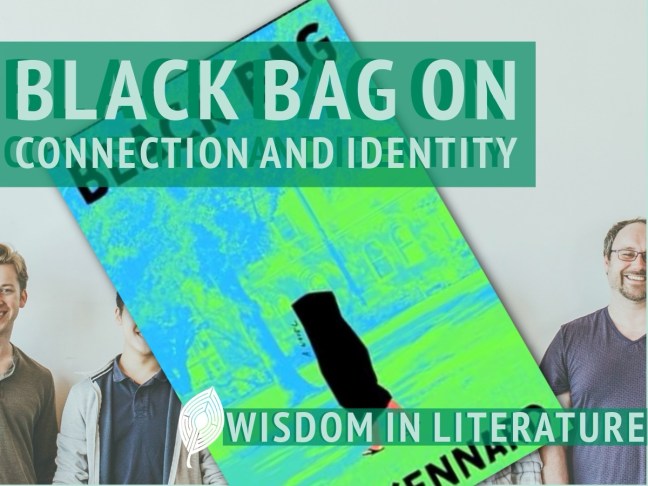
Last week I reviewed Pope Leo XIV’s magnificent Encyclical Magnifica Humanitas, about what it means to be human in the age of artificial intelligence (AI) and what we must do to maintain our humanity today. In an age when labour has been devalued, when the West has ceased to talk about citizens but only of ‘consumers’ and ‘taxpayers,’ and where decision-makers default to what is easiest and cheapest, these are important questions indeed. This year I read another wonderful book that waded into these waters, albeit in a very different way: Luke Kennard’s wonderful Booker Prize-shortlisted book Black Bag.
The premise of the book is simple, if strange: an out of work actor accepts a job recreating an old psychology experiment in which he must silently attend a semester of college classes covered head to foot in a giant black bag. The goal of the experiment is to see how the students react to having him there, not only dressed so oddly but also devoid of any markers of race, class, gender, and personality. “Bag is to be characterless,” the professor running the study notes, although ‘The occasional involuntary movement will be allowed.” Desperate for the job, our protagonist promises to do his best, to which the professor suggests “About half should be sufficient.”
As the days go on, he comes to think of Black Bag as character in itself, and he discovers this new persona easier to be in than his own. Gone is the need to perform, either the charm and wit expected of him as an actor, or the trappings of masculinity expected of him as a man. At the same time, those around him react in different ways, from his childhood best friend who tries to monetise Black Bag, to a professor who studies dysfunctional men who propositions him because she wants to “fuck nothing.” It’s a fascinating and utterly original, often hilarious, exploration of what it means to be a man specifically, but also a human more broadly, in our world today.
Unsurprisingly, the book revolves around the idea of personas, the versions of ‘us’ we present to the world, and how that shifts depending on our context. As a millennial, the protagonist grew up in an era where authenticity was valued more than anything (hence ‘millennial cringe’ — nothing is ‘more cringe’ than being oneself!). But one’s authentic self is also to a large degree a role to be played, not only because of the curation we naturally do to impress others, but also the roles society casts on us based on our looks, clothes, race, and (from the book’s perspective, especially) gender. As much as black bag is itself a role for the protagonist, it is also a kind of “rejection of the current options,” as his best friend puts it.
In all this, I was reminded of a friend of mine who once called zombie movies “an exercise in apophatic anthropology.” What he meant was that zombies reveal what it means to be human by exploring what a lack of humanity looks like. In the same way, by exploring what a lack of personhood looks like, Black Bag is a fascinating exercise in apophatic personhood.
And what it suggests in the end, albeit in shadow, is that, rather than obsessively trying to wrangle the ‘self’, perhaps the self naturally comes into view in relationship with others. “Our only assumption must be that everybody else’s life is more meaningful than our own. That is the only way to encounter the other. The rest is window dressing.” Connection — genuine connection — is the only antidote to the malaise gripping so many of us in our rapidly changing world. It’s far from a radical idea, but it is, after all, what being human is all about.

