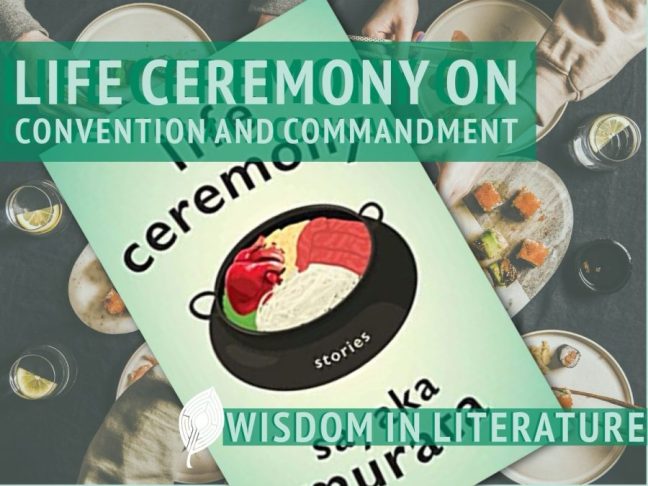
There’s a famous saying attributed to C.K. Chesterton that exhorts us to “Keep the commandments, break the conventions.” It urges us to dig down to the heart of things, and focus on what God truly requires of us, rather than the trappings in which our culture has wrapped up ideas of piety. But who gets to decide what convention is? In her masterful collection of short stories, Life Ceremony (2019, transl. 2023), Sayaka Murata explores the surprisingly and disturbingly blurred edges between convention, taboo, and commandment.
What makes these stories so effective is that they present a clear right and wrong, which the reader agrees with, only to upend and disrupt them through the course of a story. For example, the first story, “A First-Rate Material,” is set in a near-future Japan where it has become customary to use human remains as a material (think human skin lampshades or human hair sweaters). One of the main characters is horrified with this development, much to the chagrin of his fiancée, who doesn’t see what the big deal is and longs to keep up with the latest fashions. But, when he’s presented with something made from his late father — a beautifully crafted object his father wanted him to have to remember him by — he has his certainty shaken. And, surprisingly, I did too, as a reader. The title story takes this even further, exploring a society in which eating the dead has become an important part of funerary custom, turning cannibalism from something inherently dehumanising into the greatest possible celebration of humanity.
While there are absolutely very good reasons why such practices are roundly condemned in Christianity, they’re not quite as beyond the pale as our first instincts might make us think. For example, altars were traditionally built over the bones of martyrs, and the physical remains of the Saints have been venerated since the earliest days of Christian faith (outside Protestantism of course, but historical evidence suggests this was less a ‘restoration’ of an earlier prohibition than it was a removal of something that had been there from the start). And, there are the famous examples of monasteries which used the bones of the dead as a construction material for their chapels as a memento mori and celebration of the communion of Saints. And, in the Eucharist, whether symbolically or sacramentally, we believe and say we consume the body and blood of Jesus to sustain us and have his life within us. It’s not a huge leap from that to the kind of reverential cannibalism “Life Ceremony” explores. I’m certainly not arguing for such practices — far from it — but found it a fascinating, if very discomforting, exercise to be forced to think through my boundaries on these ideas and try to separate commandment from convention from taboo. While I’ve highlighted two stories, others engage with conventions surrounding things like food, faith, sex and reproduction.
Truth be told, I wasn’t sold on the collection as a whole until the final story, “Hatchling,” which somehow brought everything together for me despite working with a far less radical theme. In this story, we meet a socially awkward young woman, who can only fit into different social situations by code switching — to the extent that she doesn’t even know who she is because she feels like she’s a wholly different person in every group. This comes to a head when she plans her wedding and cannot figure out how to behave when all of her worlds — and personalities — collide. While her situation is extreme, the phenomenon itself is universal. We all wear slightly different masks at work, at home, and among our friends and family. We consider this completely normal, and even necessary. But this story forces us to ask at what point this becomes problematic, or even sociopathic. For me at least, this tied the whole book together perfectly.
Normally in these “Wisdom in Literature” posts I want to highlight some insightful idea or theme. This is very different. While I’m not about to take up any of the ideas of Life Ceremony, I still found myself deeply moved by it. It made me think, and more importantly, made me rethink my assumptions and interrogate my boundaries. And what is literature for, if not to make us do just that?

