
The aim of this series is to develop a toolkit of practices we can use to quiet the mind and so be better be able to connect with and listen to the soul. But so far, all of the practices we’ve looked at have still been pretty mind-oriented: things designed to ‘empty’ the mind, whether by exhausting it or quieting it, or to stimulate the imagination. Today’s practice, or rather practices, involve the body more, in a partnership with the mind and soul. Today we’ll be talking about three different ways creating visual art can help us listen to the soul.
By visual art I mean any creative process by which we use our bodies to shape matter into an expressive form. For me, that’s generally pigment on a page but it can also be clay, sculpture, assemblage, and so on. If that sounds vague, it’s intentionally so, because art can be whatever we want it or need it to be. But today I’d specifically like to talk about three ways I use it in my life of faith.
The first is the most intentional: representative or figurative art. This is creating art that seeks to represent things we see: a bowl of fruit, a pet, a tree, whatever. I know a few artists (much more skilled and practiced than me!) who consider this a form of meditation: the focus it takes to render something on the page or in clay clears the mind of distractions and attends to the smallest details of an object or scene. But for me, it tends to be a form of active imagination, the Jungian practice we looked at the other day in which one stays with and even expands on something that’s stuck out at you (generally in Jungian practice, a dream image, but I also use it as a way of staying with synchronicities (coincidences), turns of phrase, song lyrics, prayers and passages from books. For example, I was really struck with the imagery in one of the prayers I wrote about for Good Friday. So as part of my sacred practices on Good Friday, I took some time to draw it (ish).
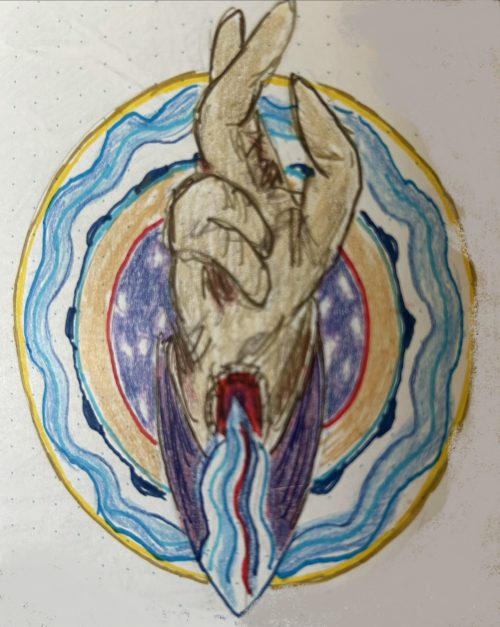
As you’ll see in the image, the point of this isn’t for it to be artistically good, but to spend time with the imagery. Sometimes, as with this one, it’s pretty straightforward, but at other times I’ve been quite startled and moved by what’s come out when I spend time with images like this.
Going down one level of intentionality is the practice of mandalas. I did a whole post on these a few years ago, but to summarize, a ‘mandala’ is a circle used as a symbol of wholeness; it generally consists of concentric circles decorated more-or less symmetrically. While the practice originated in South Asian traditions, similar images have appeared in Taoist, Jewish, Muslim, Christian, and Mesoamerican settings as well, so there’s clearly something universal about the imagery. In contemporary practice, they are most commonly associated with C.G. Jung, who found them a profound and revealing practice not only in his own life, but for his clients as well.
The practice here is simply to create a mandala and spend time with the symbolism: what shapes or images are present? what colours did you use? what feelings arise when you look at it?
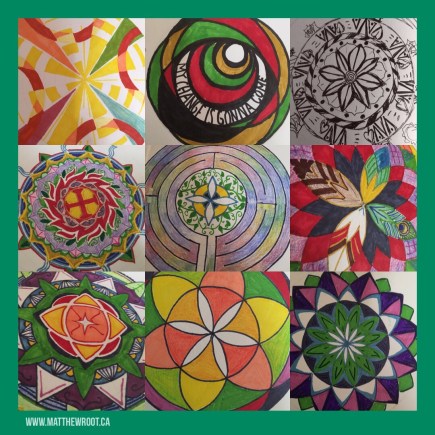
On the surface, creating mandalas is a way of entering into a relaxed, meditative flow (more on that below). But I’m almost always impressed by how meaningful it is for me too. Because it can take me to this flow state, it also opens up the self or soul to me in surprising ways. As I assessed back in the day:
While some of the symbols and patterns were either obvious — the form lends itself naturally to stars, leaves, flowers, and compass roses — or intentional — such as imagery from my religious tradition or that was otherwise meaningful to me, how those symbols and patterns came together in a cohesive way was almost always a surprise. This was even true when I approached the practice with a certain motif in mind (e.g., a compass rose or a labyrinth). Each of the mandalas told a story. Each of these stories was obvious to me after the mandala was completed, at very first glance. Each of the stories was true, and a story I needed to hear. And with only one exception, none of those stories was one I was intending to tell.
Finally, we have the least directive and intentional way we can use visual arts, and that is purely as a meditative tool. While this can happen with the extreme focus required to draw an accurate representation of something or in the symbolic realm of mandalas, for me this is mostly the purview of doodling. My doodles are like needlepoint, knitting, colouring, or whittling, in the sense that it creates a state of relaxed flow that ends up being very similar to the altered states of meditation practices. It’s a matter of keeping the mind just occupied enough that it’s not running amok but not so occupied as to dominate one’s mental state. Like meditation, this creates space for the soul’s quieter voice to be heard.
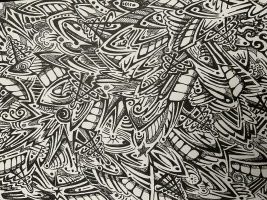
No matter how skilled an artist one is, I truly believe incorporating visual arts of one kind or another is incredibly beneficial. Not only do they add colour (literally and figuratively) and interest to a journal, but they engage and bring different parts of the self into one’s practice. And so, I’d encourage anyone and everyone to give them a try.


2 thoughts on “Soul Speech: Visual Art”