My best friend likes to tease me about how little I buy in the way of home decor. Despite that, I wouldn’t say I’m a minimalist. My apartment is filled with books and art and photographs. The difference is that I want to be surrounded by beautiful things that are also meaningful to me. It’s about curating an environment that makes me feel cozy and comfortable, but also personally meaningful. This spirit is behind one of my absolute favourite sacred practices, one that brings together all the rest into something cohesive, thoughtful, and beautiful. It’s my take on a practice known as florilegium (which delightfully enough means ‘flower picking’ in Latin).
As I wrote in my original post on this practice, in its purest form, florilegium is about collecting and anthologizing excerpts from trusted texts. It makes sense that such a practice would develop in monastic communities considering the huge costs of paper, ink, and effort it took to copy books. But also, it’s just a very human tendency to collect beautiful things — words and phrases included.
But over the years, what I’ve found really special is to use the practice as a way of reviewing, framing, and reflecting upon time. It’s like a combination of the traditional florilegium, a ‘commonplace book’ (a journal where one keeps track of ideas, insights, quotes — really anything one doesn’t want to lose sight of), and Jung’s Red Book (his journal full of his illustrated dream amplifications).
Here’s what I do:
- I jot down quotes, ideas, and insights as they come up. (I’d love to do this in a journal, but using the notes on my phone has been much more successful; it also makes it easy since I can snap photos or use the camera’s live text feature to capture quotations.)
- To this same file, I add symbols or iamges, summaries of dream work, Examens (really the results of any of the practices discussed in this series) that jump out at me.
- At the end of the week, I pray, then spend time with the words, messages, and images in the file.
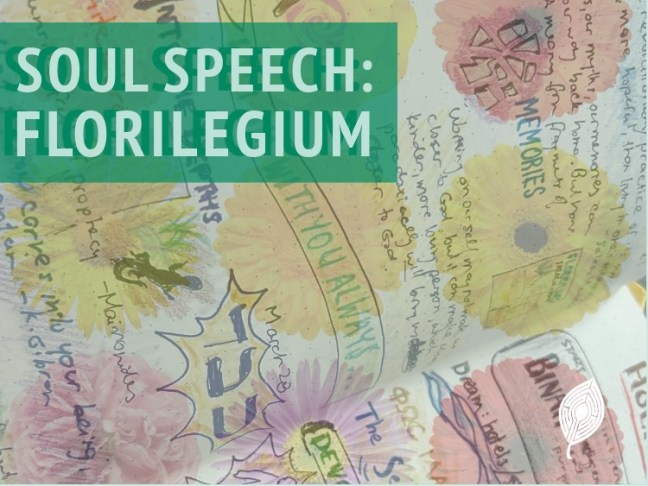
- I pick out the biggest and brightest quotes, images, and most importantly, the themes among them into my actual journal, which then becomes like my personal version of Jun’s Red Book.
The florilegium part — the sifting through and picking out what really stands out — is the most important part of this process for me, especially since like a lot of us, I’m relying a lot on technology for my practices. If I were to just keep the weekly log on my phone, little of it would be memorable or ultimately meaningful. The meaning comes through spending the intentional time with it, slowing down, and copying out by hand, as beautifully as I can, what seems the most important for me. That’s what I remember. And that’s what I refer back to.
I’ve tried a lot of different things over the years in an attempt to work in intentional time for soul work, and this has been not only the most fruitful for me, but also the most sustainable. It’s become my favourite time of the week, and has been helpful too. A good example of this happened just a couple weeks ago. As I was going through the process, I noticed a recurring theme of trimming and pruning. Now for the previous few weeks I’d been in a high-productivity, high-curiosity, high-(for me)-energy phase, but I took the pruning theme as a warning that that cycle was coming to a close. Sure enough, the next week I had a lot less energy and focus. But the warning that came through my florilegium practice allowed me to plan ahead, trim back the projects I had on the go, and handle it all with less resistance and more grace than is usually the case.
And so I would encourage you to take a similar approach to your soul work and sacred practices. It’s wonderful to jot down things down that pop up in the busyness of life, as well as the more intentional practices. But taking the special, sacred time to prayerfully spend time with what’s come up can make all those practices all the more meaningful.
 Matthew Root
One thought on “Soul Speech: Florilegium”