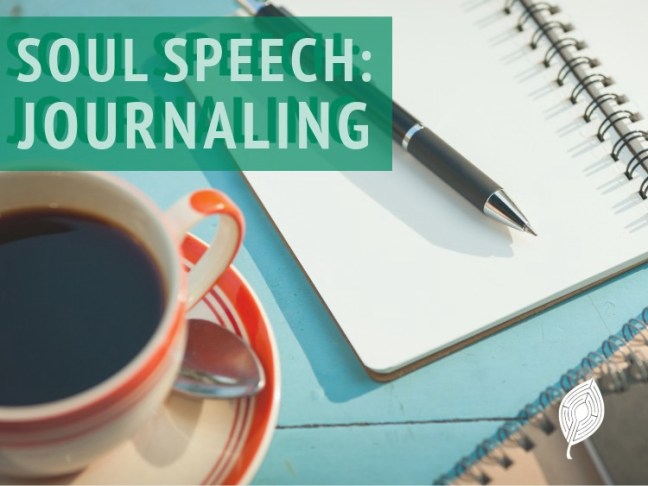
As I mentioned the other day, in some ways this series that I’m calling “Soul Speech” circles back on the first ever series I did here, in which I spent a whole year undertaking different sacred practices. And one of the very firsts posts I wrote here was on today’s topic: journaling as a sacred practice. Journaling has been called the world’s oldest form of self-help, and with good reason. In our journals we can not only express things we want to say, but never actually do, but also uncover long-hidden truths about our thoughts and feelings. If you’d like more background, please check out that old post from 2018. But for today’s purposes, it’s this last aspect of journaling — journaling as a tool for self-discovery — that will be the focus.
Journaling has played different roles for me in different seasons of my life. It was a very routine — almost daily — practice for me for a good fifteen years. This was especially true in seasons of upheaval, when I was either wrestling with life-changing decisions and their always-messy aftermath, or when I was really struggling to understand and come to peace of heart and mind with my circumstances. Looking back on those old journals now, I’m shocked by the intensity of feeling in them. There’s a lot of mess there, what Brene Brown helpfully calls “shitty first drafts,” where we just spew all that we are thinking and feeling out onto the page, all of our cognitive distortions and automatic negative thoughts written out in black and white, irrespective of context or whether they withstand any closer inspection. As I wrote in that 2018 post about this aspect of journaling:
…it helps me sort out my conflicting feelings or opinions, especially during periods of transition. My journal can help me figure out where I’m going, or where the energy of my life is drawing me, in a way that little else can. In a sense, it’s like a dialogue with myself, in which I simultaneously speak the mysteries of my heart that are too tender and raw for public consumption and listen actively, carefully, and compassionately to what it is I’m saying.
But, just as often, I’m shocked by the wisdom I see in those old entries. I’ll encounter a truth in something I wrote in 2013 that I wasn’t really able to embody until years later. Is it frustrating to see that I actually knew something years before I knew it? Yes, for sure. But if the whole journey of my late 20s and early 30s taught me anything, it’s that there’s a big difference between learning something, being able to apply it, and embodying it. Take for example the very idea of cognitive distortions and automatic negative thoughts that I mentioned above. I was first told about these ideas in 1998. But I wasn’t able to accept their reality until around 2009-10. I wasn’t able to recognize them and combat them in my thinking for a couple years after that. And it took a couple years after that for me be able to (mostly) stay out of those ruts entirely. I think the precocious threads of wisdom I can see in my old journals function the same way. I can see them as good seeds that were planted, even if it took a while for them to grow and bear fruit.
But in recent years, I’ve struggled to keep up with a journaling practice, and indeed, there isn’t much interesting in what I’ve written at all. I think that’s because, while the world has been looking increasingly unstable, I’ve been in a pretty good and stable place in my heart, mind, and soul. Really, anything I’ve journaled for the past six years just seems to be a variation on the same themes: ‘The world is scary right now, I’m grateful to be employed, housed, and fed in the midst of it all, and while I feel like I’m bumping up against brick walls and closed doors a lot of the time, I’m feeling a general peace about what I’m doing and in my relationship with God.’ The thing is, I don’t think it’s a bad thing that my journaling practice doesn’t seem very fruitful recently. We do our business with ourselves and God in different ways in different seasons of our lives, and that’s okay.
The very stability of the message coming out in my journaling when I do do it these days is itself useful information. A number of years ago now, during a relatively stable time in my heart, but also during a difficult discernment process, I looked back at my journal and noticed the same concerns coming up week after week, over the course of over a year. That was an eye-opening moment that empowered me to make a huge decision — and one which I have never once regretted.
No matter what type of season you’re in — a time of inner tumult or relative inner peace — journaling is a beautiful practice. In the end, it enables a greater sense of perspective on our lives. In a sense it’s like digging a tunnel into the heart. The deeper you go, you never know what you’ll find: sometimes you’ll strike water, sometimes you’ll strike gold, sometimes you’ll strike oil (for better and for worse), and sometimes you’ll strike out. But any way it goes, you’ll have a greater understanding and perspective of what’s going on in the heart and what your soul is trying to say.


5 thoughts on “Soul Speech: Journaling”