
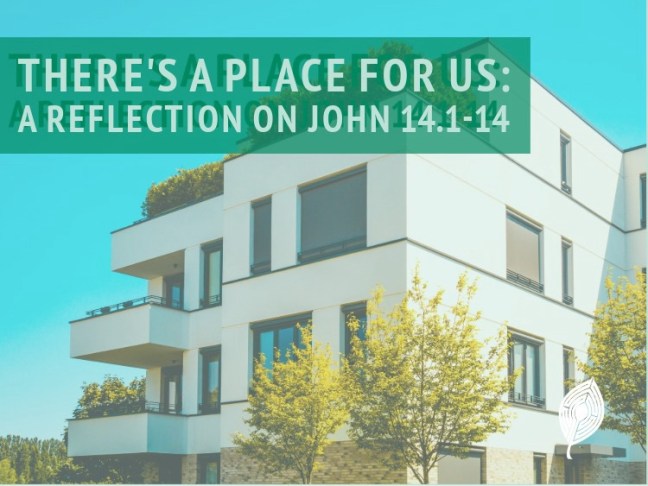
There’s a famous saying that ‘There’s no place like home.’ It refers of course to the sense of peace and rightness that comes from returning to the place where we belong, whether it’s after years living abroad or just a long day at work. And yet, it’s a sad reality that for millions of people today, that feeling of home is out of reach. There are an estimated 2.5 million refugees worldwide in April 2026, people torn from their lives and homes by war, persecution, drought, or famine; add to this all those who are out of touch with the places they call home, and the millions more whose access to housing has become precarious over the past decade, and the problem grows by magnitudes. “There’s no place like home,” but what happens when we have no home, or when the homes we’ve known no longer exist, or are no longer recognizable? How many people on this planet right now can relate to Jesus’ words, “Foxes have holes, and birds of the air have nests; but the Son of Man has nowhere to lay his head” (Matthew 8.20)! But as we find out in today’s Gospel reading, that’s not the only thing Jesus has to say about the subject.
Taken from John 14, the reading starts like this:
May your hearts not be troubled. Trust God; trust also in me. In my Father’s house there are many apartments. If it were not so, would I have told you that I go to prepare a place for you? And if I go and prepare a place for you, I will come again and will take you to myself, so that where I am, there you may be also. And you know the way to the place where I am going. (John 14.1-4)
In a world where so many find themselves cut off from their homes, or even the idea of ‘home’, Jesus tells us that in God’s house, there is room for all of us: God’s kingdom is a place all of us can call home. As an urbanist, I love the detail that Jesus says here that there are many apartments (monai, ‘cells, apartments, quarters’) in God’s house. The kingdom of heaven Jesus envisions for us is not a suburbia with everyone apart in single detached houses, to say nothing of a gated community, but a place where we all have our own space, but together.
But however we think of it, there is a home for us in God. And moreover, Jesus says we already know the way to get there. The rest of the reading is a back-and-forth about this last point between Jesus and his clueless disciples who are likely taking his comments a bit too literally and want to know the exact directions to this heavenly palace. But, he keeps telling them that if they’ve seen him, they know the way to the Father. Because he is the way.
He doesn’t mean that he’s some magical formula or password, that we can enter just by seeing or ‘believing in’ him. He means that if we follow the path that he’s demonstrated throughout his life and in his teaching, we will be certain to arrive home. Knowing the address and following the address are not the same thing! He concludes: “Indeed, I tell you, anyone who trusts in me will also do the things that I do…” (14.12). Now, from the context it seems that he’s speaking specifically of miraculous signs and wonders here, but how can we expect to follow in Christ’s footsteps in such big things if we are not following them in the basics of his life and teaching! Or rather, as Jesus says elsewhere, performing miracles is nothing if we aren’t doing the basics:
Not everyone who says to me, “Lord, Lord”, will enter the kingdom of heaven, but only one who does the will of my Father in heaven. On that day many will say to me, “Lord, Lord, did we not prophesy in your name, and cast out demons in your name, and do many deeds of power in your name?” Then I will declare to them, “I never knew you; go away from me, you evildoers.” Everyone then who hears these words of mine and acts on them will be like a wise man who built his house on rock” (Matthew 7.21-24)
Or, as Paul would put it:
If I speak in the tongues of mortals and of angels, but do not have love, I am a noisy gong or a clanging cymbal. And if I have prophetic powers, and understand all mysteries and all knowledge, and if I have all faith, so as to remove mountains, but do not have love, I am nothing. If I give away all my possessions, and if I hand over my body so that I may boast, but do not have love, I gain nothing. (1 Corinthians 13.1-3)
All this is to say that, yes, if we have seen Jesus at work in the world, we know the way to the Father’s house. We know the way home. We just need to follow it.
Of course this does nothing to mitigate the many crises of housing and ‘homing’ facing the world, and all of us who have any power, whether through personal wealth, political office, or the ballot box, have a responsibility to do what we can to fix that. As Christians, our whole point of living here on Earth is to live as Christ did, to live out the ways of Kingdom of God as best we can within the kingdoms of this world. So, if there is a home for everyone in the Kingdom of God, we’re called to ensure there’s a home for everyone here too.
But today’s Gospel reminds us that we are all ultimately foreigners in this world (e.g., Hebrews 11.13). This world is not our home. Our true home is in God, and that home is big enough for everyone.

