Today is the wonderful feast of Pentecost, the day when we commemorate the coming of the Holy Spirit upon God’s people. To hear many Christians talk about it, what this looks like in practice is the founding of the Church. Theologically speaking, there’s no doubt that that is correct. But it feels more than a little unsatisfying. For too many of us, the Church has been a place where consistency is valued more than creativity, where uniformity has been confused for unity. And yet, what are the alternatives? The problem comes because we all too often resort to either-or options: it’s either competition or cooperation, either order or freedom, either self-denial or self-esteem. These are the ways of this world. It tells us we have to pick one or the other. And when the Church plays this game, as it has in every expression, time, and place in the past two thousand years, it ceases to be the in-breaking of the Kingdom of God that it was meant to be, and acts instead like just one more human institution of the ‘kingdoms of this world.’ But what are the alternatives?
I think today’s Epistle reading offers a glimpse at what the holy, Gospel, Kingdom-of-God vision can be. It says:
Now there are varieties of gifts, but the same Spirit; and there are varieties of services, but the same Lord; and there are varieties of activities, but it is the same God who activates all of them in everyone. To each is given the manifestation of the Spirit for the common good. To one is given through the Spirit the utterance of wisdom, and to another the utterance of knowledge according to the same Spirit, to another faith by the same Spirit, to another gifts of healing by the one Spirit, to another the working of miracles, to another prophecy, to another the discernment of spirits, to another various kinds of tongues, to another the interpretation of tongues. All these are activated by one and the same Spirit, who allots to each one individually just as the Spirit chooses. For just as the body is one and has many members, and all the members of the body, though many, are one body, so it is with Christ. For in the one Spirit we were all baptized into one body – Jews or Greeks, slaves or free – and we were all made to drink of one Spirit. (1 Corinthians 12.4-13)
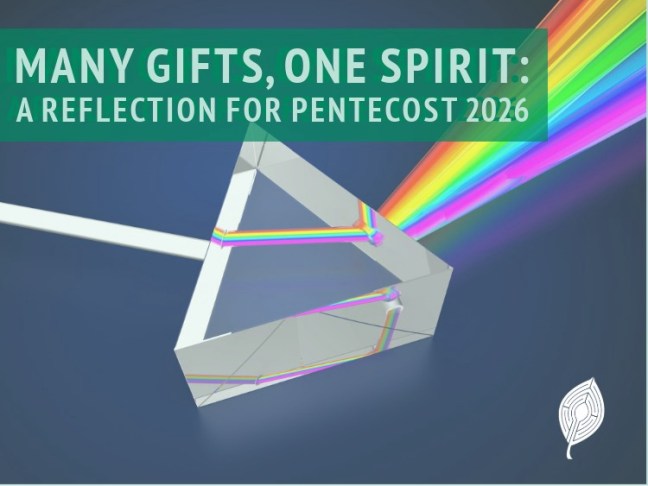
Here we see what psychologists call dialectical epistemology at work. It’s not a vision of uniformity, undifferentiated sameness, or stifled creativity. But neither is it a vision of division, individualism, or unbridled creativity. The kingdoms of this world tell us we can only have community responsibility or personal freedom. The Kingdom of God tells us the two work hand-in-hand, that a healthy, holy, and godly community expresses unity in diversity, that individual interests, aptitudes, and vocation are never truly opposed to the health of the community, but serve it; and likewise the healthy community will recognize and support individuals’ gifts. This is not easy. It doesn’t lend itself well to bylaws and canons and one-size fits all approaches. There are good human reasons why the Church has historically found it hard to live it out. But that doesn’t make it any less true, needful, or holy.
We all have our pet images for the working of the Spirit. But if we trust the Scriptures, we have to accept and lean into the uncomfortable truth that the “rush of a violent wind” that fell upon the disciples in “flames of fire” on the day of Pentecost is also the “still, small voice” that met Elijah on the mountain. This means that the Spirit is truly unpredictable, for it cuts across all our conceptual opposites. In the life of the Spirit diversity can express unity, unity can express diversity; likewise change can express consistency and consistency be embodied in change; contemplation can be action and action contemplation. This is a wonderful gift, because as much as compromise and realpolitik are very real and often necessary in human communities, the Spirit asks us to look for what else we might do, not Option 1 or Option 2, or an unsatisfying Option 1.5, but something completely different that embodies the best of both, an Option Z.
For “there are varieties of gifts, but the same Spirit; and there are varieties of services, but the same Lord; and there are varieties of activities, but it is the same God who activates all of them in everyone. “
As we enter into the expanse of this next, long stretch of the Church year, whether we conceive of it as “ordinary time” or as the “season of Pentecost,” may we bring this spirit (Spirit) into it. Whatever our gifts, may we use them for the benefit of the whole community. And may we as communities of faith find ways of supporting those gifts — especially the odd ones! — for the life of the individual and the whole world.

