When we think about sacred practices we in the West tend to think of engaging with our hearts, minds, and spirits — not our bodies. This is not a new issue, and has in some ways been a defining feature of Western thought for millennia. Whether intentionally or accidentally, we have internalized a dualism that says the spirit is good and matter, therefore our body, is lesser, if not evil. But while such dualism has been common throughout Christian history, it is not consistent with Christian theology. After all, we were lovingly created by God as embodied creatures, and we believe God became physically embodied in the person of Jesus of Nazareth. Our Creeds also remind us that our vision of the Kingdom of God is not about disembodied spirits in heaven, but about the resurrection of the body. We are, as Eastern Christian monasticism has been insisting from the beginning, ensouled bodies, not embodied souls. And so today, I’m going to try to redress the balance a bit by talking about practices of the body that can help us become more attuned to the voice of the soul.
I have to admit that of all the types of practices discussed not only in this series, but over the long history of this blog, and really in my life a as whole, body-oriented practices are the hardest for me to do regularly and to experience as sacred. Whether through acquired habit as a child or innate ineptitude (likely some combination), my default is to be disconnected and unaware of my body. Even as I write this, I notice that I am slouched on the couch, leaning at about a sixty-degree angle, and wearing only one slipper. I wondered how this could be comfortable, only to realize that I am in fact profoundly uncomfortable — there’s too much pressure on my right hip, there’s a strain in my right shoulder, my laptop is digging into my left thigh, my un-slippered foot is cold. This is hardly the way to treat my body, which is the only medium I have through which I can engage the world (both the external world and the internal world of my heart and mind), and which St. Paul calls “a temple of the Holy Spirit” (1 Corinthians 6.19)!
Because of this default disconnection from my body, the most meaningful practices of embodiment and sacred movement for me are those that force me to think intentionally about my body. In this vein, even mindfulness meditation counts, since it forces me to pay attention to the movement of my chest as I breathe in and out. This deep embodiment of human experience was not lost on our Christian spiritual ancestors; traditional forms of Christian worship are incredibly physical, from the smells of incense to the taste of bread and wine and the slickness of oil and the slipperiness of water, from fasting and feasting to the movements of crossing oneself, processions, bowing and prostrating.
This brings up the idea of sacred movement, which is probably best expressed in the world’s quintessential sacred practice of the body, hatha yoga. As I wrote a few years ago about how this practice helps to connect me to my body:
The biggest lesson I’ve taken away from yoga is awareness: to be aware of my body, my sensations, and to observe them, be curious about them, and not run away from them. When I’m struggling in a certain posture, my instinct now is to pay attention to what my body is telling me, rather than to immediately collapse or let go. When I’m trying to find my pose, I have become aware of my how I might challenge my body to find the right edge. When transitioning from pose to pose, I’m now more aware of how I’m getting there. And when I am in a routine of daily practice, I become aware of the changes in my body and what I can expect from from day to day and side to side. … [W]hat has set yoga apart for me is that its lessons in awareness of my body and its energies transfer seamlessly into life ‘off the mat’. I am simply more aware of and more intentional in how I use my body when I’m in a regular yoga practice.
All this said, this series is not about sacred practices per se, but specifically about practices to help us become attuned to the voice of the soul. So how do they fit in here? Again, the body is the only medium we have to access the soul. So, every practice we’ve thought through in this series is embodied: we meditate by paying attention to the breath, we write and draw with our hands and fingers, we perceive the beauty around us through our senses of sight, hearing, touch, smell, and taste. But beyond this, the more intentionally embodied practices can be powerful tools to help us hear what our soul or self or spirit (or even at times Spirit) is trying to tell us. Some of my most profound spiritual epiphanies happened while running, lessons learned in yoga have been helpful in my daily life (”Balance is always earned and not given,” or “Find your pose between ease and effort”), and in some ways I credit (or blame) the big confrontation between my faith and sexuality on getting more in touch with my body through the embodiment of traditional Christian worship practices. So great is the link between the body and soul that sacred dance is an important part of some forms of Hasidic spirituality and Sufi mysticism (most famously represented by the ‘whirling dervishes’ of Turkey).
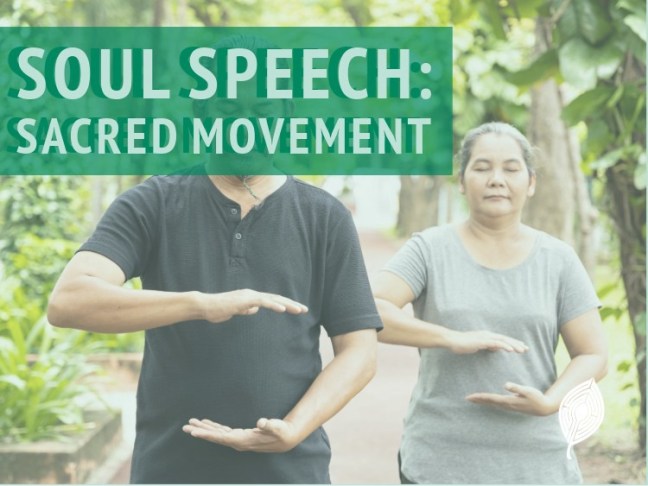
So, whether you’re like me and chronically disconnected from your body, or are a trained athlete, I would encourage you to find some way, whether big or small, to incorporate the body, and preferably some form of sacred movement, into your life. Attend a yoga class, take up tai chi, lift up your hands in prayer, re-frame your exercise regime, or even just allow yourself to feel your weight against your chair, bed, or floor. It can be anything really, as long as it recognizes and celebrates your status as an embodied and beloved creature of God. As for me, I’m going to start by finding that slipper.


One thought on “Soul Speech: Sacred Movement”