
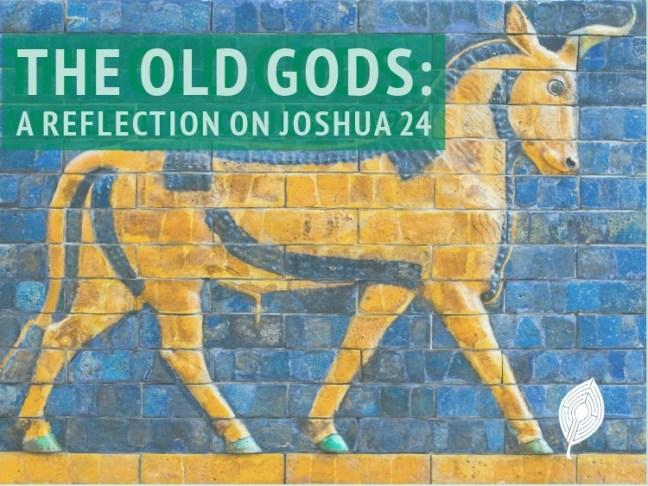
If there’s one thing I’ve learned in adult life it’s that the past doesn’t just resolve itself. If we don’t actively work to address the past, it will come back to haunt us. And this is true both personally, in terms of deeply ingrained patterns and psychological wounds, and as a society. The past casts a long shadow indeed. This came to mind for me again this morning as I was reading through today’s assigned reading from the Old Testament. In it, the newly arrived tribes of Israel are at a crossroads: Will they live in the new ways of freedom in the land of promise? Or will they fall back to the old ways they knew as slaves in Egypt, or those of the land they now inhabit?
The passage starts like this:
Then Joshua gathered all the tribes of Israel to Shechem, and summoned the elders, the heads, the judges, and the officers of Israel; and they presented themselves before God. And Joshua said to all the people, “Thus says YHWH, the God of Israel: Long ago your ancestors Terah and his sons Abraham and Nahor lived beyond the Euphrates and served other gods. Then I took your father Abraham from beyond the River and led him through all the land of Canaan and made his offspring many. Now therefore revere YHWH, and serve him in sincerity and in faithfulness; put away the gods that your ancestors served beyond the River and in Egypt, and serve YHWH. Now if you are unwilling to serve YHWH, choose this day whom you will serve, whether the gods your ancestors served in the region beyond the River or the gods of the Amorites in whose land you are living; but as for me and my household, we will serve YHWH.” (Joshua 24.1-3a, 14-15)
This part of the story is pretty famous. At one point a few years ago, “As for me and my house…” signs were as common in suburban Protestantism homes as “Live, laugh, love” pillows. Joshua identifies the god YHWH with the people’s ancestral God and reminds them of all their God has done for them: calling Abraham out from Mesopotamia and making him a great patriarch, and in more recent years, freeing them from captivity. The choice is theirs whether to serve YHWH anew, but if they do, they must do so sincerely and “put away the gods” of Mesopotamia, Egypt, and Canaan.
They, of course, eagerly accept Joshua’s challenge, claiming that they could never forsake YHWH who has freed them from captivity and driven out the people of Canaan before them, so of course they will serve YHWH (24.16-18). But Joshua isn’t convinced. He knows the long reach of the past and the temptations of the old gods. He warns them not to make this choice lightly, for YHWH is a jealous and holy God who will not take kindly to backsliding after all He has done for them (24.19-20). But they insist. And so he concludes:
“You are witnesses against yourselves that you have chosen to serve YHWH … Then put away the strange gods that are among you, and incline your hearts to YHWH, the God of Israel.” The people said to Joshua, “The Lord our God we will serve, and him we will obey.” So Joshua made a covenant with the people that day, and made statutes and ordinances for them at Shechem. (24.22-25)
Of course, we know (and the writers of the story know) how things go. The people’s confidence in how far they’ve come and their commitment to following the new ways of God’s law is overstated, and they are constantly tempted into following the gods of the land, God’s like Ba’al, and Asherah.
There’s a lesson here for us. As quick as we may be to say “As for me and my house, we will serve the LORD,” are we really prepared to do so? Our recent political history suggests those throw pillows don’t capture the whole truth. While our story as Christians is indelibly linked with Israel’s story it’s not the same story. Our story is not about God choosing one nation, freeing them from political captivity, and blessing them with a land to call their own. Rather it is about God making a new unified people out of all the nations of the world, freeing us from captivity to sin, and empowering us to live out the ways of God’s kingdom within the lands we already inhabit. This is what God has done for us. This is the story to which we commit ourselves when we say “As for me and my house, we will serve the Lord.” And, as we saw last week, the ways of this story and its heavenly kingdom are clear. I’ll repeat it here: It is the poor and humble, the grieving, the meek, those who hunger and thirst for what is good and right, those who show mercy, whose hearts have been purified by life’s fires, those who work for the sake of peace and justice, and those who are persecuted who are blessed (Matthew 5.3-10). It’s a message of humility, grace, and compassion to all, of the inherent value of every life, and a full-hearted commitment to the peace that is not just the absence of violence but the presence of healthy, healed and whole relationships.
This is what we sign up for as Christians. And yet, as the news and so much of public Christianity shows with total clarity, the old gods of greed, self-protectiveness, tribalism, violence, empire, and hatred remain great temptations. The world is asking, and I believe Christ is asking, “Will the real Christianity please stand up?” Who are we for, really? What do we stand for? What will we fall for?
As it happens, today’s Gospel reading is the Parable of the Bridesmaids, which reminds us that we cannot be complacent when it comes to these questions. The time is coming soon. And we are nowhere near ready.
And so, with this in mind, together with Joshua, I encourage us all: Put away the strange old gods that are among us, and incline our hearts to Christ, whose humble path is our way, our truth, and our life.

