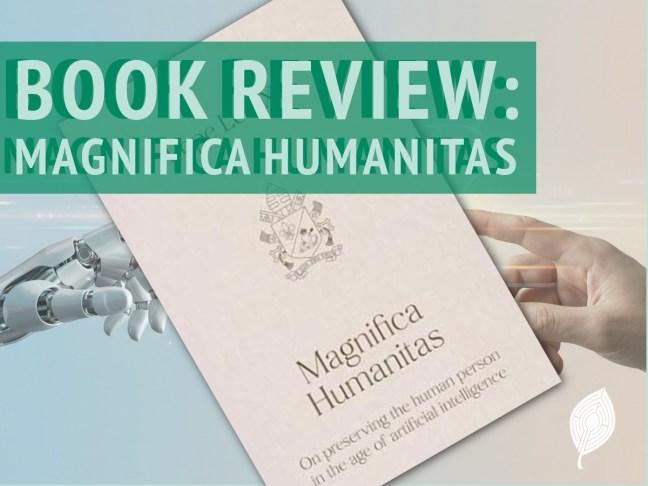
There can be no doubt that artificial intelligence (AI) has emerged over the past couple years as the defining issue of our time. Even amidst looming ecological disaster, we are now faced with a second existential threat. What has been most jarring about this has been what seems to be a complete lack of oversight or planning on this issue from not only the industry (whose own leaders are simultaneously telling us it’s a looming disaster while refusing to slow down development), but also government. When the fear of falling behind becomes the only consideration, thought, reflection, and intention go out the window. Into this void has stepped a perhaps unexpected world leader: Pope Leo XIV, in his Encyclical Magnifca Humanitas (MH), ’Magnificent Humanity,’ issued in May 2026. Not only is it an important and relevant discussion on the state of the world but it is also one of the richest theological texts I’ve read in a while. And so, over the next two posts, I’d like to provide a summary and review of this important document. Today I’ll look at the introduction and first two chapters, which provide the rationale and theological foundation for the project. Next time, I’ll turn to his discussion of AI itself in the latter half of the work.
The introduction to MH lays out the stakes of the AI revolution as follows:
Humanity, created by God in all its grandeur, is today facing a pivotal choice: either to construct a new Tower of Babel or to build the city in which God and humanity dwell together. Each generation inherits the task of shaping its own era, of guiding history to become a place where the dignity of every person is safeguarded, justice is promoted and fraternity is made possible. Yet every era also runs the risk of creating an inhumane and more unjust world (1).
In other words, it’s asking the important questions that seems to be lacking from the conversations about AI: “Where are we going? Toward what goal do we wish to orient ourselves? What direction should we choose as a people and as a human community?” (6). The governing metaphor is the contrast between two Old Testament stories about building: The Tower of Babel and the rebuilding of Jerusalem’s city wall following the Babylonian Exile. In the former story, humanity tries to build tower so tall that it would reach heaven itself, to show that humanity is God’s equal:
It was an impressive feat: a single language, a single technology, a single direction. However, the project concealed a profound danger. It was a project conceived without reference to God, supported by a uniformity that eliminated diversity and that chose homogenization over communion. (7)
The latter story, told in the book of Nehemiah, speaks of a very different approach to construction:
He [Nehemiah] convened the families, assigned each of them a section of the wall to rebuild, listened to their concerns, coordinated their efforts and addressed any opposition. The narrative shows how the city is reborn, not through the initiative of one man, but through the shared responsibility of all: men, women, priests, artisans, heads of households and young people all play a part. It is an undertaking with God at the center, which rebuilds relationships before rebuilding with stones. Thus, ancient Jerusalem rediscovers a common language — not one of uniformity, but one of communion, namely the harmony that arises when all persons assume their own role and recognize that their strength comes from the Lord. (8)
What are we building, why are we building it, and who are we building it for? These are fundamental social questions that lie at the heart of the controversy about AI today. Proponents of AI often claim that the tool is value-neutral like any technology, and they are not therefore responsible for its abuse. In MH, Leo XIV posits that this neutrality of technology is only theoretical: “In practice, however, technology is never neutral, because it takes on the characteristics of those who devise, finance, regulate and use it” (9). He insists that whatever we build must be for the greater good, and not just as defined in the aggregate but also in individual lives, measured by what he calls “humanity’s vocation to a full and just life” (3).
So that’s the rationale for the project. Leo XIV then lays down his theological foundation. In what seems a strange approach to non-Roman Catholics, he grounds it not directly in the Scriptures or ancient traditions, but in the last 130 years of official Roman Catholic teaching. As jarring as this was for me initially, I think for the purposes of this document this approach makes sense on at least two levels. First, simply by virtue of how the Roman Catholic Church understands authority, the Scriptures are the roots of the faith but not the tree, and what’s happening in the branches — the ways the Scriptures have been interpreted and what those interpretations have produced — is what is most relevant. (To use another analogy, if you’re wanting to understand your family values, it makes the most sense to start with your parents, not your great great great great grandparents.) But secondly, especially in the current social and political climate, in which claims of heresy and apostasy are thrown about easily, and in which many on the far right are trying to justify hateful and exclusionary policies in their Roman Catholic faith, it was important for Pope Leo XIV to demonstrate that what he is advocating is fully grounded in and consistent with established Roman Catholic teaching and is not some new-fangled, ‘liberal’, or ‘socialist’ agenda. (Really, this century is exhausting.)
At any rate, the chapter provides a helpful and fascinating survey of ‘recent’ official documents touching on the themes of human dignity, human rights, and human work:
- Rerum Novarum (The Latin literally means ’Concerning New Things’, but carries the connotation in Latin of’ Concern Revolution’), 1891: Leo XIII reflected on “the dignity of work and workers,” “affirm[ing] the right to a fair wage” and “recogniz[ing] that persons have a fundamental value that takes precedence over capital and profit,” while also defending the right to private property (30)
- Quadragesimo Anno (‘Forty Years On’, written in honour of the fortieth anniversary of Rerum Novarum), 1931: Pope Pius XI criticized both unfettered capitalism and collectivism, arguing that they both “undermine the freedom and responsibility of the individual,” and reaffirmed workers’ rights and employers’ responsibility to provide workers a living wage (31).
- Populorum Progressio (’The Development of Peoples’), 1967: St. Paul VI affirmed a holistic understanding of development that benefits “every dimension of the person and all people without exception,” and a vision of peace that centres human dignity and social justice (35-36).
- Fratelli Tutti (’All Brothers’), 2020: Pope Francis emphasized the need to come together in the face of widespread warfare, globalization that benefits only the rich, and the breakdown of communities, exhorting “a culture of encounter, a ‘better politics’ capable of seeking the common good, paths of reconciliation and a world that ensures ‘land, housing and work for all’ (44)
So then, Leo XIV demonstrates a consistent interpretation of the Gospel in recent Roman Catholic theology that affirms both individual human dignity and communal human solidarity.
Chapter 2 reinforces this survey by outlining what he sees as the primary elements of Roman Catholic social doctrine. These are:
- Equal and inherent human dignity, opposing any movement that would suggest or worth must be earned, value efficiency over dignity, or instrumentalize people (51-53)
- Human rights, which are fundamental and not earned or negotiable (54-58)
- The common good, defined as the social expression of that inherent dignity, and rejecting any movement that limits us to “the narrow confines of one’s own interests” (60-64). This is in line with the teachings of Vatican II, which defined the common good as “the sum total of social conditions which allow people, either as groups or as individuals, to reach their fulfillment more fully and more easily” (60, quoting Gaudium et Spes (’Joy and Hope’)).
- The universal destination of goods, meaning that “the earth’s goods — soil, water, air and natural resources — are given by God to the entire human family to sustain the lives of all, and that every person has an inherent right to the use of such goods, both now and in the future. (65; the discussion lasts from 65-67).
- Subsidiarity, the principle that upholds both individual contribution and collective responsibility: “It is the responsibility of the political community to create the conditions that allow individuals, families, associations and intermediary organizations to fulfil their mission in society, without being replaced or reduced to mere facilitators” (68-72, quote on p. 69)
- Solidarity, the corollary of subsidiarity, insisting that every human person “is part of a network of relationships that bind him or her to others, to specific populations and to creation” (73).
- Social justice, the concrete expression of following Jesus and of faithfulness to the Gospel, which is always “good news to the poor” (Luke 4.18). In concrete terms, “Social justice is, therefore, characterized by the capacity of a social, economic and political order to allow everyone — particularly the weakest — to live a truly dignified life, without leaving anyone behind” (77).
- Integral human development, which holds that “development is authentic only if it can ‘foster the development of each man and of the whole man’ (82, quoting Populorum Progressio.). Human uplift, not the accumulation of wealth, must be at the center of economic policy. “Development is not truly human if it increases consumption for some while shifting costs and burdens onto others, or relegates entire regions to subordinate roles, preventing them from realizing their full potential” (82-83)
By way of assessment, there is no doubt that these principles are firmly grounded in Christian teaching, consistent with both the Scriptures and two thousand years of Christian tradition. It’s striking to me that until very recently, they would have been unquestionably and uncontroversially basic tenets of Western constitutional democracy. This is not surprising so much from a historical perspective, since the development of Western constitutional democracy was rooted in Christian humanism as much as its secular counterpart. But it is striking because many of these ideals would now be called ‘radical,’ ‘liberal’ or ‘socialist’ by large swaths of the political spectrum. It goes to show just how much the political landscape has shifted in recent years towards the demands and interests of the rich at the expense of everyone else.
At any rate, the key point is that Leo XIV grounds his later discussion of AI in Christian anthropology. These teachings are not new-fangled, but are deeply consistent with the Scriptures, ancient Christian traditions, and just as importantly for his purposes, with the past 130 years of Roman Catholic interpretation of this tradition. Humanity, not just as a whole, but also as individual human persons, is precious and contains inherent value. Worth is not earned. And any policy or idea of development must understand and reflect that truth if it is not to be, and I say this without exaggeration, an incarnation of evil. And so, this is not just a critique of AI, but also of the whole political and economic climate that has led us to this moment.
In all this, his choice of the Tower of Babel as the symbol for this climate is fitting. Everything is about bigger — taller buildings, larger profits, broader reach — without any concern for better. The value on which policies are being made is growth for growth’s sake, which as we know, is the definition of cancer. Against this, the image of the communal rebuilding of the Jerusalem wall, in which every person has a role in building something for their mutual benefit, stands as a striking and apt contrast.
If the questions before us as a society are what are we building, why, and for whose benefit, the question before us all as individuals is simply ‘What is my piece of the wall?’ What concrete thing can I do today to help build the kind of society reflected in the Gospel values?
Next time, we’ll see how Leo XIV uses the theological foundation laid in the first half of the Encyclical to address the question of AI specifically.

