
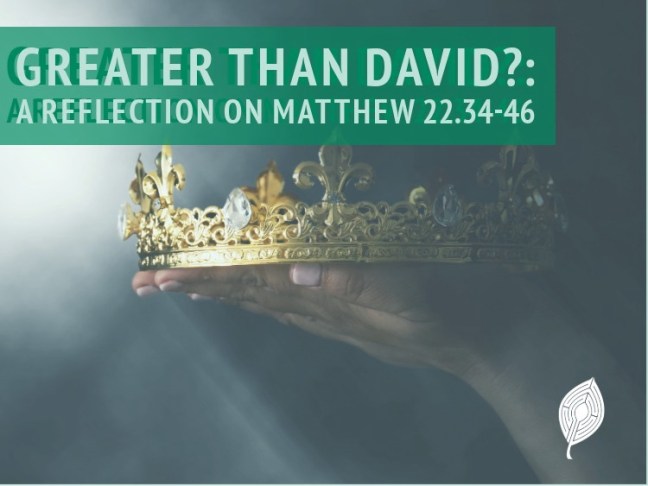
The Gospels contain a lot of stories about religious leaders trying to trap or test Jesus. Today’s Gospel contains one of the most famous of these, the question of which commandment on the Law of Moses is the most important. But after answering (in a way that is crucially important for us, but was boring and expected in the context of the story), Jesus does something less common: he tests the leaders right back. And the question he asks them is a curious one, at least to our minds. Let’s take a look.
The text goes like this:
When the Pharisees heard that he had silenced the Sadducees, they gathered together, and one of them, a lawyer, asked him a question to test him. “Teacher, which commandment in the law is the greatest?” He said to him, “‘You shall love the Lord your God with all your heart, and with all your soul, and with all your mind.’ This is the greatest and first commandment. And a second is like it: ‘You shall love your neighbour as yourself.’ On these two commandments hang all the law and the prophets.” Now while the Pharisees were gathered together, Jesus asked them this question: “What do you think of the Messiah? Whose son is he?” They said to him, “The son of David.” He said to them, “How is it then that David by the Spirit calls him Lord, saying, ‘The Lord said to my Lord, “Sit at my right hand, until I put your enemies under your feet”‘? If David thus calls him Lord, how can he be his son?” No one was able to give him an answer, nor from that day did anyone dare to ask him any more questions. (Matthew 22.34-46).
As important as Jesus’ summary of the Law is, what struck me today is the second half of the story. The first thing to note is the shift in audience. In the first half, Jesus is tested by the Sadducees (the pro-Temple, pro-elite group who advocated a policy of accommodation to Roman rule). But in the second half, Jesus addresses the Pharisees (the class-transcending party of scrupulous Law-following) — perhaps seeing them enjoying his back-and-forth with their rivals a bit too much. Either way, he asks the Pharisees whose son the Messiah will be. This strikes us as an odd question. But two things can perhaps clarify it for us. First, in Semitic languages, ‘son of’ carries the wider sense of ‘one who follows in the footsteps of’ rather than simply biological descent. And second, messianic expectation was not the singular thing many Christians imagine it to be; not all Jews in Jesus’ day believed in a coming Messiah, and those who did had very diverging opinions about what he’d be like. So the question Jesus puts to the Pharisees essentially means “What kind of Messiah are you expecting?” They give (as Jesus did to the question put to him) the most common, expected answer: the Messiah will be a king in David’s image and likeness: he will unite the people, defeat their enemies, and honour God in (almost) all things. Jesus accepts this answer, but digs deeper, pointing out that in one of the most common texts used to promote a Davidic Messiah, Psalm 110, David refers to this figure as “my lord,” that is, as his superior. If the Messiah is to be David’s son, how can David envision him as his superior? This is not a disavowal of a Davidic Messiah, but does make them think more deeply about what that might mean.
There are, I think two sides of this. The first and most obvious to Christian minds and hearts is that the Messiah is greater than David because he is, through the mystery of the Incarnation, both fully human and fully divine. But I think the second is just as important: When looking at what the Messiah is going to be and do, he’s calling on them — and us — to think beyond the normal categories of success. David had everything going for him from an earthly perspective: he was handsome, talented, charismatic, a leader of men and vanquisher of enemies. Be that as it may, that wasn’t why God chose him to be the king. If you remember the story, David was the youngest brother of his family, and therefore the least likely to be thought of as a potential ruler. And in this he stood in a consistent pattern from Israel’s Scriptures: that God passes over what is obvious in the ways of this world to what is unexpected. God chose a nobody in Abram to be the forefather of the faithful. God chose the younger son Isaac over the firstborn Ishmael to be the child of promise, and again passed over the older, manlier brother Esau for Isaac to carry on that family legacy. What I think part of what Jesus is saying here is to remember to expect the unexpected where God is concerned. The Messiah, Davidic though he may be, will not be a retread of the David experience. God is more creative than that. (And, as iconic as David was, his reign wasn’t near the success it was often made out to be!)
This is in keeping with Jesus’ general sensibility when it comes to Messianic expectation in Matthew’s Gospel. He previously called for something “greater than the Temple,” the dwelling-place of God on Earth (12.6), “greater than Jonah,” the prophet who survived three days inside a whale and led Nineveh to repentance (12.41), something “greater than Solomon,” who was famed for his wealth and wisdom (12.42). And now he’s alerting his audience for the need for something greater than David, the posterchild for what it means to be a king.
In other words, what God is up to has nothing to do with their, or our, nostalgia. As those who long to be faithful to God, our calling is always to think bigger, to think and hope beyond the categories that dominate our everyday lives and thoughts and fears.
May we, today and always, grasp on to this hope in what we have not yet seen and work for a salvation, a love, a peace far greater than we can imagine, the biggest, boldest salvation of our God. Amen.

