
A good friend of mine did his degrees in Religious Studies and always asks me interesting, if pointed, questions about Christianity. One such question is about how Christianity was able to form around the figure of Jesus, when there were so many other ‘failed’ messiahs and wonderworkers and teachers whose movements simply disappeared after their deaths. The answer that I always turn to is the one that the New Testament itself provides: In the days after his crucifixion, Jesus’ followers continued to experience his presence. And this is true whether we come from a place of faith, that he was raised from the dead, or a more skeptical position, that it was a purely spiritual experience. No matter how we choose to understand it, Christianity arose because Jesus’ followers continued to see, hear, touch, chat with, walk alongside of, and eat with Jesus, starting on the third day after his crucifixion. We saw that in the Gospel for Easter Sunday, where Jesus appeared to Mary Magdalene in the garden. We saw it last week, where Jesus appeared to the disciples that evening. And we see it again in today’s Gospel reading, in which Jesus appears to disciples walking along the road to Emmaus, a story whose details bridge the events of Easter Sunday with the ways we continue to experience Jesus to this day.
Let’s look at the story. It begins:
Now on that same day two of them were going to a village called Emmaus, about seven miles from Jerusalem, and talking with each other about all these things that had happened. While they were talking and discussing, Jesus himself came near and went with them, but their eyes were kept from recognizing him. And he said to them, “What are you discussing with each other while you walk along?” They stood still, looking sad. (Luke 24.13-17)
The story takes place the afternoon of Easter Sunday. Two of Jesus’ disciples are leaving Jerusalem devastated and confused. They’re so distracted by their hashing and rehashing of everything that had happened over the past week since Jesus had entered the city met by cheering crowds that they fail to notice that Jesus himself has started to walk alongside them. He cheekily asks them what they’re talking about and they just stop in their tracks, dumbfounded by this stranger’s ignorance.
It’s an interesting detail that they’re going over everything that had happened, yet again. It touches on a deep truth, I think. Whereas Mary didn’t recognize Jesus because of her worry and fear, they don’t recognize him because they’re too in their own heads to notice. Grief can blind us, but so can distraction and our perseverating thoughts an dinner dialogues.
At any rate, they answer:
“Are you the only pilgrim in Jerusalem who does not know the things that have taken place there in these days?” He asked them, “What things?” They replied, “The things about Jesus of Nazareth, who was a prophet mighty in deed and word before God and all the people, and how our chief priests and leaders handed him over to be condemned to death and crucified him. But we had hoped that he was the one to redeem Israel. Yes, and besides all this, it is now the third day since these things took place. Moreover, some women of our group astounded us. They were at the tomb early this morning, and when they did not find his body there, they came back and told us that they had indeed seen a vision of angels who said that he was alive. Some of those who were with us went to the tomb and found it just as the women had said; but they did not see him.” (24.18-24)
Here we learn of what they had thought about Jesus and what their expectations for him were: He was prophet who backed up his words with signs and wonders. They had hoped he’d be the one to free Israel from its bondage to Rome and usher in the new messianic age. But their hopes were disappointed. Their own religious leadership, affronted by his teaching and the attention he was getting betrayed him to the Romans and had him killed. If that wasn’t enough of a wild turn of events, now some women among his followers were claiming that not only was his tomb now empty, but that an angel had told them he was alive! This is too-good-to-be-true news and they just don’t know what to think.
There’s a lot of irony in this exchange. They refer to this stranger as a visitor or pilgrim to Jerusalem, and of course Jesus’ was in many ways a visitor and pilgrim on Earth (”Foxes have holes, and birds of the air have nests; but the Son of Man has nowhere to lay his head’ (Matthew 8.10); “You are from below, I am from above; you are of this world, I am not of this world” (John 8.23)). They call him a prophet and seem surprised that a prophet was poorly received. (Jesus himself had a more realistic view when he called Jerusalem “the city that kills the prophets and stones those sent to it” (Matthew 23.37).) Likewise they had hoped Jesus would be the one to “redeem Israel,” and he was — just not in the way, or from the enemy, they had expected. And of course, they are confused about rumours of the resurrection, when Jesus is standing right before them!
Then he said to them, “Oh, how foolish you are, and how slow of heart to believe all that the prophets have declared! Was it not necessary that the Messiah should suffer these things and then enter into his glory?” Then beginning with Moses and all the prophets, he interpreted to them the things about himself in all the scriptures. As they came near the village to which they were going, he walked ahead as if he were going on. But they urged him strongly, saying, “Stay with us, because it is almost evening and the day is now nearly over.”
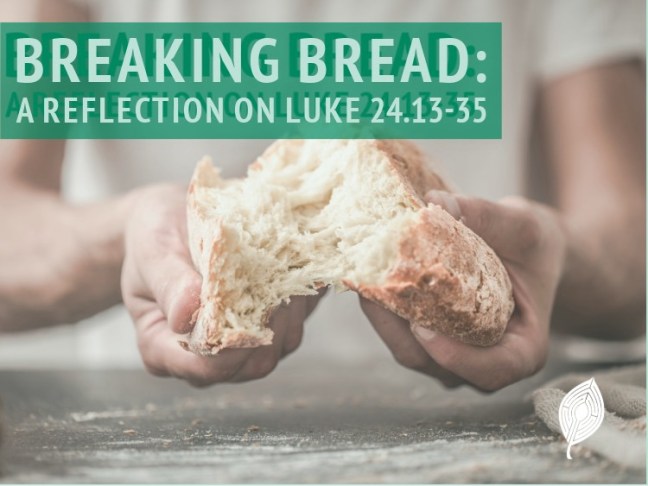
So he went in to stay with them. When he was at the table with them, he took bread, blessed and broke it, and gave it to them. Then their eyes were opened, and they recognized him; and he vanished from their sight. They said to each other, “Were not our hearts burning within us while he was talking to us on the road, while he was opening the scriptures to us?” That same hour they got up and returned to Jerusalem; and they found the eleven and their companions gathered together. They were saying, “The Lord has risen indeed, and he has appeared to Simon!” Then they told what had happened on the road, and how he had been made known to them in the breaking of the bread. (24.25-34)
Intrigued by this stranger’s exposition of the Scriptures and how they relate to Jesus, they invite him to stay with them in Emmaus. During the meal, they come to recognize Jesus, he disappears, and they rush back to Jerusalem to share the good news.
There’s a lot happening here, and this is where it bridges the Easter experience and our own post-Ascension experiences. The Eucharistic allusions here are impossible to ignore (”he took bread, blessed and broke it, and give it to them” and “made known to them in the breaking of the bread”). And yes, Christ continues to be present with us in the sacraments. But I think a solely Eucharistic reading misses the point. Because the Eucharist originated as a communal meal. It was a ritual, yes, but one embedded in the basic practice of breaking bread together in community. The disciples here invite a stranger to share their hospitality and in that experience he is revealed to be none other than Jesus. In this way, the story calls back to the Hospitality of Abraham, the story in Genesis where Abraham invites three strangers to share his hospitality and they turn out to be angels, and sorta-kinda even God. (As it happens, that story has been traditionally read by Christians as foreshadowing the revelation of the Trinity.) So there’s a long history in our tradition of hospitality being connected to theophany, of being with God as we be with others. (”Where two or three are gathered in my name, there I am among them” (Matthew 18.20).)
And I think that’s the message for us, especially in our heavily individualistic, alone, and lonely society. We’re so tempted to think we can only know God on our own, for ourselves, whether in our own ‘personal relationship with God,’ acts of service, or sacred practices. But as important as all of these are, community itself can be a mystical experience, a theophany. And if we rob ourselves of that, we rob ourselves of a big part of knowing God.

