
The lectionary this time of year can often feel a bit all over the place. This is because there are two calendars that overlay each other: the ‘normal’ seasonal calendar, in which we’re in the fourth Sunday after Epiphany, and the festal calendar based on the timing of events in Jesus’ life. And so while last week, a grown-up Jesus was taking on the mantle of Isaiah’s messianic figure as the basis for his own ministry, today we find ourselves roughly three decades earlier in the story, forty days after his birth, when his parents present him in the Temple in accordance with the Law. It’s one of my (many) ‘favourite’ passages in the Gospels, mixing a soaring prophetic hymn with more ominous, but no less prophetic, words. And these words are the ones that stick out to me today.
To remind ourselves of the story, Mary and Joseph bring Jesus to the Temple in accordance with the Law on the fortieth day after his birth. Present in the Temple that day is an old man named Simeon, who had been told by the Spirit that he would not die before he saw the promised Messiah. Upon seeing Jesus, he is inspired by the Holy Spirit and prophesies the famed words of the canticle known as “The Song of Simeon” (or “Nunc Dimittis,” from the first two words of the Latin translation):
Master, now you are dismissing your servant in peace,
according to your word;
For my eyes have seen your salvation,
which you have prepared in the presence of all peoples,
a light for revelation to the Gentiles
and for glory to your people Israel. (Luke 2.29-32)
One would be hard-pressed to find more joyful words in the Scriptures than these. Simeon has been waiting and longing for this day and can finally (literally) die in peace now that his expectations have been fulfilled. Simeon’s patience and faithfulness are a wonderful example for us, since hope and expectation can easily turn into disappointment and resentment. (And this was indeed what I was planning on writing on today, before the second half of Simeon’s prophecy gripped my attention.)
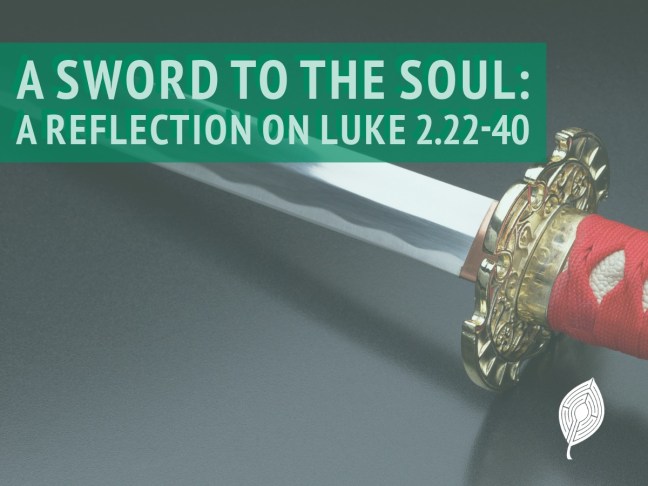
But Simeon’s prophecy doesn’t end here. After he blesses Jesus, he turns to Mary and utters these words, “This child is destined for the falling and the rising of many in Israel, and to be a sign that will be opposed so that the inner thoughts of many will be revealed—and a sword will pierce your own soul too” (Luke 2.34-35). As much as Jesus may bring salvation to God’s people, he will also bring dissension. He is also a crisis for God’s people, in the literal sense of a judgment, a moment of truth, a critical point upon which everything depends.
And indeed, when we look at Jesus’ life, we see this play out. While many flock to him and his message, he quickly runs afoul of the ‘good religious people’. He rejects their public performance of religion, their obsession over minor details of the law while they ignore its main message, and most of all their self-righteousness. Later, his disciples will find that Jesus’ message will cause a further rupture within the people of God, as for many, the welcome of Gentiles into the community of faith will prove to be a bridge too far. This is the strange reality of Jesus’ message and life: His message of compassion and grace, and of welcome of all tends to divide as much as it unites.
As strange as it is, I think it’s inevitable. Jesus is a religious teacher whose teaching undermines much of the natural ‘religious’ instinct. He is a king whose kingdom goes against everything we know about how kingdoms and this world work. He is the fullest manifestation of our omnipotent God on earth, yet his “power is made perfect in weakness” (2 Corinthians 12:9). Because of this, Jesus is always a ‘crisis’, in any and every nation, in any and every community, in any and every heart. Simeon’s words directed to Mary that “a sword will piece” her soul too are generally thought to refer to having to witness the crucifixion, and I think that’s certainly a big part of it. But I think having Jesus as a son continually pierced her soul, requiring a constant checking of herself and her expectations. When he went missing for three days and when she finally found him in the Temple, he brattily asked her where else he’d be; when she was worried sick about the rising opposition to him and wanted to get him to safely and he brushes her off, saying that his real family are those who listen to him — these too, I’m sure, pierced her soul. In this way, as with so many, Mary stands in for all of us as the quintessential human. For us as much as her (and her as much as us) “the word of God is living and active, sharper than any two-edged sword, piercing until it divides soul from spirit, joints from marrow; it is able to judge the thoughts and intentions of the heart” (Hebrews 4.12). It doesn’t matter where we sit on the political spectrum or social hierarchy. It doesn’t matter whether we’ve been Christians since birth or are just encountering him for the first time. He and his message will always be a challenge, always make us uncomfortable. To quote the wonderful line from Solzhenitsyn once again, “The line separating good and evil passes not through states, nor between classes, nor between political parties either — but right through every human heart — and through all human hearts” (The Gulag Archipelago). (As Simeon’s prophecy as it, “This child is destined for the falling and the rising of many in Israel, and to be a sign that will be opposed so that the inner thoughts of many will be revealed”.)
We find ourselves at yet another flashpoint in this two thousand year-old truth. Today it seems there is a split between those who think you can be a Christian by believing in Jesus (that he is God and died for our sins) without following him, and those who believe that one cannot claim faith in Jesus if that faith is not lived out in following him and his ways. And so we have Christians in the news angrily criticizing a bishop for preaching the prophets and Sermon on the Mount from the pulpit, and viral clips of prominent pastors saying that Jesus’ message of compassion and grace is “too feminine” and “emasculating” for any self-respecting man to follow. It’s a situation I never thought I’d see. And yet here we are. And again, no matter which side of this divide we find ourselves on, there’s no room for self-satisfaction or self-righteousness. Our faith is about being “doers of the word”, and Christ’s message is as sharp a sword for us as for anyone else.
And so, my exhortation for us all this week is not to shy away from this second half of Simeon’s prophecy, but to lean into it. Let Christ, let the Gospel message and teaching of Jesus, be as sharp a sword as possible, piercing us, challenging us, and bringing the light into all our darkest places.


3 thoughts on “A Sword to the Soul: A Reflection on Luke 2.22-40”