
One of the books I reference most often here is Purple Hibiscus by Chimamanda Ngozi Adichie. It tells the story of a Nigerian girl whose abusive father uses their Christian faith as a weapon to control her. This is an all-too-common theme in literature — not because literature has it out for Christianity or faith more generally (there are so many beautiful portrayals of faith on the page too!), but because religious abuse is an all-too-common reality in the world.
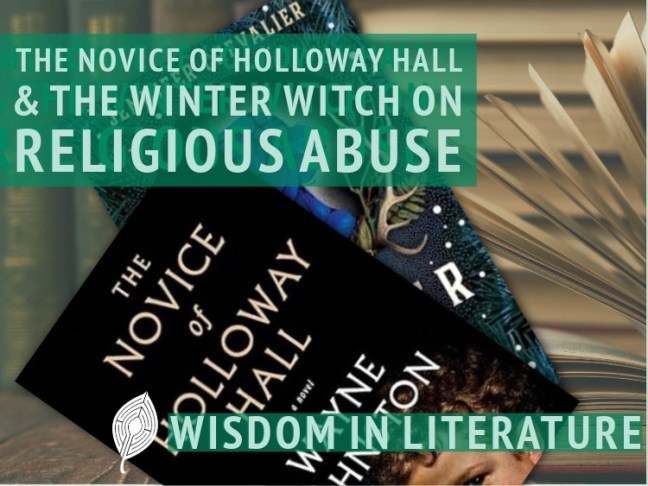
This is a theme that has been recurring a lot for me of late, in both my reading and in conversations with friends. Focusing on the former, in just the past week (at the time I write this) I’ve read two novels in which the power of religion to harm others was a major theme. The first was Wayne Johnston’s The Novice of Holloway Hill, about a staunchly Roman Catholic family’s iron grip on a small Newfoundland town. In this case, religion doesn’t seem to be about faith at all, but entirely about power. The wealthy family tied their wealth and power to the Church, thereby giving their actions the cover of God’s will and blessing. It’s chilling. It’s also the antithesis of the gospel of Jesus Christ, which as we saw the other day, is all about the humble, service-oriented way of Jesus, which sets aside privilege rather than grasping after it.
The second book, The Winter Witch, by Jennifer Chevalier, features distorted religion in three forms. First, there is Elizabeth, a young woman who has been made to believe she has been cursed and becomes anxious, hyper-vigilant, and scrupulous as a result. When her piety does nothing to assuage her fears, she comes to see her every thought and feeling as being demonic. Then there is a crazed and power-hungry witch-hunter, who sees devils and witches in every dark corner. While this is a a fairly stock character, his actions are nonetheless revelatory. He has become so caught up in his own ideas that he cannot see the world and its inhabitants as they are. And he has the authority to turn the world into the living hell he is so concerned about, laying accusations at the feet of anyone who questions him, and subjecting people to torture and impossible trials. Finally, there is also the less extreme but no less destructive character of “Mother” Poulin, a bored and self-important widow, who takes it upon herself to know — and report on — everyone’s business. She foments fear and anxiety in the community, while also acting as a one-woman moral police.
All four of these examples are very different: the Holloways merely use religion as a screen for their greed and lust for power; Elizabeth, the witch-hunter, and the widow are all legitimately believers, but their faith is dark and obsessive. In Elizabeth we see a person traumatized and troubled by the religious beliefs she’s been taught. In the widow we see a self-righteous busy-body. And in the witch-hunter, we see someone whose beliefs are so dark that they are unable to see the light, and in such a self-justifying echo-chamber, he is unable to experience any opposition as anything other than evil. But what they all have in common is religion used as a weapon for controlling others.
The questions of religious abuse and trauma are big. And as I mentioned, it’s a topic that’s been coming up often for me lately. So this post is actually a bridge into my next series, which will focus on the problem of religion gone wrong, and what we can do about it.


One thought on “Wisdom IN Literature: The Novice of Holloway Hall and The Winter Witch on Religious Abuse”