
Holy Saturday is a strange day in Holy Week. For there is no story to tell. It’s the day in Holy Week when nothing happens. Jesus is dead and buried. But we’re still a day away from the joy of Easter. If we try to put ourselves in the shoes of the disciples, it’s a day of complete and utter grief and sorrow, when everything has been lost. But, as people of faith, who know how the story ends, we are caught in between their grief, and the resurrection joy to come. This makes Holy Saturday the ultimate liminal place — neither grief nor joy feels appropriate. What are we to make of this time?
The Eastern tradition fills in this space by essentially holding Jesus’ funeral. His shroud is processed three times around the building and laid in the middle of the congregation. While this is a solemn commemoration, it’s also a hopeful one. The hymns touch on grief, but also look back to all the Old Testament passages that prophecy or foreshadow the resurrection: Habakkuk and Isaiah’s prophecies, the vision of the dry bones, the stories of Jonah and the three youths in the furnace, and so on.
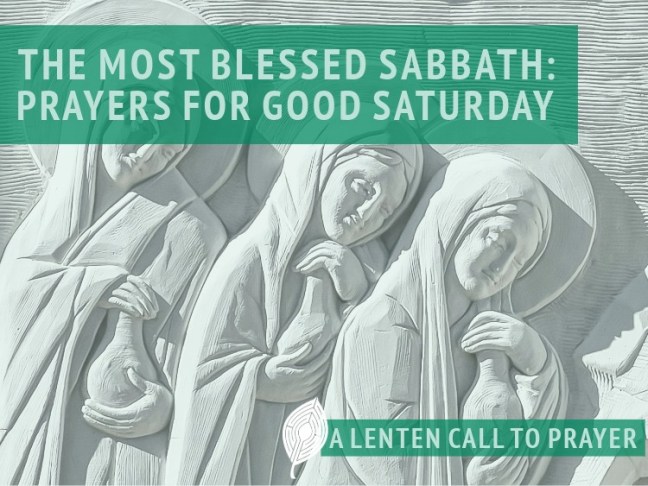
When the hymns gets to the Passion story itself, they continue with these precocious whispers of the resurrection. The kontakion (a kind of thematic hymn) for Holy Saturday even puts faith in Jesus’ resurrection on the lips of the women who come to his tomb to anoint his body with spices:
He Who shut in the depths is beheld dead,
wrapped in fine linen and spices.
The immortal one is laid in a tomb as a mortal man.
The women have come to anoint him with myrrh, weeping bitterly and crying:
“This is the most blessed Sabbath on which Christ has fallen asleep to rise on the third day”
And, in place of a normal Theotokion, the canon puts these touching words on Jesus’ lips:
Do not lament me, O Mother, seeing me in the tomb,
the son conceived in the womb without seed,
for I shall arise
and be glorified with eternal glory as God.
I shall exalt all who magnify you in faith and in love.
As we saw the other day when looking at St. Kassiani’s hymn, putting words of Christian faith — about the cross, the resurrection, Jesus’ divinity, or the Trinity — onto the lips of biblical characters was a common trope in Byzantine hymnography. It wasn’t that the hymnographers thought the characters would have actually thought or said these things, but that the hymns are about what the stories mean for us rather than what ‘actually happened.’
So we have these hymns that are solemn but unrepentantly hopeful. They don’t deny the grief and loss we are right to feel in Holy Week — the myrrh-bearers are “weeping bitterly and crying” and Mary is lamenting the death of her son — but neither do the hymns deny the truth that we know how the story ends. As the kontakion puts it, this is just “the most blessed Sabbath,” the day of God’s rest at the end of creation, before the mystical apocalyptic eighth day when God will renew and remake the world.
Not only is this an appropriate posture for this strange, liminal day in the liturgical calendar, but I think it’s also a good way to think about our attitude towards the world as a whole. We are right to grieve the state the world around us. How can we not? But that legitimate grief does not delegitimize our faith and hope for the future, that not only can we make things better, but also that there will be a time when God will complete and perfect the work of re-creation started with Christ’s resurrection, and establish the Kingdom of Heaven — of love and grace and the true peace that is not just the absence of violence but the presence of healthy, healed and whole relationships — once and for all, in all its glory.
He Who shut in the depths is beheld dead,
wrapped in fine linen and spices.
The immortal one is laid in a tomb as a mortal man.
The women have come to anoint him with myrrh, weeping bitterly and crying:
“This is the most blessed Sabbath on which Christ has fallen asleep to rise on the third day”

