
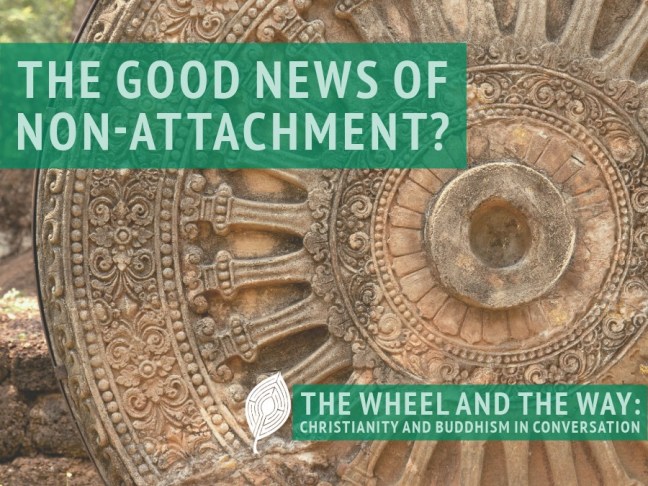
As introduced last week, the goal of this series is to use Buddhist thought as a mirror to help better-understand Christianity. Last time we looked at the Buddha’s story and how it compared to the stories of Jesus and the major prophets of Abrahamic faiths more generally. Today we’ll shift to exploring what it was he came to understand during his night of enlightenment or awakening under the Bodhi Tree. Specifically, today we’ll look at the most foundational Buddhist teaching, known as the Four Noble Truths. Then we’ll see how this teaching connects — and doesn’t — with the teaching of Jesus.
The Four Noble Truths
The Four Noble Truths can be summarized as the truth of suffering and its end. They go like this:
- There is suffering.
- Suffering has a cause, namely attachment.
- There is a way to end suffering, namely non-attachment.
- The way to achieve this is the Eightfold Path.
This is the Buddha’s diagnosis, cause, and prescription for the human condition. But what does it mean? The word at the heart of this teaching is dukkha in the original Pali. I’ve used the traditional English translation for it here, ‘suffering,’ but it includes a wider range of ideas, encompassing anything from feeling uncomfortable on a hot day, existential ennui, and work stress, to the suffering of torture, grief, loss, and death. Perhaps ‘unsatisfactoriness’ is the best translation, because it simply describes that general sense we all have from time to time, and most of us quite a bit more often than that, that something is just not quite right. And that, according to Buddhism, is the heart of the human condition. (And it’s hard to argue its truth!)
The cause of dukkha is our inability to accept that everything in life is impermanent: We want the good things in life (and indeed life itself) to last for ever, and get upset when they don’t; conversely we feel like the bad things in life will last forever. And so we are attached to and cling to the good things. Rather than appreciating them while we have them, we live in fear of losing them. Conversely, we also focus on what we don’t have, and become trapped by our desires and cravings — attachments to what we don’t have. This teaching suggests that, while pain and loss are inevitable in the world, our suffering is not.
The good news, according to the Buddha, is that there is a way out of this. While that way is described in full as the Eightfold Path, which we’ll look at in more detail later in the series, the path itself amounts to the way of letting go of our attachments. When we stop craving and clinging, suffering stops too. Nothing in this life is meant to be clung to. The Buddha extended this even to his own teachings, which he compared to a rowboat used to cross a river: Just as it would be counterproductive to carry the rowboat with you once you crossed the river, so too would clinging to his teaching after achieving enlightenment be an unnecessary burden (Majjhima Nikāya 22).
Christian Response
At the start of this series, I posited that the difference between religious traditions is less about their answers to life’s big questions than it is in the questions they ask. The big question the Buddha was trying to answer was really the problem of human consciousness. At first glance, this really couldn’t be more different from Christianity’s big question of the problem of sin. The concept of sin is notoriously hard to talk about, but as I’ve come to define it over the years, it’s simply the universal human tendency to break faith, intentionally or otherwise, in our relationships — with God, with each other, with ourselves, and the world around us. In other words, while Buddhism defines the problem psychologically, Christianity defines it relationally.
But that doesn’t mean the two traditions have nothing to say to each other. For Buddhism’s psychology must be lived out relationally (as we’ll see in the coming weeks), and our tendency to break relationships that is at the heart of Christianity’s understanding of sin has a psychological origin. In fact, in his teaching, Jesus consistently pushes the focus away from actions and onto the feelings or attitudes that motivate them: it’s hatred that’s the ultimate problem, not murder; it’s lust, not adultery. And in this way, the Gospel teachings of Jesus end up being profoundly psychological. Moreover, if we were to try to define Jesus’ psychological program, we could do far worse than to call it, like Buddhism, a psychology of non-attachment to the things of this world.
Even without doing a thorough search, I can think of the following attachments Jesus openly calls us to reject:
- wealth (Matthew 6.2; cf. 19.21; Luke 12.15-21)
- family (Luke 14.26; cf. Matthew 12.48-50)
- personal defense and security (Matthew 5.38-41; cf. 26.52)
- honour and status (Luke 14.10)
- performative religion (Matthew 6.1-8; cf. Luke 11.42-43)
Adding Paul’s teaching to the equation, we might also add spiritual materialism to the list of things we must ward against getting attached to (1 Corinthians 12.28-31).
In fact, in Philippians, Paul even defines the whole way of Christ in terms of non-attachment and a letting go of clinging:
Let each of you look not to your own interests, but to the interests of others. Let the same mind be in you that was in Christ Jesus:
Who, though he was in the form of God,
did not regard equality with God as something to be clung to,
but emptied himself, taking the form of a slave,
being born in human likeness.
And being found in human form,
he humbled himself and became obedient to the point of death
— even death on a cross. (Philippians 3.4-8)
We also see this idea in the way the New Testament talks about the psychology of sin, which was largely borrowed from prevailing Greek (specifically Stoic) understandings of motivation and action. The basic idea is that our mind’s interpretive faculty (the nous) is broken, causing us to mistake wants for needs and misunderstand the source of our feelings. This in turn makes us lose control over ourselves and cling to what we have and chase after what we don’t have. (See, for example, Ephesians 4.17-19.)
This isn’t quite the same as the Second Noble Truth, but it’s not far from it at all.
Conclusion
This post has shown that, while we don’t tend to think of non-attachment being a core Christian teaching, when we peel back even just the first layer of things, it’s all over Jesus’ teaching and the teaching of the New Testament more generally. But where Buddhism and Christianity diverge on it is that, where in the Buddhist tradition the psychological state of equanimity and freedom is the point in and of itself, in Christianity it’s the starting point from which healed and whole relationships can grow. The improved psychological wellbeing is a side-benefit of this, but not the ultimate aim. These are in a sense two sides of the same coin, for both bring improved psychology and improved relationships, but the focus is different.
This is where Christianity tends to critique our society’s contemporary trends in spirituality, including the appropriation of Buddhism into pop-psychology and self-help culture: The point of religious devotion and spirituality, from our perspective, is not good feelings, but good relationships. True wellbeing is not to be found in inner peace, but only in genuine community. That’s what makes it so hard and elusive.
But it remains that the Four Noble Truths hit upon an important, and I would say incontrovertible, truth about the human condition. Whether we conceive of it as part of our inner journey to freedom or as the way to build healthy, healed, and whole good-faith relationships, we need to loosen our attachment and stop clinging to the ‘things of this world’, even (and maybe especially) the good things.
 Matthew Root
On the day that I have to put down my 17-year-old cat (you may remember I got him in Victoria), this is a very good read. Thank you!
LikeLiked by 1 person
I found this post helpful. I’m preaching a sermon on Sunday and I was searching for a way to better understand the similarity and difference between the two traditions in thinking about non-attachment. you helped!
Boston, USA
LikeLiked by 2 people
I’m glad you found it helpful! Thanks for the feedback
LikeLike