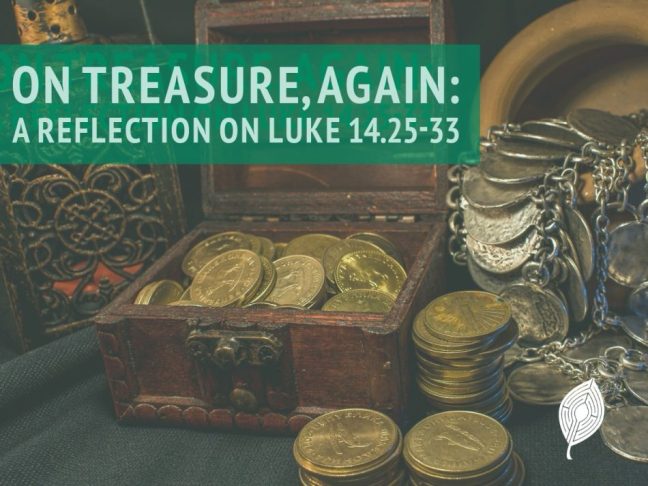
One of the recurring themes in Jesus’ teaching is his insistence that we sort out our priorities. As he famously put it in the Sermon on the Mount, “Where your treasure is, there your heart will be also;” and “No one can serve two masters …. You cannot serve God and wealth” (Matthew 6.21, 24). In today’s Gospel reading, which takes place among the parables of grace in Luke 14 and 15, Jesus repeats this teaching, with a slightly different — and shocking — spin. And so it’s worth reflecting on once again this week.
The reading goes like this:
Now large crowds were travelling with Jesus; and he turned and said to them, “Whoever comes to me and does not hate father and mother, wife and children, brothers and sisters, yes, and even life itself, cannot be my disciple. Whoever does not carry the cross and follow me cannot be my disciple. For which of you, intending to build a tower, does not first sit down and estimate the cost, to see whether he has enough to complete it? Otherwise, when he has laid a foundation and is not able to finish, all who see it will begin to ridicule him, saying, ‘This fellow began to build and was not able to finish.’ Or what king, going out to wage war against another king, will not sit down first and consider whether he is able with ten thousand to oppose the one who comes against him with twenty thousand? If he cannot, then, while the other is still far away, he sends a delegation and asks for the terms of peace. So therefore, none of you can become my disciple if you do not give up all your possessions.” (Luke 14.25-33)
For Jesus, it seems, nothing — nothing — is to get in between the faithful and their commitment to discipleship. Here, even the most basic commitments to filial piety and family life, and even one single possession, are seen as threats. So before anyone decides to follow him, they must count the cost, like a builder financing a tower or a king on the cusp of war.
Why are Jesus’ demands so extreme? His explanation in Matthew 6 is helpful here too:
Do not store up for yourselves treasures on earth, where moth and rust consume and where thieves break in and steal; but store up for yourselves treasures in heaven, where neither moth nor rust consumes and where thieves do not break in and steal. For where your treasure is, there your heart will be also (Matthew 6.19-21).
As I wrote about this last Fall:
There’s an astute detail here. Jesus doesn’t say that our treasure — what we value most — follows our heart, but that our heart follows our treasure. The heart in the New Testament often serves as a parallel to the Greek word nous, which is generally translated ‘mind’, but which is more about perception and interpretation than cognition or thinking (which is covered by the Greek dianoia). When the New Testament uses these words in a technical sense, it’s generally talking about how we understand the world. The heart or mind (nous) can be clear and therefore oriented toward God, seeing the world as God sees. Or, it can be clouded or dysfunctional, leading us astray. Here, Jesus is making the point — and I think it’s a good one — that our interpretation of what we see and experience in the world will always follow our treasure, whatever that treasure may be. If we value money above all else, then we will understand the economy and society as a whole through the lens of making money. If our ultimate value is our ‘nation’ (really whoever we think of as being included in ‘us’), we will see the world entirely through the lens of the thriving and security of our nation. If our ultimate value is pleasure, then again we will see everything through that lens. In other words, everything becomes justifiable to us in order to get, increase, and protect our treasure.
And if our hearts are focused on our bank accounts, the next high, our personal security, or our national honour as our greatest treasure, they can’t also be focused on love of God and love of neighbour.
Jesus puts it more bluntly a few verses later: “No one can serve two masters; for a slave will either hate the one and love the other, or be devoted to the one and despise the other. You cannot serve God and wealth” (6.24). We can worship at the altar of wealth (or nation or security or pleasure or any number of things), or we can worship God. We can serve these things, or we can serve God. We cannot do both at once. As it happens, this is why the whole notion of ‘Christian nationalism’ is a categorical falsehood. You cannot serve both God and nation any more than you can serve God and wealth simultaneously. Love of nation blinds us to the true meaning of loving our neighbour as ourselves, just as love of wealth does.
And as Jesus states in today’s gospel, the same thing is true for love of family or friends or possessions. Anything we set up as an ultimate value, whether intentionally or unintentionally, will become our treasure and thereby come to direct our heart and determine how we view the whole world, and behave in it.
These are undeniably hard teachings, but they are true.
But what is perhaps missing here is that, the real treasure, the Kingdom of God, is worth every sacrifice: “The Kingdom of Heaven is like a treasure hidden in a field. Upon finding it, a man hid it. Then joyfully he goes and sells everything he has and buys that field” (Matthew 13.44).
May we heed this call and, counting the cost, still choose God’s Kingdom, renouncing all claims to power, wealth and success, and taking up our crosses to follow Jesus. Amen.
 Matthew Root
One thought on “On Treasure, Again: A Reflection on Luke 14.25-33”