
[This series explores the way some of my favourite novels engage with spiritual things. As much as I will try to avoid discussing major plot points, I will be using quotes from the novels and be discussing how they fit generally into the story. So please take this as a spoiler warning.]
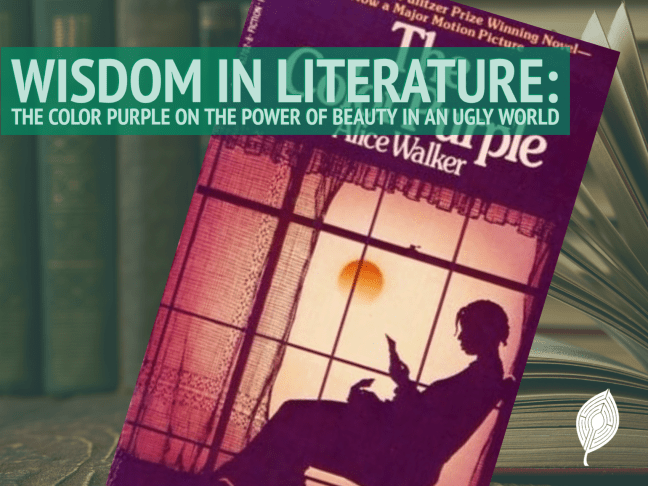
In this past Sunday’s post on the feast of Transfiguration, I reflected on how the true miracle of the transfiguration was not that Jesus was changed, but that the disciples were able to see him as he really was, and how this could be a paradigm for our own life of faith. To see the world as it is, for all its beauty and wonder, ugliness and terror, is a miracle indeed. This theme of seeing the beauty that exists within an ugly world is one of the major themes of Alice Walker’s 1982 classic The Color Purple, which has been adapted into an award-winning film and musical (whose film adaptation is also to be released this year). Today I’d like to take a few minutes to see a few ways it addresses this theme.
The Color Purple is the story of a woman born into poverty, abuse within her home, and race-based violence in the American South, who finds the resilience to overcome these barriers to chart her own path in the world, and find love, connection, and success along the way. It’s a beautiful novel, told in letters the main character writes to God, and yet, because of its honest depiction of racism, the main character’s journey away from conventional religion, and her finding love with another woman, it has been among the most commonly challenged and banned books since its release. (That one of the reasons it’s been challenged has been her rejection of the ‘old white man in the sky’ vision of God — which has never been the biblical understanding of God or even remotely close to Church teaching — shows just how pervasive this blasphemous understanding of God has become in contemporary Christianity!)
As controversial as the book’s religious themes may be, they actually in no way challenge traditional Christianity. In fact, its understanding of God and faith is essentially a twentieth century manifestation of the insights of the mystical tradition: that by ceasing to find God outside of us, we can truly find God within and thereby come to a greater place of acceptance of our circumstances, grow into our truest self, and see the world truly, in all its beauty.
We can see the first half of this in the words of a character named Shug, who is both a kind of foil and love interest to the main character Celie. She says:
Here’s the thing …. The thing I believe. God is inside you and inside everybody else. You come into the world with God. But only them that search for it inside find it. And sometimes it just manifest itself even if you not looking, or don’t know what you looking for.
And again, “Any God I ever felt in church I brought in with me.” This is an expression of what Integral thought calls the ‘first-person experience of God’, inherent to the mystical understanding of life and the divine. (For further reading, please check out my posts on how the first-person experience of God is discussed in the Christian tradition and in the life of Jesus.) Seeing God in ourselves is not about seeing ourselves as perfect or justifying our bad actions, but rather it allows us to better understand and trust our particular vocations in the world. About this theme, Walker later said (so closely connected to the story is it that is often attributed to The Color Purple, but it does not actually come from the text):
I am an expression of the divine, just like a peach is, just like a fish is. I have a right to be this way…I can’t apologize for that, nor can I change it, nor do I want to… We will never have to be other than who we are in order to be successful…We realize that we are as ourselves unlimited and our experiences valid. It is for the rest of the world to recognize this, if they choose. (The World Has Changed: Conversations with Alice Walker)
When such an understanding of God and self is healthy, it has the capacity to transform everything we see into a place where we might meet God. This is what we call the ‘third-person experience of God’: If God is in us, God is also in everything else. (This is called panentheism, which has a long and vital history within Christian spirituality and theology; for further reading, here are the links to my posts on this idea and how it is expressed in the life of Jesus.). In The Color Purple, this is best articulated in another quote from Shug:
I think it pisses God off if you walk by the color purple in a field somewhere and don’t notice it. People think pleasing God is all God cares about. But any fool living in the world can see it always trying to please us back.
This sensibility transforms surprise and wonder into important spiritual values. As Shug later says:
I think us here to wonder, myself. To wonder. To ask. And that in wondering bout the big things and asking bout the big things, you learn about the little ones, almost by accident. But you never know nothing more about the big things than you start out with. The more I wonder, the more I love.
I think this hits at an amazing truth. So much of the lack of love in our world is because we’ve ceased to be in awe of it. So much of the lack of love in our politics and interpersonal relationships is because we’ve ceased to wonder at the Image of God manifest in everyone we meet — especially, as Jesus would point out, in those in whom we’d least expect or want to meet it. The more wonder we experience, I think, the more love we will have.
The Color Purple is truly a wonderful gift. And, while it does indeed represent a strong critique of conventional Christianity, in doing so, it doesn’t critique Christianity itself, but rather represents the deeper, truer teachings of the faith.

