
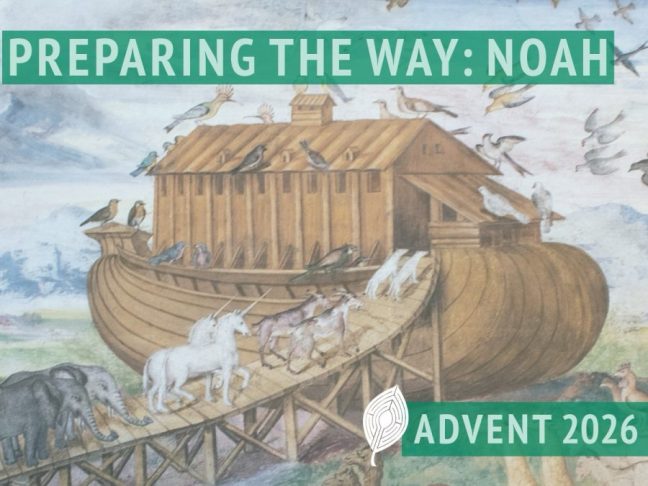
This year in Advent, we’re reflecting on the ancestors of Jesus and the ways their stories helped to prepare the way for his story. Today we’ll looking at the story of Noah, through three distinct lenses: What it would have meant in its original context, the parallels the New Testament draws between Noah and Jesus, and how the was incorporated into Christian hymnography.
As we saw a couple years ago in our series on Genesis 1-12, water was a powerful symbol of primordial chaos. And since creation involved the pushing back of the primordial waters, flooding was a compelling image for the undoing of creation and return of chaos. In such a context, the flood story is not just one of destruction and loss of life, but of divine abandonment. God is wiping off the chalkboard of creation and starting over. With this in mind, Noah and the ark are powerful symbol of God’s ongoing care for creation — the old creation will be the foundation for the new. These are interesting symbols through which to look at the story of Jesus. For one way Christians have traditionally understood the ‘Christ event’ is as the re-creation of the world (symbolized, for example, by the association of Holy Saturday with God’s Sabbath rest). In this way, Jesus parallels Noah by being the agent through whom God saves humanity within the recreation of the world.
This ties into a related theological theme that draws a negative parallel between the waters of the flood and the waters of baptism: Where the flood-waters’ destruction was incited by sin, in baptism sin itself is destroyed by water. To put it another way, the flood washed away humanity on account of our sin; baptism washes away sin on account of humanity (and God’s faithful love for us). As one ancient hymn puts it:
In the beginning you brought the all-destroying flood upon the world
Causing the terrible destruction of all things.
O God, You reveal strange and mighty wonders!
And now, O Christ,
You have drowned sin in the waters for the comfort and salvation of mortal humanity.
These are the big symbolic ways the Christian tradition has interpreted Noah in relation to the coming of Christ. But the New Testament itself takes a more prosaic approach. In Matthew 24, Jesus says about the apocalyptic Day when God will come to make things right:
But about that day or hour no one knows, not even the angels in heaven, nor the Son, but only the Father. As it was in the days of Noah, so it will be at the coming of the Son of Man. For in the days before the flood, people were eating and drinking, marrying and giving in marriage, up to the day Noah entered the ark; and they knew nothing about what would happen until the flood came and took them all away. That is how it will be at the coming of the Son of Man. Two men will be in the field; one will be taken and the other left. Two women will be grinding with a hand mill; one will be taken and the other left. Therefore keep watch, because you do not know on what day your Lord will come. (Matthew 24.36-42)
There’s an irony to this passage because, of course, their Lord had already come and was speaking to them. This irony emphasizes the very element of surprise he’s talking about. But if we think of it in terms of the coming of the Day of the Lord, rather than the Incarnation, Noah and Jesus share an identity as the harbinger of God’s decisive action in the world.
And this where everything pulls together. In a lot of ways, ‘salvation history’ is like plate tectonics. Most of the time it moves slowly — painfully so — with the irresistible force of God’s Kingdom in a seeming deadlock with the immovable object of the ways of the kingdoms of this world. But every now and then the faultline slips and things change with brutal and shocking rapidity. For us as Christians, the most of important of these is the coming of Christ in the Incarnation, an act which remade the world for us, even as we await its consummation and fulfillment. But by his faithful living and obedience to God’s warning, Noah too was a lifeline for humanity during one of these spiritual earthquakes. In this he is a figure or type for Jesus, and his example remains for us.

