
One of the major questions in the Gospels is the question of Jesus’ identity. “Who do you say that I am?” (e.g., Matthew 16.5). Some said he was a prophet, some the reincarnated form of Elijah or John the Baptist, some even whispered (even if a little too loudly) that he was the Messiah, the long-awaited hero who would free Israel from its captivity. For his part, Jesus was always a little shifty about it. In John’s Gospel, Jesus hints at his identity through a series of metaphors known as the “I am” statements: “I am the bread of life” (6.35), “I am the light of the world” (8.12), “I am the resurrection and the life” (11.25), “I am the way, the truth, and the life” (14.6), “I am the true vine” (15.1). Today’s Gospel reading, taking a step back from the post-Resurrection narrative we’ve been in since Easter Sunday, introduces another of these statements (and points toward another), using a deeply familiar and symbolic metaphor in a unique and surprising way.
Let’s take a look.
Jesus said, “Very truly, I tell you, anyone who does not enter the sheepfold by the gate but climbs in by another way is a thief and a bandit. The one who enters by the gate is the shepherd of the sheep. The gatekeeper opens the gate for him, and the sheep hear his voice. He calls his own sheep by name and leads them out. When he has brought out all his own, he goes ahead of them, and the sheep follow him because they know his voice. They will not follow a stranger, but they will run from him because they do not know the voice of strangers.” Jesus used this figure of speech with them, but they did not understand what he was saying to them. So again Jesus said to them, “Very truly, I tell you, I am the gate for the sheep. All who came before me are thieves and bandits; but the sheep did not listen to them. I am the gate. Whoever enters by me will be saved, and will come in and go out and find pasture. The thief comes only to steal and kill and destroy. I came that they may have life, and have it abundantly.” (John 10.1-10)
This rich metaphor of sheep and shepherding has come up quite a bit here lately (here and here for example), and has a long biblical pedigree. Here are a few Old Testament examples:
- “the God who has been my shepherd all my life to this day” (Genesis 48.15)
- “by the name of the Shepherd, the Rock of Israel” (Genesis 49.24)
- “so that the congregation of YHWH may not be like sheep without a shepherd” (Numbers 27.17)
- “YHWH is my shepherd, I shall not want…” (Psalm 23.1)
- “Give ear, O Shepherd of Israel … enthroned upon the cherubim“ (Psalm 80.1)
- “See, the Lord YHWH … will feed his flock like a shepherd; he will gather the lambs in his arms…” (Isaiah 40.10-11)
It was also a common image for God to delegate this shepherding role to the chosen king, with good or more commonly bad results (e.g., Jeremiah 23). But through this history delegation, the metaphor also took on a messianic weight: One day Israel’s true human shepherd, the one who would be worthy to take on this divine role, would come and destroy the wolves harassing her.
And so, when Jesus introduces this extended metaphor here in John 10, he’s both treading on familiar theological ground and playing with fire. The way he starts it, introducing the sheepfold and the idea of a shepherd, you’d expect the shocking payoff, the twist on the old metaphor, to be that he is the shepherd, taking on the ancient divine title as his own. And indeed, he does go there eventually (10.11), setting off the expected firestorm (10.19-33). But not in today’s reading. (The lectionary splits the Good Shepherd narrative into three pieces, and does one every year in its three-year cycle: a nice way to spread the teaching out, but it also means that we never get the whole story in one go!)
No, in this first part of the story, Jesus zigs where everyone would have expected him to zag, saying: “I am the gate for the sheep.”
The gate? What’s he doing?
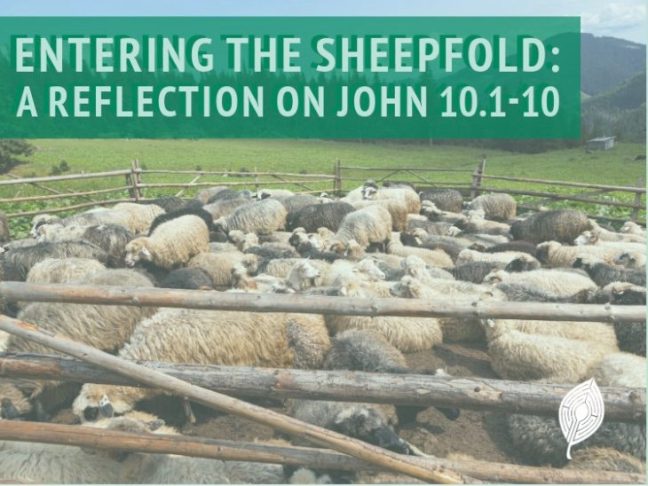
The sheepfold is not the pasture lands on which a flock would graze, but the paddock where they would return to be kept safe. It’s the ultimate safe space. And so in Jesus’ analogy we might think of it as the Kingdom of God. There are people who try to sneak in — thieves or predators — but there is only one gate, one way in. And Jesus says that he is that gate. He’s the point at which the human and divine realms meet, the bridge linking creation with our Creator. This would have been controversial not only for what it claims about Jesus, but also because in Judaism, that meeting point of the human and the divine and the way into the Kingdom is the law, the Torah.
But analogies aside, what does it mean practically speaking for us for Jesus to be the gate? If we say that Jesus is the way into the Kingdom, what does that look like? Do we give his name to the angelic bouncer guarding the throne of God as a kind of password? Or for them to check the divine will-call list under ‘Jesus’? Is he the answer to a quiz? (And really, since his name means “YHWH saves,” that wouldn’t be a bad answer!) But these don’t feel satisfactory, since the point isn’t that Jesus is the way through the gate but the gate itself. What does it mean to ‘cross through’ Jesus?
This is a more intimate and mystical image. It suggests entering into him and passing through him. And that means uniting ourselves to his way of being, unifying by grace the divine and human within ourselves, as Jesus does by nature. (If you think this is a stretch, Paul has a lot to say about it!) And this means living that same gracious and humble life that he lived.
I think this interpretation is aided by the clearer second half of the metaphor, in which Jesus finally does call himself the Good Shepherd. What makes him the Good Shepherd? His willingness to lay down his life to defend his flock (10.11-15). And later, he adds, “My sheep hear my voice. I know them, and they follow me” (10.27). In other words, plain as day, we belong to Christ inasmuch as follow him, listen to what he tells us, and obey. And that looks like loving our neighbour as ourself (and understanding that our neighbour is the person we’d least like it to be!), like welcoming the outcast, releasing captives, healing the sick, forgiving those who have wronged us, and loving those who have set themselves up as our enemies.
Jesus’ ‘I am’ statements in John’s Gospel are all famously outrageous. They are bold claims that get him into a lot of trouble with the religious authorities. Here today, he claims to be the only real way into the Kingdom of God. Not as a password or the answer to an intellectual puzzle, but as a way of life.


One thought on “Entering the Sheepfold: A Reflection on John 10.1-10”