
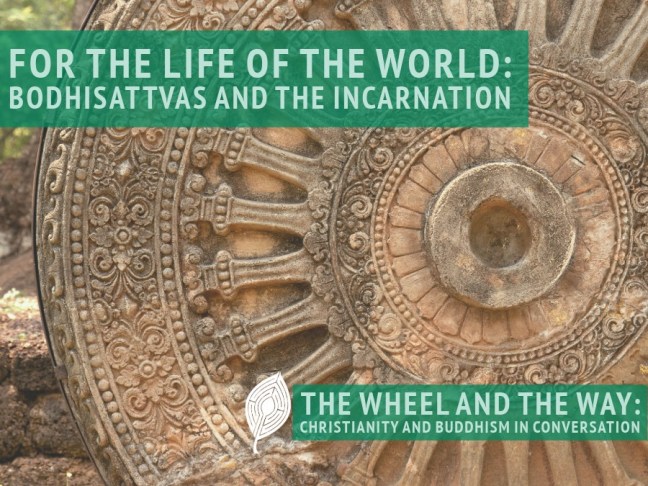
Over the past few weeks, we’ve been looking at some of the basics of Buddhist teaching as a kind of mirror to help us better understand our own Christian faith. Today’s final post will explore one final Buddhist concept, the bodhisattva, which I think will provide a perfect summary for the series as a whole.
Bodhisattva in Buddhism
The term bodhisattva translates loosely as something like ‘enlightenment-being’. It has a long history, but has also evolved quite a bit over time and in different Buddhist lineages. Originally, and in Theravada schools to this day, it refers specifically to Siddhartha Gautama, in his past and final lifetimes alike, as he approached his ultimate enlightenment as the Buddha. But in Mahayana Buddhism (including Tibetan and Zen), it has come to mean anyone who is on the path toward enlightenment.
As we saw towards the start of the series, in Buddhist thought, we are karmic beings, subject to the basic laws of cause and effect. It’s as though we are on the open ocean, directionless without sails, rudders, or oars, subject entirely to the winds, currents, and tides. Buddhism is essentially a toolkit to help us chart a course and navigate these karmic realities in such a way as to get where we want to go. By accepting the Four Noble Truths and embarking upon the Eightfold Path, Buddhists do just this. And in that simple sense of the term, they become bodhisattvas. The ultimate goal of this path is not just enlightenment and freedom for oneself, but also to relieve all suffering for all conscious beings.
And this is where the idea gets really juicy. For the goal of freeing everyone from suffering is not the work of one single lifetime. And so there is the idea that some individuals have attained enlightenment and been freed from the cycle of rebirth yet have chosen voluntarily to be reborn to continue their work in the world. Some of these thereby become beings of incredible power and are able to confer great blessings on the world. In many parts of the Buddhist world, a statue you see may not be of the Buddha, but of one of these beings, famed bodhisattvas such as Avalokiteshvara, Maitreya, or Manjushri.
So, there are a lot of layered ideas here, from the journey of the one who discovered the path, to all of those who embark on it, to those in whom the path has been so fulfilled that they go back to help others find their way.
Christian Response
The closest thing Christianity has to the idea of the bodhisattva is that of the saint. This is especially true when we remember that this is not a formal title but simply an adjective meaning ‘holy’. So we see holiness on display in the selflessness of the incarnation and of Jesus’ lifestyle, teaching, healing, death, and resurrection. Yet those who follow him are also called holy (e.g., Acts 9.32; Romans 1.7, 8.27; 1 Corinthians 16.1), and further called to become holy. And, the tradition recognizes that some of the faithful attain such holiness that their presence and ministry continues after their earthly death, hence the more formal idea of the capital-S Saints. Christianity of course does not have a notion of reincarnation, but rather holds that the Saints are able to support and serve those still in this world through their intercessions and the energies of God.
Conclusions
The premise behind this series is that because other traditions ask different questions and frame their ideas in unique ways, exploring them with curiosity rather than judgment can reveal things in our own faith that may be hidden by the ways we’re accustomed to framing our beliefs and practices. Especially when looking at Christianity and Buddhism, there’s a dialectic of similarity and difference at play: they often say similar things for vastly different reasons, or take wildly different approaches but end up reaching a similar conclusion.
The bodhisattva is a great example of this phenomenon. In its most fully developed form, its ideas are very reminiscent of the Christian idea of the Incarnation. Both ideas involve beings free from the baggage of this world who voluntarily go into it to serve others, which in turn inspires and empowers us to take up that same way of life. Indeed those famed words from Philippians 2 that I’ve quoted so often in this series could work just as well to speak of the bodhisattvas as it does of the incarnation of Jesus:
Let the same mind be in you that was in Christ Jesus,
who, though he was in the form of God,
did not regard equality with God as something to be grasped on to,
but emptied himself, taking the form of a slave,
being born in human likeness.
And being found in human form,
he humbled himself
and became obedient to the point of death— even death on a cross. (Philippians 2.5-8)
Here we have a way of radical non-attachment, even to the glories of union with God, in service to the life of the world, that fits the vision of both traditions. The main difference — and it’s a big one (again, where the two religions are at their closest reveals their widest differences) —is that in Buddhism, this incarnational movement comes at the end of the journey of liberation, while in Christianity, it is the incarnational act that sets everything in motion.
This is no accident. Because again, Buddhism is a religion of epiphany rather than a religion of revelation. The Buddha was neither God nor ‘sent by God’ to enlighten the world; rather, he was a man who came to a radical way of understanding human psychology and harnessing it in service of peace and freedom for all. By contrast, in Christianity, Jesus was the divine Word of God who became human in order to reveal truths and a way of being in the world we can no longer see on our own.
But both traditions are ultimately concerned with a way of renunciation for the life of the world.
And that seems as good a conclusion as any on which to end this series.
 Matthew Root