
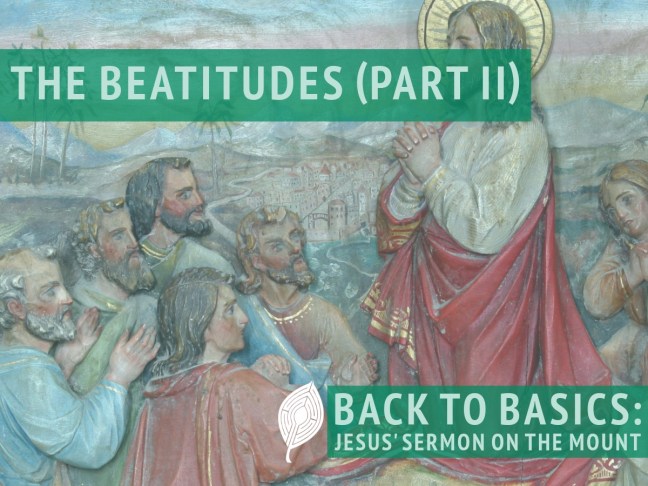
The other day, in part one of this brief exploration of the Beatitudes of Jesus, we looked at the eschatological (i.e., ‘end-oriented’), apocalyptic, and wisdom assumptions lying behind Beatitude as a literary genre in the Ancient Mediterranean world, and saw how the first three of Jesus’ Beatitudes promote an ethic based in a radical acceptance of reality, equanimity, lamentation, and humility. Today we’ll look at how these themes continue (or don’t) through the rest of the Beatitudes.
The fourth Beatitude reads, “Blessed are those who hunger and thirst for righteousness, for they will be filled” (Matthew 5.6). This is another situation where Matthew seems to ‘spiritualize’ the Beatitude, where Luke puts it in practical terms “Blessed are you who hunger now…” (Luke 6.21). But just as we saw with the blessing of the poor (in spirit), there is nothing inherently holy or blessed about being hungry, other than being an exemplar of the world’s injustice that the religion of Jesus longs to overturn. But if the Beatitudes as recorded by Luke are focused on the problem, those in Matthew’s version are focused on the solution; as Hans Dieter Betz put it: “If physical hunger is the result of social injustice, … hunger and thirst for righteousness is the beginning of the way out of it.”*
With this Beatitude we also run into the tricky question of the relationship between righteousness and justice. These were two words in Hebrew, but one in Greek. For most of Christian history, this wasn’t a huge deal because was understood that the two concepts are inherently connected: Because God is concerned with justice, one cannot be in right relationship with God without promoting justice — one cannot love God without loving one’s neighbour. This shifted a bit in the Reformation, whose emphasis on salvation through trust in Jesus alone served to decouple the two concepts in the movement’s more extreme quarters. We’re left now in a situation where it seems that Christian conservatives care about righteousness and progressives care about justice, but this is a false dichotomy. Because of the ethical focus of the Sermon on the Mount, I’m supportive of the translation giving the righteousness side of the coin top billing here, but it’s important to remember that justice is always the other side of the coin: This isn’t some personal, sentimental piety detached from the concerns of social justice, but a genuine concern for faithfulness, which is always lived out in real relationships with the aim of expressing the true and lasting peace of God. Of course, as long as we’re on this side of Paradise, such peace is unattainable. Hence here it is the longing and striving for righteousness that is to be rewarded.
Next comes the blessing of the merciful. Of all the Beatitudes, this is one that would probably have sounded the most obvious to Jesus’ original audience, as mercy was understood in all of Judaism’s many branches at the time to be a primary religious and social duty. Too often in our present political discourse, mercy and justice are set out as opposites, as though one can either be just or merciful but not both. But this is not God’s justice, which is always grounded in mercy and grace. As Luke’s version puts it, “Be merciful, as your Father is merciful” (Luke 6.36). If God is merciful, how much more should we, who are ourselves in need of mercy from others, be so!
The sixth Beatitude reads, “Blessed are the pure in heart, for they will see God” (Matthew 5.8). Purity of heart is an odd expression, found only here in the New Testament. It connects, however, to language from the Psalms:
- Who shall ascend the hill of the Lord? And who shall stand in his holy place? Those who have clean hands and pure hearts, who do not lift up their souls to what is false, and do not swear deceitfully. (Psalm 24.3-4)
- Create in me a clean heart, O God, and renew a right spirit within me (Psalm 51.10)
Despite the association in the first of these passages of purity of heart with ritual purity, we know from the rest of the Gospels that this was not Jesus’ concern, since he not only set aside matters of ritual correctness when needed (e.g., “The sabbath was made for humankind, and not humankind for the sabbath” (Mark 2.27; cf. Matthew 12.1-8)), but also regularly chastised those who consider such things to be of primary importance (e.g., “There is nothing that enters a man from outside which can defile him; but the things which come out of him, those are the things that defile a man” (Mark 7.15)). Throughout the Sermon on the Mount specifically, Jesus’ teaching emphasizes the disposition of the heart that lies behind action, the interior more than what is performed, the acceptance of the unvarnished truth over pious niceties. In this sense, purity in heart is similar to poverty of spirit, in that it encapsulates the ethic Jesus is promoting. The blessing such people receive is to “see God,” which in this context should be primarily interpreted in an eschatological sense rather than in the expectation of a literal theophany, though a mystical sensibility is certainly not excluded.
The seventh Beatitude reads “Blessed are the peacemakers, for they will be called children of God.” I’ll hold off on discussing this too much here, because I think the so-called antitheses of Matthew 5.21-48, which we’ll look at next week, exemplify what peacemaking looks like in practice. But suffice it to say, if you are promoting division, strife, and disconnection within a community, or vilifying people or groups, you are not promoting the kind of world God wants. Rather, if you are truly righteous, you will seek to unite, build coalitions, and promote reconciliation, in reflection of God’s heart. And it’s perhaps for this reason that the blessing here is to be called “children of God.” This works not only on the literal level of being adopted into God’s family and therefore living out God’s ‘family values’, but also on a metaphorical level, since the term ‘children of …’ in Hebrew (and the Hebraized Greek we get in the New Testament) was often used to describe ‘those who follow in the footsteps of …’. When we pursue peace, we are like God.
Finally, the Beatitudes end with a blessing upon the persecuted: “Blessed are those who are persecuted for righteousness’ sake, for theirs is the kingdom of heaven.” The persecution of the righteous became an important theme in Second Temple Jewish writing, as the faithful in Israel wrestled with their people’s prolonged and repeated subjugation to foreign powers, some of whom were openly hostile towards their religious beliefs and practices. But even in Greek thought there was a long recognition that doing the right thing is the best way to make powerful enemies. It’s always easier just to give in and go with the flow instead of persisting in the face of opposition. And so persisting in the face of persecution is The reward for these is the same as for the first Beatitude, marking it as completing the narrative unit (a rhetorical devise known as an inclusio). But, the same sentiment is then repeated in the passage’s conclusion:
Blessed are you when people revile you and persecute you and utter all kinds of evil against you falsely on my account. Rejoice and be glad, for your reward is great in heaven, for in the same way they persecuted the prophets who were before you. (Matthew 5.11-12)
While it’s not the intent of the passage, I’ve always appreciated the ambiguity here — grammatically, it can just as easily be blessing those who are unjustly persecuted by those who falsely think they are acting for Jesus as those who are persecuted because they follow Jesus. It’s a nice little reminder and warning for any Christian pursuing earthly power. (And one that’s been sadly unheeded a lot of the time.)
So to the ethic of radical acceptance of reality and equanimity, lamentation, and humility we saw last time, today we can add the pursuit of righteousness and peace, simplicity, grace and mercy, and perseverance in such things in the face opposition. These are the attributes Jesus tells us we should live out if we want to be citizens in God’s Kingdom and members of God’s family. If we want to advocate for a ‘Christian’ society, these are the virtues on which we should be focused. And if our lives are not marked by these things, then we really need to take a step back, repent, and start again from the beginning.
*Betz, Hans Dieter. The Sermon on the Mount. Hermeneia. Minneapolis: Fortress Press, 1995.
 Matthew Root
6 thoughts on “The Beatitudes (Part II)”