
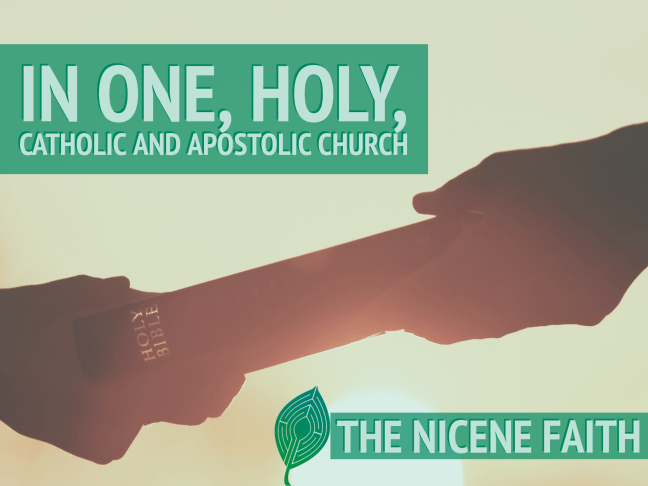
We’re now coming to the last section of the Creed, which shifts its attention from the nature of God to some basic things about the Christian life. Today, we’ll look at the Church, which the Creed calls “One, Holy, Catholic, and Apostolic.” Right off the mark, we have to say that this description is both beautiful and impossible. These are deep, important words about the community of faith. But, they also fail to account for the lived reality that in actual practice, Christian communities are just as prone to division, sin, schism, and wandering from identity and purpose as any other human community. And so for me, as much as it is an article of faith, it is so as an ideal, a hope, and a calling rather than as a fact. Let’s look at each of these five words in turn to see what this might entail.
First, let’s talk about the Church itself as a concept. The fact that I need to defend it at all is enough to demonstrate why its nature as “One, Holy, Catholic, and Apostolic” is also in doubt. I would hazard to guess that every single person who has ever been involved in any church community has been hurt and disappointed by it in one way or another, whether in small ways, like being chastised for sitting in ‘someone else’s’ seat, or big ways, like spiritual abuse or religiously-motivated violence or war. And there’s a lot of historical evidence now to suggest that if there’s a major historical debate, a huge segment of the Church are going to find itself on the wrong side of history. It’s no wonder it’s so tempting to do away with it as an idea and a practice, let alone as an article of credal faith. But, for Christians, that is simply not an option. We are not saved as individuals, but together, as a community. First, community is simply an inherent part of being human. We aren’t a solitary species, but one that has always relied on the group for its safety and success. We need support, assistance, and the care of others, not to mention other perspectives to help us understand the world and God better. The depths of loneliness so many of us experience in the individualistic twenty-first-century world is indication enough just how essential community is to us as humans. But, second, community is no less critical to us as Christians; for faith in the Church is a necessary corollary of faith in the Holy Spirit. If the Holy Spirit is living and active in us, then we are all united in sharing that Spirit’s life and activity. If we put both of these reasons — our need for others and the unifying force of the Spirit — together, we get something like Paul’s teaching about the Church as the Body of Christ. To remind you, to the Romans, Paul wrote: “For as in one body we have many members, and not all the members have the same function, so we, who are many, are one body in Christ, and individually we are members one of another” (Romans 12.4-5). And to the Corinthians:
For just as the body is one and has many members, and all the members of the body, though many, are one body, so it is with Christ. For in the one Spirit we were all baptized into one body—Jews or Greeks, slaves or free—and we were all made to drink of one Spirit. Indeed, the body does not consist of one member but of many. If the foot were to say, ‘Because I am not a hand, I do not belong to the body’, that would not make it any less a part of the body. And if the ear were to say, ‘Because I am not an eye, I do not belong to the body’, that would not make it any less a part of the body. If the whole body were an eye, where would the hearing be? If the whole body were hearing, where would the sense of smell be? But as it is, God arranged the members in the body, each one of them, as he chose. If all were a single member, where would the body be? As it is, there are many members, yet one body…. (1 Corinthians 12.12-20)
And so, as hard as it so often is to live in practice, we need each other, and are called together as Christians into the community we call the Church.
This ties in nicely to the idea of unity, or ‘oneness.’ We aren’t many bodies but one body, together. There isn’t a different Christ in one part of town from another, or a different Christ in Canada than in South Korea, or an Eastern Orthodox Christ and an Anglican Christ. There is simply Christ. As the Creed has said, we believe in “One God” and “One Lord, Jesus Christ.” And the one Church is his one Body on Earth. And yet, as true as this is, from the very beginning, the Church has known division. The New Testament itself records disputes about the acceptance of Gentiles, disputes among local churches founded by different apostles, divisions of class and wealth, and conflicts of personality. By the late second century, there were conflicts with groups such as the dualistic Marcionites, and enthusiast Montanists. The third century saw the rise of Gnostic Christian sects of various kinds, and in the fourth century there were, of course, the Council-inspiring controversies surrounding Arianism and Pneumatomachianism. There were conflicts in late antiquity the West over Donatism and Pelagianism and in the East over Monophisitism, Monothelitism, and Iconoclaism (the nature of these groups and controversies is not important for our purposes today). And on and on and on, through today’s current divides over gender, sex, an sexuality in the Church. And, historically, many of these divisions became openly violent, as concerns about orthodoxy trumped belief in our shared humanity. From an outside perspective, the Church has never been ‘one’ and there have always been Christianities rather than ‘Christianity’. And yet, as elusive as it has always been, belief in our one God demands that we uphold our trust that, ultimately, the Church is one — not as a rejection of difference, but as a hope that we can find a way where difference does not need to create division.
The Creed also calls the Church ‘holy’. This is a word that makes us think of ideas of ritual or ethical purity. But in the thought world of the Bible (especially in the New Testament, where Jesus does away with the ideas of ritual purity), holiness is primarily about something being set apart for God: Something, whether tableware, a building, or even a person, becomes ‘holy’ by being set part for ceremonial or otherwise Godly usage. So when we call the Church ‘holy’, we’re not saying it’s perfect, but that it’s set apart for God, that it operates according to the principles of Christ’s kingdom rather than the broken ways of our world. But again, this is a marker of the Church we must hold as an ideal rather than a reality. For the Church has tended to operate no differently than the ‘kingdoms of this world,’ just one more place where power-hungry people have been able to have there way, ‘lording it over others’, whether in silly internal politics or in those major, ‘wrong side of history’ events, like dividing humanity along racial and religious lines, aiding and abetting imperial agendas, privileging men’s ‘right’s over women’s health and safety within marriages, or hiding and enabling the actions of sexual predators. We don’t need the Church to be perfect, but these are not the acts of a ‘holy’ Church, this is not a community living as a beacon of the Kingdom of God! So when we say the Church is holy in the Creed and when we insist on this in our lives, we must do so not as an indication of what it has been or is right now, but a statement about what it must be, what it is when it is itself: the Body of Christ on Earth, the inbreaking community of the Kingdom of God.
The third descriptor of the Church is that it is “catholic,” a word for which most of us have no context outside them name of the “Roman Catholic” Church. But it’s a beautiful word, meaning something like ‘in accordance with the whole’. It refers to, as per the famous saying of St. Vincent of Lerins (5th C), “that faith which has been believed everywhere, always, by all” (The Commonitory). Of course, the incredible diversity that Christianity has always had makes such a statement almost meaningless in actual fact, and different Christian traditions define this differently. But it remains an important principle. It’s essentially about what I said about the importance of the ‘we’ at the start of the Creed: It’s saying that we don’t do theology or life on our own, but in community. It’s saying that we need each other in order to understand the world. The Church in Toronto must hear what the Church in Hay River, in Bogota, or Baghdad is saying, and vice versa. Catholicity, when understood best, is not about the top-down unity of sameness, but about how diversity of experience and language helps us to understand more about God, humanity, and the world.
Finally, the Church is called ‘apostolic.’ At its most general, this simply means that the Church is grounded in the authority and teaching of the Apostles. But, once again, this has been interpreted in different ways. In the fourth century context, this would have meant that the true faith is guaranteed by the apostolic succession of bishops. As we saw last year, this idea of the primacy of the tradition in the Rule of Faith (of which the Scriptures are a part), was the primary way the Scriptures were understood from the second century, through the development of formal interpretive schools in late antiquity and the Medieval Synthesis, until the Reformation. But, of course, apostolic succession was no guarantee of either theological agreement or Church unity. But, I still think it’s valuable. Just as catholicity requires that our faith cast a wide net theologically, apostolicity requires that we do this through time as well as space. We are just links in a chain reaching back thousands of years into history, and, God willing, reaching forward into the distant future. We owe it to our ancestors in faith as well as our descendants to transmit our faith as faithfully and as beautifully and as helpfully as we can.
In all of the foregoing discussion, it may seem like I’m being hard on the Church. And to that I’d say yes and no. Yes, it is absolutely a call to repentance and a demand for the Church to be and do better. There can be no doubt, upon any and every measure, that the Church has failed in every generation to live up to its ideals and live into its vocation. We not only have the right, but also the duty to demand accountability in the present and a commitment to doing things better. But at the same time, I’m not being ‘hard on the Church’ because the Church is not something ‘out there’ apart from me or you; if we are Christians, then the Church is us. This means, first of all, that any call for the Church to do better is a call for me and you and all of us together to do better. The Church, holy as it may be, is made up of individual Christians who are caught up in the ‘now but not yet’ of our faith, born anew to the new life in Christ yet at the same time still entangled, far more than we’d like to be, in the old ways of ‘this world’ that lead to ‘death’. And this means that, second of all, if I want grace for myself when I slip up, and see the need to extend grace to you when I see you slip up, so too must our desire for accountability and repentance for the Church also include an extension of grace to the Church. Pointing out the ways the Church isn’t what it’s supposed to be isn’t about pointing fingers, but about a broken-hearted longing for the Church truly be one, holy, catholic, and apostolic, to be the presence of God’s kingdom in the midst of a hurting world, trusting that God too is broken-hearted, wrathful against its injustice, but always open-hearted and gracious, calling the Church — that is to say, all of us — into a fuller and more beautiful, and more faithful way of life.
We believe in one God, the Father Almighty, Maker of heaven and earth, of all that is, seen and unseen. And in one Lord, Jesus Christ, the Son of God, the Only-Begotten, Who was begotten of the Father before all ages, light from light, true God from true God, Begotten not made, Who is of the same essence as the Father, Through whom all things exist. Who, for us humans and for our salvation, came down from heaven, And was incarnate of the Holy Spirit and the Virgin Mary, and became human. Who was crucified for us under Pontius Pilate, and suffered and was buried, and rose gain on the third day, in accordance with the Scriptures, and ascended into heaven and is seated at the right hand of the Father. Who is coming again in glory to judge the living and the dead, whose kingdom will have no end.
And in the Holy Spirit, the Lord, the Giver of life, Who proceeds from the Father; Who with the Father and the Son is worshiped and glorified Who spoke by the prophets.
And in one, holy, catholic, and apostolic Church…
 Matthew Root
6 thoughts on “In One, Holy, Catholic, and Apostolic Church”