
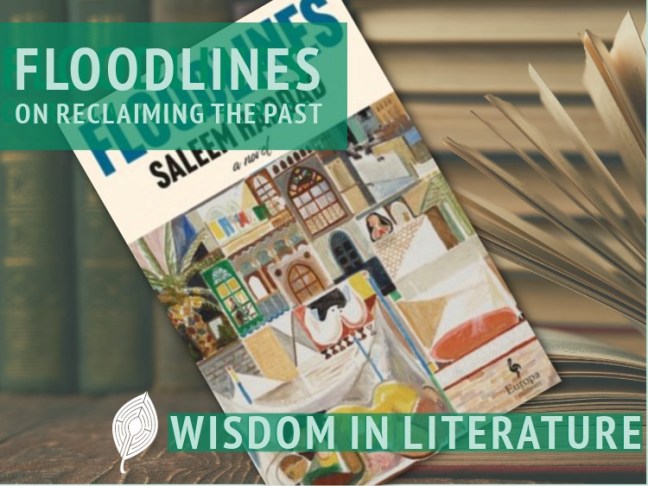
It’s an ongoing tradition here on the blog to spend the time regrouping between long series looking at what I call ‘Wisdom IN Literature,’ the ways novels I’ve read interact with themes of faith, personal growth, and other big issues of human experience. Of the novels I’ve read so far in 2026, none has been more thought-provoking than Saleem Haddad’s Floodlines (2026). It follows an Iraqi expat family who grapple with their family’s and culture’s legacy as they watch their homeland collapse from afar. What I love about it is that it doesn’t offer pat solutions; each of the characters presents a unique point of view on the situation, and each is right and each is wrong in their own ways. While there a lot of things from this novel I could address in a post like this, today I’d like to focus on the question of how to use the past well as we construct our futures.
In our current socio-political climate, the question of the past is generally being driven by nostalgia, looking at the past through rose-coloured glasses and longing for the good-ole’ days, while ignoring the often big problems that didn’t make them ‘good-ole’ days’ for everyone, or even most.
Because there are no ‘good-ole’ days’ in Iraq’s recent history to look back on, nostalgia is not quite the issue at play in Floodlines. Rather, the question is, when looking back across a civilization that has existed, evolved, ebbed and flowed in various guises, over roughly six thousand years, what parts of that history are valuable? Who gets to decide? And why? And as one character points out, “Memories of the past can so easily be changed, misremembered, manipulated.” Moreover, as another character notes quite humorously, “just because you are angry about imperialism, war, and climate destruction doesn’t mean you also don’t have a problem with your mother.” In other words, our understanding of the vast reaches and movements of history are always going to be clouded by our personal experiences.
The book doesn’t come to any firm conclusions about how to successfully deal with the past. But it does insist that we lean into all that uncertainty as try:
It is true that our paths, our myths, our histories can give us clues to find our way back home. But how to look back, to construct meaning from fragments and broken mirrors? We try to organise our memories into a portrait of something or archive them like artefacts in a museum. Perhaps we should instead embrace the uncertainty of memory. And to embrace uncertainty, one can only be armed with hope.
I think what this is getting at is recognizing that when we call upon ‘history’, or in a religious context, when we call upon ‘tradition’, we’re really calling on a story we tell ourselves about that history. And yes, in this age of conspiracy theories, denialism, and ‘alternative facts,’ we must recognize that some stories are more accurate than others. But they are stories nonetheless. Accepting this fact should allow us to loosen our grip on them, and open us up to telling bigger, better, and yes, more complex stories about the past. And this in turn should allow us to create better futures for us all.
Floodlines is a brilliant nesting doll of a novel about the interconnected and clashing legacies of individuals, families, nations, cultures, and civilization itself. These are timely questions, not just for the Arab world but for the West too: What is our story? Who gets to tell it? and Why?

