
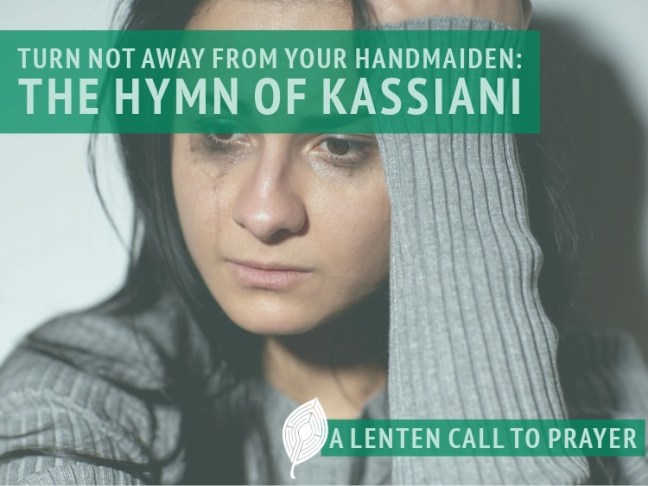
It’s rare for an ancient hymn or prayer to be so strongly associated with its writer so as to be named after them. It’s even rarer when that writer was a woman. But that’s the case with the hymn we’ll be looking at today, which in the Eastern Church has become synonymous with Holy Wednesday: The Hymn of Kassiani.
St. Kassiani was a ninth-century nun, who is arguably the most important female contributor to the Orthodox tradition: Twenty-three of her roughly fifty extant hymns are included in official liturgical books, and hundreds of her aphorisms or sayings also survive. (My favourite reads “I hate the rich man moaning as if he were poor” — how little times have changed!). According to tradition, she had also got into a famous verbal sparring match with the heir to the throne who had been courting her. All this to say, she’s an icon and a legend. But of all of her writings that survive, one has become so famous and beloved as to take her name. It reads:
O Lord God, the woman who had fallen into many sins,
having perceived Your divinity received the rank of ointment-bearer,
offering You spices before Your burial, wailing and crying:
“Woe is me, for the love of adultery and sin has given me a dark and lightless night;
accept the fountains of my tears, O You who draw back the waters of the sea from the clouds
incline to the sigh of my heart, O you Who bent the heavens by Your inapprehensible condescension;
I will kiss Your pure feet and I will wipe them with my tresses.
I will kiss Your feet, whose tread when it fell on the tears of Eve in Paradise
dismayed her so that she hid herself because of fear.
Who then shall examine the multitude of my sin and the depth of Your judgment?
Wherefore, O my Saviour and the Deliverer of my soul,
turn not away from Your handmaiden, O You of boundless mercy.”
This hymn takes as its basis the story of the woman who anointed Jesus’ feet with her tears in Luke 7.36-50. But in a move that can make some Protestants uncomfortable, but which was common in Byzantine hymnography (and which we also see in the later Ignatian practice of Gospel Contemplation), she expands on what’s in the text, imagining through her sanctified imagination the circumstances and emotions behind the story, and, most importantly, drawing out its theological significance.
As is always the case in hymns of this style, the woman precociously, if not anachronistically, recognizes Jesus in his full divinity, and is remembers the full scope of biblical imagery. (Again, the point is not to describe ‘what happened’, but ‘what it means’.) And so, as she cries her watery tears, she thinks on how God separated the waters in creation; as she bends low in repentance, she think on how God ‘bent down’ to ‘bend’ the heavens; and as she wipes the tears from Jesus’ feet, she imagines them as those same feet that trod upon Eve’s tears in the Garden of Eden.
Then, remembering that Eve’s guilt and shame caused her to hide from God, she wonders how her own sins will be accounted. But, praying what she believes — that God is gracious and quick to forgive (see assumption 5 in the linked post) — she petitions Christ not to turn away from her act of humility, love, and repentance, and accept her in his compassion. By the prayer’s end, the woman’s prayer has become Kassiani’s own prayer, and by extension, our prayer.
As we approach the heavy lifting of Holy Week, it seems fitting to reflect again on our sin and need for repentance — not because we’re obsessed with our sinfulness, but because if we’re going to do anything about it (that is, if we’re really going to repent, and come to see the world through God’s eyes and act accordingly, loving God and our neighbours as ourselves), we need to acknowledge it, and to a certain extent, normalize it: “Who then shall examine the multitude of my sin and the depth of Your judgment?” But understanding that God’s judgment is “boundless mercy,” we also we pray with her with every confidence, “O my Saviour and the Deliverer of my soul, turn not away from Your handmaiden.”
Amen.
 Matthew Root