
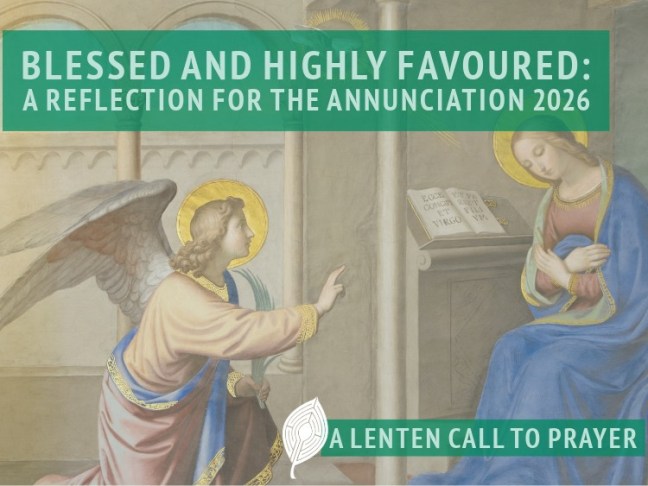
As I mentioned in yesterday’s post, today is the Feast of the Annunciation. It’s a time when our thoughts naturally turn to the Virgin Mary. But when we look at the tradition, most of the things done or said that set Mary apart, are really about setting Jesus apart. We saw that yesterday when looking at the title Theotokos, ‘she who gave birth to God’. The point of that title isn’t really about Mary at all, but to insist that Jesus was God in the flesh, fully divine while also remaining fully human. A similar thing happens today, for the Annunciation is not technically a Marian Feast on the calendar, but a Christ-oriented one. Mary’s role is critical, for obvious reasons, but the focus of our attention is on Jesus. Even as we remember her, she is always pointing us to her son. And so do the prayers for the feast.
My favourite is the troparion, or thematic hymn, from the Byzantine tradition:
Today is the beginning of our salvation,
The revelation of the eternal mystery!
The Son of God becomes the Son of the Virgin
As Gabriel announces the coming of grace.
Together with him let us cry to the Theotokos:
Hail, O Full of Grace,
the Lord is with you!
The hymn reveals its point of view at the very start: The Annunciation is the event that sets the whole Gospel story in motion and reveals “the eternal mystery,” the apocalyptic divine plan hidden from the ages: that God, specifically God the Word, will become human, bringing a new way of grace into the world. And so, we greet Mary, she who gives birth to God, with the same words as the angel Gabriel: “Hail, O Full of Grace, the Lord is with you!”
“Full of grace” is a reasonable translation for the underlying Greek here, but it can be a bit misleading. Gabriel calls her “full of grace” because she has received great grace from God. God has chosen her, graced her, with both the visitation, but also the incredible vocation before her. (As it happens, she is also an incredibly gracious person, so she might also be called ‘full of grace’ in that sense, but it’s not what the angel, or the prayer, is saying here.)
There is a similar double meaning, though with more irony, in the second part of the greeting. “The Lord is with” her because of the angel’s visit. (Remember how all through the Old Testament, angelic visitations were treated as theophanies, appearances of God — think of Abraham at the oak of Mamre, or Jacob wrestling the angel, or Moses at the Burning Bush.) But the Lord is also with her in a literal way, in the form of the foetus growing inside her. (This is where we get poetic reflections on Mary calling her greater than the heavens, since what the heavens cannot contain was held in her womb.)
So then, this short prayer packs a big punch, and it tells us everything we need to know about the feast. It is nothing other than the start of the Gospel story, and Mary is blessed and highly favoured to have been asked to play her role in it, and we are blessed and highly favoured through her humble assent to God’s plan.
 Matthew Root