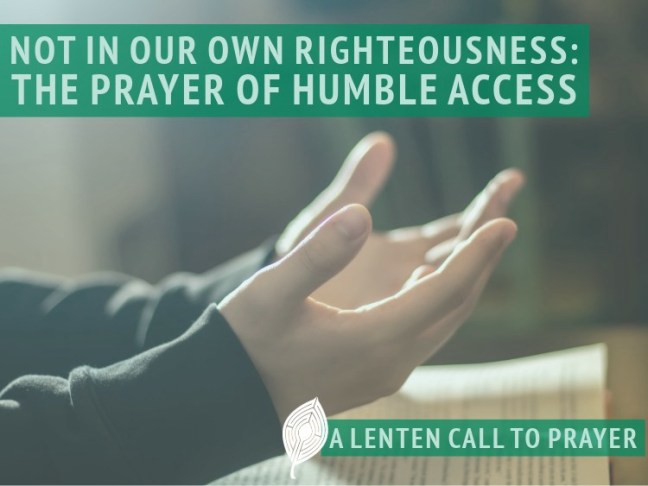
In many churches, the second half the twentieth century was marked by a lot of wrangling and division surrounding liturgy: Whether to update the language, and if so, whether to update the theology of the prayers at the same time. In my own Anglican world, this was particularly divisive and resulted in less of a resolution than a cease-fire. I wrote earlier in the series about having to qualify or push back against some of the theology of old Book of Common Prayer. Today, however, I’ll be defending a BCP prayer so maligned that it was simply removed entirely from the newer liturgical form: the Prayer of Humble Access.
This prayer (and prayers with similar messages in the Eastern and Roman traditions) is prayed right before going up to receive communion and it says:
We do not presume to come to this thy Table, O merciful Lord, Trusting in our own righteousness, But in thy manifold and great mercies. We are not worthy So much as to gather up the crumbs under thy Table. But thou art the same Lord, Whose property is always to have mercy: Grant us therefore, gracious Lord, So to eat the Flesh of thy dear Son Jesus Christ, And to drink his Blood, That our sinful bodies may be made clean by his Body, And our souls washed through his most precious Blood, And that we may evermore dwell in him, And he in us. Amen.
I remember once hearing a (lovely and well-meaning, and deeply pastoral) deacon rail against this prayer from the pulpit as us self-flagellating and groveling to crawl up to communion like worms. It was definitely a memorable sermon! And it was well-intentioned, since this deacon like many in the last century grew up exposed to versions of Christianity that over-emphasized sinfulness and threats of eternal damnation as a means of behaviour control. And so, it’s no wonder that they were highly sensitive to language that emphasizes our sinfulness and lack of worth before God.
But, while I’d prefer a slightly more balanced perspective in the prayer, emphasizing our created dignity before God as those created in God’s image and likeness, for example, there’s absolutely nothing wrong with the prayer as it is. In fact, it’s probably my favourite part about the BCP liturgy. So let’s break it down.
It begins by acknowledging our lack of a right to approach God’s table on our own merits (“trusting in our own righteousness”). So far so good, this is Jesus’ teaching about righteousness 101: no one is perfect and so no one can measure up on their own before God. Every single human person is in the same boat before God: in need of God’s grace, mercy and forgiveness. And that’s right where the prayer goes. We don’t come to the Lord’s table “trusting in our own righteousness, but in [God’s] manifold and great mercies.”
It goes on, echoing the words of the Syro-Phoenician woman: “We are not worthy so much as to gather up the crumbs under Thy table.” Again, nothing in Christianity is about our worth or merit before God, so while it’s a strong statement — as it was for the Syro-Phoenician woman in the story! — it’s not untrue. Everything is about God’s generosity. And again, the prayer goes immediately where it needs to go: “But thou art the same Lord, Whose property is always to have mercy.” Again, the tradition prays what it believes: We believe God is gracious and merciful and loving and so blesses us joyfully and willingly because of God’s own character, not because it’s our ‘just deserts’.
With all this in mind, we pray that we may approach the Table with confidence and receive the sacrament for the transformation of our souls and bodies, so that we might eternally participate in the divine life.
With all due respect to my old deacon friend, I see no groveling here, only a rightful Gospel confidence in God’s love and grace.
The message here, I think, is that praying liturgical prayers — that is, praying with the Church and not just from our own perspective — can prod us in different ways. Sometimes the prayers might open us up to something beautiful we hadn’t thought of before. Other times, they might poke at old wounds or unresolved theological or spiritual baggage. When they do this, it’s important to step back, like we did today, and really see what the prayer is saying — and what it’s not saying. There may be times when we have to agree to disagree with a prayer, but often we’ll find the problem is in our reaction to the prayer more than to the prayer itself.
For today, let us go into the day remembering, with this beautiful prayer, that everything in our life of faith is about God’s grace, and not about us at all.
 Matthew Root
One thought on “Not in Our Own Righteousness: The Prayer of Humble Access”