
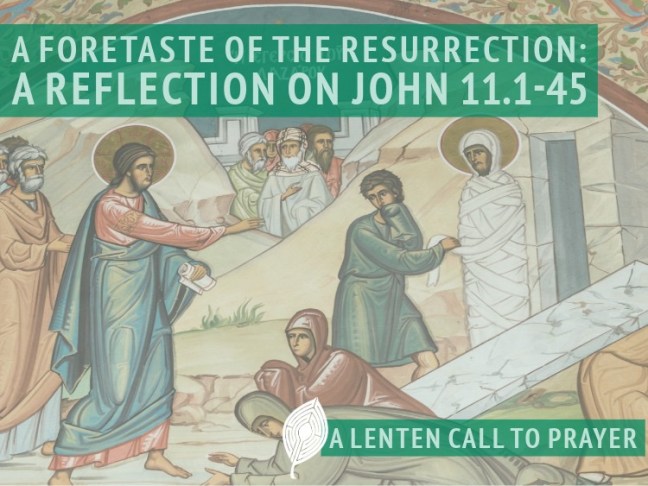
Believe it or not, today marks the last Sunday in Lent. In all Christian liturgical traditions, it’s customary to use the end of Lent (whether in this case the last Sunday within the season, or in the East, the very last day of it, the Saturday before Palm Sunday) to reflect on the story of Lazarus, Jesus’ good friend whom he raised from the dead. The connection between this story and the end of Lent works both in the timeline of the Gospel story (for it’s the last thing Jesus does in John’s Gospel before the events of Holy Week), and thematically in how it foreshadows the themes of death and resurrection of Holy Week and Easter.
This theme of the general resurrection comes through across the hymns and collects associated with this commemoration. Looking at various collects for today, we find such expressions as: “Breathe upon us with the power of your Spirit, that we may be raised to new life in Christ” and “God of compassion, you call us out of the bindings of death on this, our resurrection day.” And the Eastern Orthodox troparion for the joint feast of Lazarus Saturday & Palm Sunday echoes this theme before linking it directly with the people’s response to Jesus as he entered Jerusalem:
By raising Lazarus from the dead before your passion,
You confirmed the universal resurrection, O Christ God.
Therefore we also, like the children, carry the banners of victory,
And we cry out to you, O Vanquisher Of Death:
Hosanna in the highest!
Blessed is He that comes in the name Of the Lord!
The thing to remember about all this is that the raising of Lazarus is only a foretaste and foreshadowing of the real resurrection. For Jesus raised Lazarus back to our normal everyday life of toil and troubles within the kingdoms of this world. The resurrection to come, ushered in by Christ’s own resurrection at Easter, is the real show, resurrection into the new life of God’s Kingdom. But that doesn’t make the raising of Lazarus any less impressive or beautiful — especially to his sisters Mary and Martha, who would likely have been left both emotionally and materially bereft after their brother’s death. The fact that his resurrection here is a symbol of things to come does not make its impact any less important in the moment. The sign should not overwhelm what it signifies here.
And that’s why my favourite of the hymns and prayers from the day is actually a relatively new one, from the Church of England’s Prayers for an Inclusive Church. It reads:
God of all consolation,
your Son comforted the grieving sisters, Martha and Mary,
for your breath alone brings life to dry bones and weary souls.
Pour out your Spirit upon us,
So that we may face despair and death
with the hope of the resurrection and faith
in the One who called Lazarus forth from the grave.
Amen.
Just as we saw the other week with the Prayers for the Dead, Christianity takes death very seriously, but also understands that death does not have the last word. Therefore any setbacks, disappointments, losses, and mourning that we experience are likewise not the last word. They’re real — hope in the resurrection does not undo them; this is no spiritual bypassing. But, we believe, they must be framed within our faith that life will ultimately prevail, and not just life but life eternal — life marked by God’s Kingdom peace, love, and wholeness.
But for now, as we await that day when it all comes to fulfillment, we can hope to be consoled with Mary and Martha and “face despair and death with the hope of the resurrection.”
By raising Lazarus from the dead before your passion,
You confirmed the universal resurrection, O Christ God.
Therefore we also, like the children, carry the banners of victory,
And we cry out to you, O Vanquisher Of Death:
Hosanna in the highest!
Blessed is He that comes in the name Of the Lord!
 Matthew Root