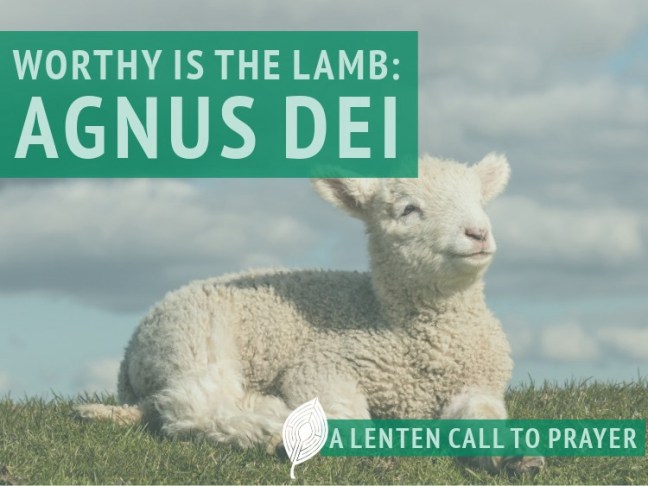
These past few days, in reflecting on prayers from the Eucharistic liturgy, a common theme has been preparing us for an encounter with God’s glory. The various Anaphorae all tell the Christian story in a way that builds up to the dramatic summoning of the Holy Spirit to transform the bread and wine, but also the gathered community; the Eastern rite’s Cherubic Hymns put us in the place of the angels in God’s presence; and the Sanctus and Benedictus give that angelic worship a notably Christological but also apocalyptic spin. The prayers are bold and dramatic, and if we give them their due, awe-inspiring — “Let all mortal flesh keep silence!” But the Western liturgical tradition, right before the distribution of Holy Communion, changes the tone significantly, praying a a simple threefold prayer known as the Agnus Dei, or ‘O Lamb of God:’
Lamb of God, you take away the sin of the world, have mercy on us.
Lamb of God, you take away the sin of the world, have mercy on us.
Lamb of God, you take away the sin of the world, grant us peace.
We’ve previously seen in this series, how prayers the use of the sheep metaphor to describe us, as “the sheep of [God’s] hand,” who should be attuned to hear and obey God’s voice, and as “lost sheep” who habitually do not do so. So what’s with its use here to describe Jesus at one of the most important moments in the Eucharist?
The title “Lamb of God” for Jesus comes from John 1.29, when John the Baptist sees him and declares: “Behold the Lamb of God who takes away the sin of the world!” As I’ve previously noted, we would do well to rid ourselves of ritual sacrificial imagery here, since the killing of sheep was not associated with the removal of sin in the Jewish sacrificial system. Rather, the image seems more strongly associated with Isaiah’s Suffering Servant:
He was oppressed and afflicted,
yet he did not open his mouth;
he was led like a lamb to the slaughter,
and as a sheep before its shearers is silent,
so he did not open his mouth.
By oppression and judgment he was taken away.
Yet who of his generation protested?
For he was cut off from the land of the living;
for the transgression of my people he was punished. (Isaiah 53.7-8)
The image is of God’s faithful Servant being like a lamb led to slaughter: The focus is not ritual sacrifice, but the innocence and vulnerability of the one killed. Bringing the image to mind here at this moment of heightened liturgical expectation is fitting because, in the Christian way of thinking, the way of genuine glory is always the humble, self-sacrificial way of the Cross. This has been a common theme this winter here, but it’s true. The only genuine theology of glory in Christianity is a theology of the cross. It is only the Lamb who was slain who is “worthy… to receive power and wealth and wisdom and might and honour and glory and blessing!” (Revelation 5.12).
The prayer itself is simple, “have mercy on us” the first two times, and “grant us peace” the third. This is a common use of the literary “rule of three,” where the twist that breaks up the repetition calls our attention to the meaning. Again, we pray here what we believe. It is not “God you are awesome in your power and rightfully indignant at our behaviour, but please have mercy on us anyway” but “God we know you are merciful, so please in your mercy have mercy on us.” “God we know your heart is for the peace that is not just the absence of violence but the presence of healed and whole, reciprocal, and life-giving relationships, so in your peaceable Kingdom, grant us this peace.”
I for one can’t think of a better set of truths and prayers to bring to mind as we complete our preparations to receive the sacrament.
Lamb of God, you take away the sin of the world, have mercy on us.
Lamb of God, you take away the sin of the world, have mercy on us.
Lamb of God, you take away the sin of the world, grant us peace.
 Matthew Root