
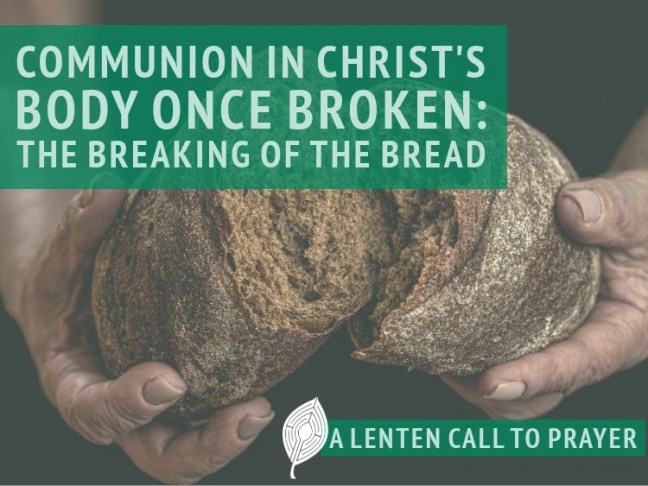
The Eucharist is a rite full of symbolism, to the extent that any and every act within it can take on added meaning. This is true for even the most practical actions, like the breaking of the bead. Just as we saw with the Eucharistic Prayers, in contemporary times, this is a place where my church, the Anglican Church of Canada, incorporates some diversity. It includes four general prayers for the breaking of the bread, and four seasonal ones (for Advent, Christmas, Lent, and Easter respectively).
These prayers come in the form of a dialogue between the celebrant and the congregation, quoting one of many Scriptural references to bread. For example, the most commonly used one goes like this:
Priest: “I am the bread of life,” says the Lord. “Whoever comes to me will never be hungry; whoever believes in me will never thirst.”
All: Taste and see that the Lord is good; happy are they who trust in him!
The priest’s part here is taken directly from John 6.35 and the response from Psalm 34.8. But that isn’t the prayer I’d like to focus on today. Rather, I’d like to reflect, appropriately enough, on the prayer marked out for Lent:
Priest: We break this bread:
All: Communion in Christ’s body once broken.
Priest: Let your Church be the wheat which bears its fruit in dying.
All: If we have died with him, we shall live with him; if we hold firm, we shall reign with him
I like this prayer because it shows the symbolic, meaning-making possibilities inherent in the rite. The action is simple and practical — breaking bread — but it also reminds us that Christ’s body was broken for us (”But he was wounded for our transgressions, crushed for our iniquities” (Isaiah 53.5)). We also remember that our calling as Christians is to live in solidarity with him and his ways. So the priest exhorts the gathered community to “be the wheat which bears its fruit in dying,” quoting Jesus in John 12.24. To this the congregation responds with the words of promise from 2 Timothy 2.12: If we truly die with him — if we live in solidarity with his self-sacrificial death — then we will also be resurrected with him. And if we are persistent and resilient in this, then “we shall reign with him.” These are powerful words, but can also be taken woefully out of context. Again it’s a question of the ways of the kingdoms of this world and their theology of glory, which grasps after power and domination and predatory wealth, or the Kingdom of God and the theology of the cross, of which Jesus is the revelation and example. The only true way to reign with Christ, the prayer reminds us, is to persist in his humble, healing way.
These are beautiful words, perfect not only during this Lenten season, but as we go about our daily life.
Taste and see that the Lord is good;
happy are they who trust in him!
 Matthew Root