
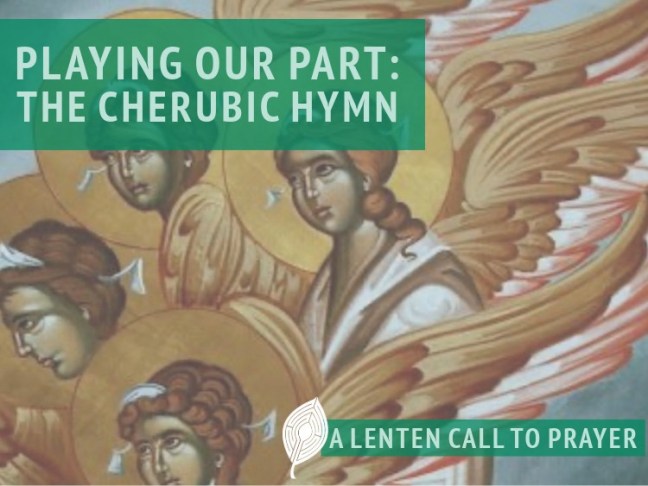
If it is true that the older Eucharistic liturgies essentially play-act the Gospel, it is fair to wonder what role we as the gathered community play in this piece of sacred theatre. For, contrary to what more contemporary worship expressions may lead us to believe, the congregation is not intended to be the ‘audience’, but an active participant in the action.
At the second, ‘Great’ Entrance in the Byzantine rite, our role is called out explicitly in what is known as the Cherubic Hymn. As the gifts (i.e., the bread and wine) are processed through the congregation up to the altar, representing Jesus’ arrival in Jerusalem for his Passion, the congregation sings a hymn comparing us to the angels worshiping before God’s throne. St. John Chrysostom, preaching around the turn of the fifth century, spoke of this association between the congregation and the angels as an existing tradition even in his own day:
On high, the armies of angels give glory; below, people, standing in church forming a choir, emulate the same doxologies. Above, the Seraphim declaim the thrice-holy hymn; below, the crowd of people sends up the same. A common festival of the heavenly and the earthly is celebrated together; one Eucharist, one exultation, one joyful choir. (Homily on Isaiah 6, from Patrologia Graeca 56 col 97)
By ‘thrice-holy hymn’, he is referring to the scene in Isaiah 6 where the angels sing “Holy! Holy Holy!” at God’s throne, a hymn sung as part of Christian Eucharistic rites from as far back as we know, and which we’ll look at more tomorrow.
With all this in mind, it’s no surprise that the Eucharistic llturgy attributed to St. John Chrysostom picks up strongly on this motif:
We who mystically represent the Cherubim,
And who sing the thrice-holy hymn,
To the Life-Giving Trinity
Let us now lay aside all earthly cares,
That we may receive the King of all,
Escorted invisibly by the angelic orders.
Alleluia!
Why the tradition replaces the Seraphim of Isaiah 6 with Cherubim here is lost to time, but likely a substitution of one type of angel with another that the Church didn’t think too much about. At any rate, here we see that we the faithful are said to “mystically” or, “in a mystery” represent the hosts of angels worshiping at God’s throne. It should be noted that this is strong and technical vocabulary in Greek, where ta mysteria is the name for what in the West came to be called the sacraments. In our act of worship, it’s saying, we ourselves become a kind of sacrament, something tangible through which we might know and experience God.
Because we are in this sacramental space, it then reminds us to “lay aside all earthly cares,” all those concerns and distractions of everyday life — as real and important as they may be. Why? “That we may receive the King of all.” We are preparing ourselves to receive the presence of God, not only in our midst, but through the sacramental bread and wine, into our very bodies. A great and holy Mystery indeed! The Cherubic Hymn sung at the Liturgies of St. James and St. Basil goes even further here, exhorting:
Let all mortal flesh keep silent,
and stand with fear and trembling,
and in itself consider nothing earthly,
For the King of kings and Lord of lords
comes forth to be sacrificed,
and given as food to the believers; […]
So, then, these prayers may be short and simple, but they are deceptively so. For they are also rich in their message, not just theologically but spiritually too. By calling forth the Mystery in which we are about to participate, they tell us it’s time to set aside any distractions, to focus, and silence our mouths and minds alike so we may participate as fully and worthily as possible.
We who mystically represent the Cherubim,
And who sing the thrice-holy hymn,
To the Life-Giving Trinity
Let us now lay aside all earthly cares,
That we may receive the King of all,
Escorted invisibly by the angelic orders.
Alleluia!
 Matthew Root
3 thoughts on “Playing Our Part: The Cherubic Hymn”