
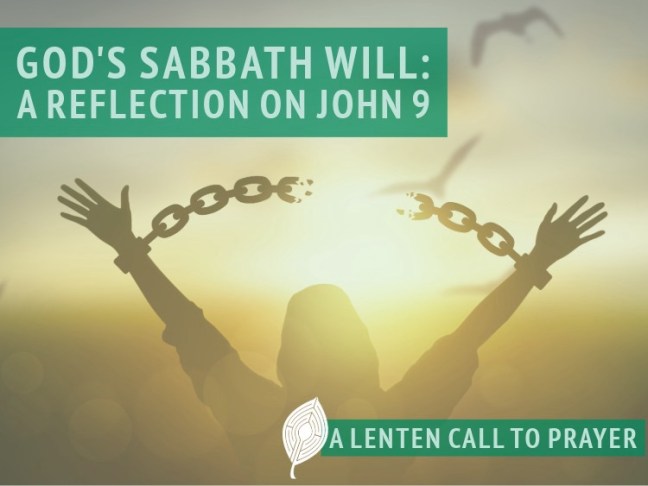
The other year when I was writing my series on the Sermon on the Mount, an idea that came up was that Christianity is an anti-religion. That is to say, religion as a phenomenon seems to tend towards behaviour-control, legalism, finger-pointing, and self-righteousness. This seems like something of a built-in default setting in our bruised and battered world. But the Gospel teaches against all this and flips the ‘normal’ ways of religion inside out and on their head — it is the poor not the rich who live in God’s favour, it is in the cross not glory where God is revealed, righteousness is about how we treat others not fulfilling some divine to-do list, and on and on and on. But so deeply ingrained is the way of ‘religion’ in us, that it remains a deep trap that many Christians fall into with ease.
We see the battle between ‘normal’ religion and the Gospel play out in today’s reading from John 9, the story of Jesus healing the man born blind. Most of you will know the story. While walking on the Sabbath, Jesus and his disciples see a man born blind, and they ask Jesus, from their ‘good religious sensibilities’, whether the man’s condition was a punishment for his parents sins or his own. This finger-pointing, victim-blaming mentality is alive and well in our own day. Take, for example, the so-called Prosperity Gospel movement, which claims that if you are poor or sick, it is because of some unconfessed sin or a lack of faith. But, Jesus doesn’t play those games, then or now. He rejects the disciples’ premise entirely:
Neither this man nor his parents sinned; he was born blind so that God’s works might be revealed in him. We must work the works of him who sent me while it is day; night is coming when no one can work. As long as I am in the world, I am the light of the world (John 9.3-5)
The disciples and their religious sensibilities see a blind man and leap to finding an explanation other than the obvious — that sometimes, people are just born blind. Jesus sees a blind man and with this anti-religious sensibilities leaps to finding ways of alleviating his burden. He heals the man (in a rather gross object lesson of smearing mud made from dirt and spit over his eyes), who is then able to see for the first time.
But, when people bring the formerly blind man to the Pharisees for inspection, the conflict continues. For them, the question was not the cause of the man’s blindness, but Jesus’ decision to heal him on the Sabbath, and that question divides them: To some, Jesus’ act had to have been bad because he ‘broke’ the Sabbath to do it; but others balk, rightly understanding that a healing like this cannot be sinful (9.16). Again it’s a question of religion and anti-religion. The religious sensibility focuses on the letter of Law; Jesus’ anti-religion focuses on its spirit and intention. The Sabbath was meant to be a blessing and a joy, a lifting of burdens; turning it into a list of what can and cannot be done ends up being almost as burdensome as the toil of daily life — the opposite of God’s intention for it.
In looking for prayers to reflect on about this story today, I stumbled across a more recent Collect approved for use in the Church of England. It captures the spirit of this story perfectly:
Creator and Healer,
you work your Sabbath will
in the chaos of our life:
teach us the insight that gives true judgement
and praises you wherever you are found,
making miracles from spit and mud;
through Jesus Christ, the Son of earth. Amen.
I love the phrasing of God’s “Sabbath will.” What is God’s Sabbath will in the world? Rest and eased burdens, for humanity, livestock, and the land itself. And in the concept of the Jubilee year, which was ‘the Sabbath of Sabbaths’, we can add to God’s Sabbath will emancipated slaves, forgiven debts, and redistributed lands — this is a great healing or ‘wholing’ of society that is a far greater ‘work’ than healing a blind man! But that is God’s Sabbath will in the chaos of human life.
And yet it’s so easy for us to reject the goodness before our eyes because it doesn’t behave in accordance with our preconceptions and rules. And so we are right to pray for “the insight that gives true judgment and praises [God] wherever [God] is found,” working surprising everyday miracles in the most unexpected ways.
May our eyes always be opened to God’s Sabbath will.
 Matthew Root