
I mentioned the other day that for several centuries, Morning Prayer became the normal form of Sunday morning worship in much of the Anglican world. Trying to go back to the more traditional, Eucharistically-focused model of worship, sparked an inevitable backlash — though an ironic one, since the move towards the more traditional model was accused of novelty and betraying tradition! But that’s how traditionalism — versus tradition — works: it’s a fixation on one’s own reconstruction of the past. I once encountered the remnant of this during a Christian Education session at my parish church on the main services of Anglican worship. Someone put up their hand asking why the Anglican Church had ‘betrayed its identity’ by abandoning Morning Prayer. I framed my answer in terms of restoring an older and biblically-warranted tradition, and asked her what specifically she missed about the service. She said she liked it because it has the strongest prayer of confession. It certainly wasn’t the answer I was expecting, but I answered “Well the good news is that Morning Prayer is designed for private worship, so you can pray it whenever you want!” I meant it earnestly, but I admit it she did not find it any consolation! At any rate, over a decade later and I still think of her whenever I come across this prayer.
So what was all the fuss about? Let’s take a look:
Almighty and most merciful Father,
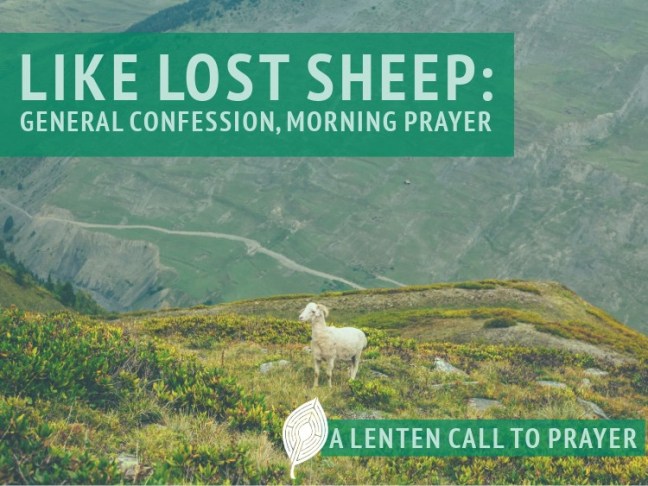
We have erred and strayed from thy ways like lost sheep,
We have followed too much the devices and desires of our own hearts,
We have offended against thy holy laws,
We have left undone those things which we ought to have done,
And we have done those things which we ought not to have done;
And there is no health in us.
But thou, O Lord, have mercy upon us, miserable offenders.
Spare thou them, O God, which confess their faults.
Restore thou them that are penitent;
According to thy promises declared unto mankind in Christ Jesu our Lord.
And grant, O most merciful Father, for his sake,
That we may hereafter live a godly, righteous, and sober life,
To the glory of thy holy Name.
Amen.
This is certainly a strongly-worded prayer! I can understand why those who grew up with it would find the prayers of confession from the Eucharistic liturgies weak in comparison. It was also front and centre in the Book of Common Prayer Morning Prayer service, prayed even before the Inivatory (the Venite, Jubilate, etc.). This was a Church that made a point (or at least a performance) of taking sin seriously!
The prayer begins with the sheep metaphor we looked at the other day: There it is reinforced that we are the sheep of God’s flock and should therefore be attuned to God’s voice. Here we accept and admit that the opposite is true: We have not followed God’s voice, but have followed “the devices [that is, plans] and desires of our own hearts,” and have therefore “erred and strayed,” through sins of omission and commission alike (”we have left undone those things which we ought to have done, and we have done those things which we ought not to have done”). It concludes, in words that would have made the Calvinist contingent of early Anglicanism proud, “there is no health in us.”
This is the kind of language that turns off a lot of people. It’s so extreme that it seems to miss the very human inner complexity and conflict most of us experience, and which Paul expressed so memorably: “I do not understand my own actions. For I do not do what I want, but I do the very thing I hate” (Romans 7.15). Now, while I don’t find the language of being wholly unhealthy particularly helpful or representative of either the Bible’s teaching or human psychology, I also don’t think it’s necessarily wrong. In the interest of “normalizing sin without minimizing it,” I think it’s undeniable that in a world as complex and messy as ours, with competing claims on our time and attention, to say nothing of living within an economic system that is inherently exploitative, it’s very hard to conceive of any act that is not in some way sinful, that doesn’t break faith with some relationship with God or neighbour. And so in this way I can accept the prayer’s melodramatic language. As so many of us trying to manage health concerns can attest, wanting to be healthy and even making big changes to lifestyle in order to become healthy, do not always make us healthy. Especially in a sick world. (That is my more Eastern, ‘jam-hands’ theory of sin way of accepting the language; the prayer is obviously grounded in the Western understanding of Original Sin, for which the wording here is not melodramatic at all but a simple statement of fact.)
At any rate, lest we falsely accuse this prayer of being obsessed with sinfulness and wickedness, as strong as its language about sinfulness is, it then moves on to equally strong statements about God’s mercy, grace and forgiveness. It asks God, “according to [God’s] promises” in and through Jesus, to have mercy, sparing us from any punishment, and restoring us fully in relationship with God. It concludes with a final request that God empower us to “live a godly, righteous, and sober [i.e., responsible, clear-minded] life.”
So while I don’t love all of the language of this prayer, as a whole it offers a balanced perspective on both sin and salvation. Yes we accept and admit that we have missed the mark, “erred and strayed” like the inattentive sheep that we are. And this has real, negative, and lasting consequences on the world around us. But we also accept and trust that God is gracious and quick to forgive and delights in giving us the insight, skills, and strength we need to do better next time.
 Matthew Root
3 thoughts on “Like Lost Sheep: General Confession, Morning Prayer”