
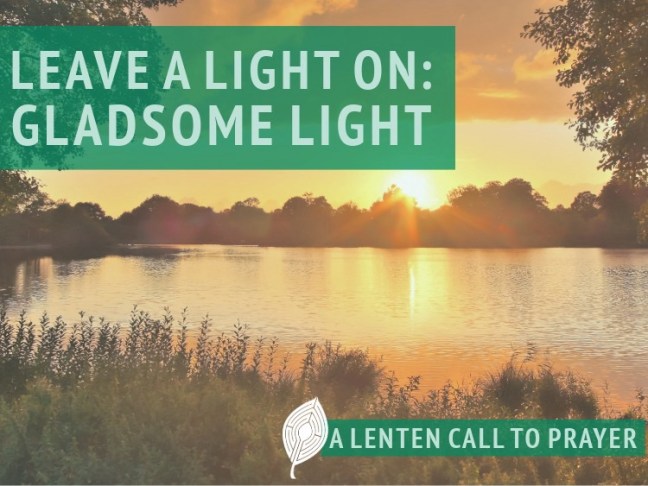
Anyone who takes a lot of photos knows all about Golden Hour. It’s that time just before sunset (or after sunrise) when the light turns soft and warm, and hits everything at just the right angle to transform even the most ordinary object into something beautiful. At Golden Hour, the world seems a little bit gentler, filled with possibility, and just a little bit of magic.
To me, there’s an ancient prayer that captures all of this beautifully. It’s known as Gladsome Light (or sometimes by its Greek name Phos Hilaron) and is sung during Vespers when the lamps are lit and the lights turned on. One of the earliest extra-biblical hymns known and still regularly prayed by Christians, its singing was considered an ancient tradition of the Church even in the fourth century (per St. Basil of Caesarea). The funny thing is, content-wise, the hymn doesn’t say that much. Today I’d like to reflect briefly on what it says, means, and why perhaps it has stayed around as long as it has.
The words of the prayer are as follows:
O Gladsome Light of the holy glory of the Immortal,
Heavenly, Holy, Blessed Father, O Jesus Christ:
Now that we have come to the setting of the sun and behold the light of evening,
We praise God, the Father, the Son, and the Holy Spirit.
At all times You are worthy of praise and song,
O Son of God and Giver of life.
Therefore, all the world glorifies You.
It’s a prayer offered to Jesus, riffing off of passages like John 8.12 which identify him as “the Light of the world.” Here this light is described in terms of its source: it is the very divine light of God’s holy glory — which shrouded Moses at Mt. Sinai, which filled the Temple, and so on. God is then described as “the Immortal, Heavenly, Holy, and Blessed Father.” Without going into details, we’re clearly focusing on God’s transcendence here. God the Father is infinite and transcends not only our lives, but even our very conceptions of what God might be like. And yet, the prayer reminds us, God’s light has shone out into all the world in and through Jesus.
This divine light is called “gladsome,” which is hardly an obvious English word. Other translations have tried such diverse options as “gladdening,” “gentle,” “joyful,” “gracious,” and “radiant.” The underlying Greek word, ilaron, had two connected meanings. First is the sense of “merry, cheerful, propitious,” and then, by metaphorical extension it was used to describe the play of light off of shiny surfaces like water or gold, so “shimmering, gleaming.” We might find a similar metaphor at play (though of reverse provenance) in the English use of ‘sparkling’ in “She has a sparkling personality.”
The rest of the prayer is pretty basic, essentially saying we praise God because God is worthy of praise.
So why then is it so popular? I have two thoughts on why this might be.
First, the double sense of ilaron makes the guiding metaphor of the prayer simply delightful. It just sort of fits how many of us see the presence of Jesus in the world and in our lives. He is Light, and, while light can certainly illuminate things that would prefer to stay in darkness, for most of us, and in most of the stories of the Gospels, Jesus illuminates in a gentle and playful way. We might think of the Samaritan woman at the well, or the Syrophoenician woman with the sick daughter, or his encounters with Nicodemus and Zacchaeus, his teasing of Simon (whom he nicknames Rocky because he’s simultaneously solid and hardheaded), and the brothers James and John (whom he nicknames “the Thunderboys” for their overenthusiastic desire for God to smite their perceived enemies). Like the light at Golden Hour playing off the sea, there is something about God’s revelation in and through Jesus that sparkles in our hearts and minds. (For those of us who are theology geeks, all of this ties in beautifully with the Eastern Christian doctrine of the energies of God, but I doubt that has much say in the hymn’s mass popularity!)
And second, there’s something very powerful about singing this hymn at the lighting of lamps. As it was described to me, the original tradition was that the lamps of the church would all be lit from the Christ candle (kept lit all year from Easter to Holy Week), and from these the faithful would light candles or lamps to bring home with them, so that the light that would help them navigate the darkness and illuminate their homes would always come from the Christ candle. Regardless of how widely this tradition was actually kept, the sentiment behind it is pretty spectacular! It turns lamplight from being a simple necessity into an icon, if not a sacrament, a tangible way of experiencing God’s grace.
Either way, it’s a beautiful hymn, and it makes me smile whenever I get the chance to pray it.
O Gladsome Light of the holy glory of the Immortal,
Heavenly, Holy, Blessed Father, O Jesus Christ:
Now that we have come to the setting of the sun and behold the light of evening,
We praise God, the Father, the Son, and the Holy Spirit.
At all times You are worthy of praise and song,
O Son of God and Giver of life.
Therefore, all the world glorifies You.
 Matthew Root
2 thoughts on “Leave a Light On: Gladsome Light”