
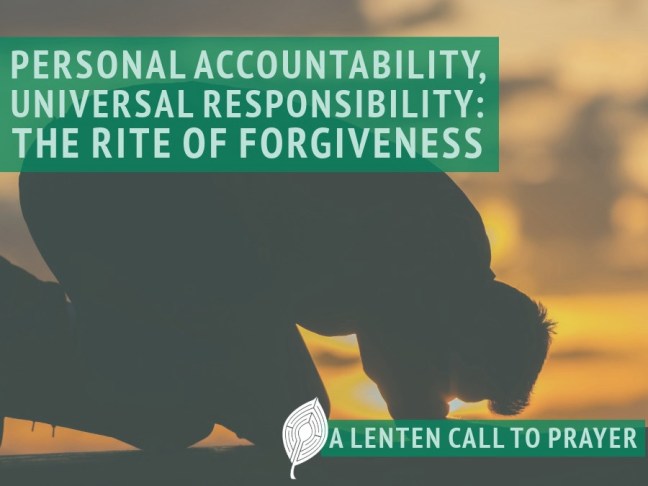
As long-time readers will know, I spent a number of years in the Eastern Orthodox Church. And while it was not sustainable for me to remain in that tradition, its liturgical, spiritual, and theological sensibilities shaped me significantly, and in many ways my heart still beats to its rhythms. One of its rituals I miss the most is the rite of forgiveness, with which it marks the start of Lent. During a Sunday evening Vespers service, every one present prostrates themselves before every one else, individually, and asks for forgiveness in a ritualized, but no less real, exchange:
“Forgive me, a sinner.”
“God forgives.”
Often people are a little shocked when they first encounter this ritual. After all, why should I ask forgiveness from someone I may have never met, let alone sinned against? But the truth behind the rite is that we are all, in big or small ways, responsible for all of the sin in the world, and so have sinned against every person in the world. This may sound dramatic and self-flagellating, but it couldn’t be further from that. It’s a result of the Eastern Church’s understanding of sin, which I like to call the “jam hands theory.” Unlike the West’s dominant theology of sin, which holds that Adam’s sin fundamentally deformed the human condition rendering us all guilty before we’re born, the jam hands theory posits that — just like how a toddler somehow manages to cover not only himself, but you, and everything in the house in jam, rendering everything and everyone sticky — Adam and Eve’s primordial sin made the world sticky and we can’t help but become sticky by contact with it. Then of course we make everything we touch sticky too. In this way, as people who can’t help but perpetuate sin in the world, we are responsible for it.
To my mind, this idea has been nowhere better expressed than in Fyodor Dostoevsky’s The Brothers Karamazov, in the Elder Zossima’s deathbed speech. Addressing a group of monks, but with a message anyone who seeks out the life of faith could use to hear, he says:
Love one another, Fathers … Love God’s people. Because we have come here and shut ourselves within these walls, we are no holier than those that are outside, but on the contrary, from the very fact of coming here, each of us has confessed to himself that he is worse than others, than all men on earth. And the longer the monk lives in his seclusion, the more keenly he must recognise that. Else he would have had no reason to come here. When he realises that he is not only worse than others, but that he is responsible to all men for all and everything, for all human sins, national and individual, only then the aim of our seclusion is attained. For know, dear ones, that every one of us is undoubtedly responsible for all men — and everything on earth, not merely through the general sinfulness of creation, but each one personally for all mankind and every individual man. This knowledge is the crown of life for the monk and for every man. For monks are not a special sort of men, but only what all men ought to be. Only through that knowledge, our heart grows soft with infinite, universal, inexhaustible love. Then every one of you will have the power to win over the whole world by love and to wash away the sins of the world with your tears. Each of you keep watch over your heart and confess your sins to yourself unceasingly. (Part 2, Book IV, Chapter i)
We can take on this sense of responsibility not because we’re self-loathing, but because we know we are loved and forgiven by God. That’s why the response is not “I forgive you,” but “God forgives.” It is a fundamental, foundational belief of Christianity that God is not stingy with forgiveness, but delights in it, and longs only for us to pass it on and extend it with others. As Luke puts it:
Be merciful, just as your Father is merciful. Do not judge, and you will not be judged; do not condemn, and you will not be condemned. Forgive, and you will be forgiven; give, and it will be given to you. A good measure, pressed down, shaken together, running over, will be put into your lap; for the measure you give will be the measure you get back.’ (Luke 6.36-38)
This is God’s pay-it-forward economy of grace. And it’s the inverse of the jam-hands theory of sin. The more we receive God’s grace and give grace to others, the less sticky we, and the whole world by extension, will be.
Both halves of this equation are true. I am responsible for the sins of the world. I am beloved and forgiven by God. And you are too.
So with all this in mind, brothers and sisters, forgive me a sinner.
 Matthew Root
One thought on “Personal Accountability, Universal Responsibility: The Rite of Forgiveness”