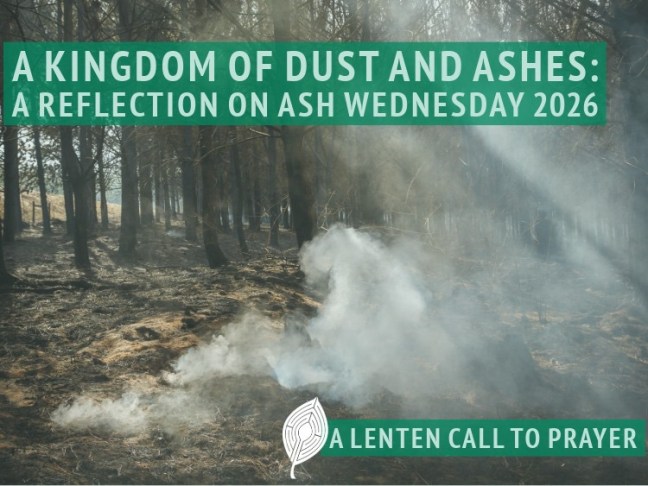
A recurring theme here lately has been the contrasts between the kingdoms of this world and their theologies of glory on the one hand, and the kingdom of God with its theology of the cross on the other. Nowhere does Christianity’s theology of the cross come to the fore more than in the Western Christian tradition of Ash Wednesday, which we celebrate today. This claim may be a bit jarring — after all, Holy Week and Good Friday exist. But during that week, we walk alongside Jesus as he journeys to his cross. But today is the day when we are most confronted by our own crosses, and what it truly means to carry them in our own world.
We commemorate Ash Wednesday with calls to repentance and humility, and against performative displays of piety, in our readings, but also with the imposition of ashes, one of our tradition’s most striking and symbolic rituals. Ashes are a powerful symbol: of impermanence, of destruction and decay, and therefore of finiteness and humility. When the priest marks our foreheads with ash (in the sign of the cross no less) with the words, “Remember you are dust, and to dust you shall return,” we feel it in our bones. It’s not just a memento mori, a recollection of death, though it certainly is that. It’s also a reminder of our smallness compared to God, and, in our scientific times, a reminder that the stuff we are made of has taken many forms over the vast reaches of time.
When I was thinking about what I wanted to write about this Lent — which is no small decision since my tradition here in recent years has been to write short daily posts for the whole season — what came to mind was Lent as a call to prayer, and reflect upon one of the Church’s great prayers every day. With that spirit in mind, I can think of no better way to start off Lent than the prayers over the ashes. In my Anglican tradition, the rite begins with an invocation to the gathered community:
We begin our journey to Easter with the sign of ashes, an ancient sign, speaking of the frailty and uncertainty of human life, and marking the penitence of the community as a whole. I invite you therefore, in the name of the Lord, to observe a holy Lent by self-examination, penitence, prayer, fasting, and almsgiving, and by reading and meditating on the word of God. Let us kneel before our Creator and Redeemer.
Then the priest prays:
Almighty God, from the dust of the earth you have created us.
May these ashes be for us a sign of our mortality and penitence,
and a reminder that only by your gracious gift are we given eternal life;
through Jesus Christ our Saviour. Amen.
We often think of taking up our crosses as involving the major arenas of our wrestling with life and God — illness, caregiving responsibilities, social stigma or marginalization, poverty, a difficult trajectory in character growth, or career growth, and so on — but these prayers zoom out to the realm of the universally human: the crosses of finiteness, embodiment, and mortality and the feelings of powerlessness that so often come with them. The liturgy specifically refers to the crosses of frailty and uncertainty, mortality, and penitence, and to self-examination, repentance, prayer, fasting, almsgiving, Scripture reading and meditation as the faithful response to them. But through this, they insist, we will receive God’s grace and come to experience “eternal life,” which in the Christian imagination is not just some inexpressible life forever with God after death, but also access to that divine life in the here and now to help us get through what the kingdoms of this world throw our way.
And so, as we pick up our crosses daily and follow Christ, especially this Lent, may we think of this ritual and these prayers and remember that we are dust and to dust we will return. And may we “throw off everything that hinders and the sin that so easily entangles. And let us run with perseverance the race marked out for us” and faithfully carry our crosses and embody God’s gracious gift of the life of the age to come. Amen.
 Matthew Root
2 thoughts on “A Kingdom of Dust and Ashes: A Reflection for Ash Wednesday 2026”