
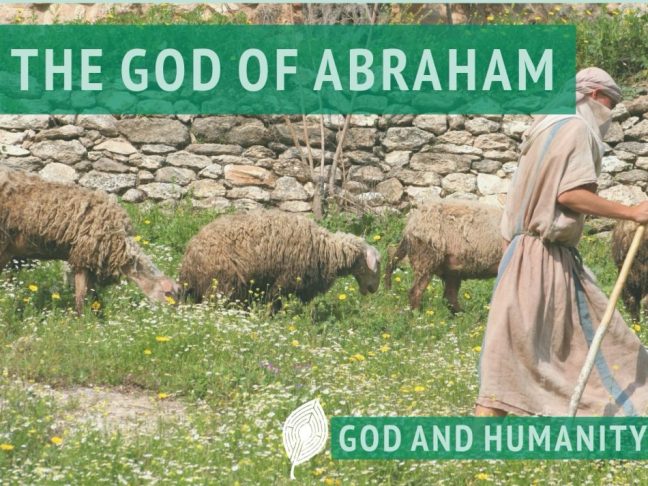
The premise of this series is that the Scriptures describe the relationship between God and humanity not in flat or universal terms, but like any real relationship, as one that changes over time. As the people came to know God better over the centuries, and as they came to see the world differently because of their experiences, their relationship with God evolved. Last time, we looked at the creation stories in Genesis 1-3, which offer a beautiful vocation for all humanity, but end with battered relationships with all around. The next few chapters show a God who keeps trying to make fresh starts with humanity, and humanity consistently messing them up. These primordial stories, or myths, take place in prehistory and set the stage for all that comes next. Today we enter more historical times, and look at what the Scriptures consider to be the decisive fresh start, in the nomadic pastoralist known first as Abram, and later as Abraham.
Before we begin, we have to deal with some assumptions about the text itself. While what primarily interests me are the canonical forms of the stories, these forms bear the marks of a long process of development and editing. While Genesis probably took its final form some time around the 5th-6th C BCE (e.g., a late date required by the clear Neo-Babylonian influences on the Genesis 1 story), some pieces seem to date to the monarchy period (e.g., Abram’s homeland is called “Ur of the Chaldeans,” a group that did not migrate into the region around Ur until the 9th C BE), and the stories themselves seem to reflect living conditions of the mid-second millennium BCE, while purporting to be about figures from the early second millennium. Moreover, as we saw in our Genesis 1-11 series, this editing process often chose to include parallel versions of an event side by side, rather than trying to harmonize them, which introduces discrepancies in the details of the bigger narratives.
With all this in mind, the best guess at this time seems to place Abram/Abraham some time in the first half of the second millennium BCE (that is, somewhere between 2000-1500 BCE), in the ancient Mesopotamian city of Ur (well before it was ‘of the Chaldeans’). He is first introduced in the genealogies that bridge the primordial stories of Genesis 1-11 with the patriarchal narratives of Genesis 12-50. There we learn the basics of his story: the names of his family, the detail that his wife Sarai was barren, and that his father took them out from Ur, travelling along the fertile crescent, with the goal of settling in Canaan, though they stop in what is now southeastern Turkey, at a place called Ḥarran.
This basic outline is expanded on in the subsequent chapters, and crucially for our purposes, it’s here where God comes into the story. Where Genesis 11 views the family’s migration as a decision made by Abram’s father, Genesis 12 frames it as the result of a calling from the God YHWH (‘the LORD’) to Abram himself:
Now the LORD said to Abram, ‘Go from your country and your kindred and your father’s house to the land that I will show you. I will make of you a great nation, and I will bless you, and make your name great, so that you will be a blessing. I will bless those who bless you, and the one who curses you I will curse; and in you all the families of the earth shall be blessed.’ (12.1-3)
The next couple chapters show Abram’s migration into the land, with various repetitions of YHWH’s promises and Abram building altars to YHWH at various locations along the way.
As a side note, but an important one, this identification of Abram’s God with YHWH is almost certainly part of the later editorial process. The best evidence available suggests YHWH worship originated in the northwest Arabian desert, somewhere around Mt. Seir, and did not arrive in Canaan (to say nothing of Abram’s native Mesopotamia) until the mass cultural turmoil of the Bronze Age Collapse of the 1100s BCE, hundreds of years after after Abram’s death. After a period where YHWH was a local god subservient to the Canaanite high god El (a remnant of which tradition seems to be found in Deuteronomy 32.8-9, where Elyon (one of the epithets of El) apportions the peoples of the world to the various gods and and offers Israel to YHWH as his portion), eventually YHWH and El became assimilated. This hypothesis is supported by the ‘doublet’ stories in the Hebrew Bible, which generally include one referring to God as some variation of El (Elohim, El-Elyon, El-Shaddai), and one from the YHWH (or ‘Yahwist’) tradition. Far from just being the result of recent scholarly theorizing, the assimilation of El and YHWH is actually described outright in Exodus, where God tells Moses: “I am YHWH. I appeared to Abraham, Isaac, and Jacob as El-Shaddai, but by my name “YHWH” I did not make myself known to them” (Exodus 6.2-3). In other words, even in a straight, ‘literal’ reading of the Bible, we have to accept that while the text tells us Abram talked and built altars to YHWH, he didn’t know that’s who he was in relationship with and he worshiped God as El. Putting these pieces together, it seems that the oldest version of the story involves the West Semitic god El appearing to a Mesopotamian herdsman and calling him and his family to move to the god’s native land of Canaan, where they will eventually take the land over as their own inheritance.
The next big development in the story is the introduction of God’s covenant relationship with Abram, which is a story told twice. First, in Genesis 15 we have YHWH appearing to Abram in a vision. They have a conversation about the apparent conflict between the promise to be the father of a great nation and his longstanding childlessness. Abram chooses to believe the promise, and the two, following what seem to be treaty-making customs of the time, make a covenant:
When the sun had gone down and it was dark, a smoking fire-pot and a flaming torch passed between these pieces. On that day YHWH made a covenant with Abram, saying, ‘To your descendants I give this land, from the river of Egypt to the great river, the river Euphrates, the land of the Kenites, the Kenizzites, the Kadmonites, the Hittites, the Perizzites, the Rephaim, the Amorites, the Canaanites, the Girgashites, and the Jebusites. (15.17-21)
The second story of the establishment of the covenant (17.1-22) tells the story from the Elohist tradition. It repeats the promises of a great nation and the land, but also introduces Abram’s side of the bargain in the rite of circumcision as a sign of the covenant. This passage also gives both Abram and Sarai new names, Abraham and Sarah, to reflect their new status. Genesis 17 also introduces the idea of the ‘child of promise’, confirmation that Abraham’s son Ishmael, born of their slave Hagar, is not the solution to Abraham and Sarah’s childlessness (17.14-20). This promise is then repeated in Yahwist terms in the story of YHWH’s appearance in Abraham in the form of three strangers by the oaks of Mamre (18.1-15).
While there is a lot more to Abraham’s story in Genesis (including most famously the incident with Isaac and the ram), this is enough to understand the nature of the relationship described here.
Raised in a polytheistic culture, Abram is personally called by a foreign god to inherit the god’s native land. While he enters into relationship with, and clearly becomes a devoté of this god, El, who is later identified as YHWH, there is nothing to suggest he ceases to believe in other gods. The two enter a covenant relationship, formalized by ceremony, under which Abram will become the father of a large people who will inherit Canaan provided he and his descendants mark their allegiance to El/YHWH through the act of circumcision.
Looking at shorthand schema of Integral stages of development, we find ourselves firmly in the initial ‘magenta’ stage (known as ‘magic’ or ‘KinSpirits’, and ‘preconventional’). While God is able to call Abram, he is still understood to be a local rather than universal god. He can appear in dreams and visions, but also in physical form, as at the oaks of Mamre. Note also how God’s greatness or ability to bless Abram is never connected to any kind of creation myth or universal authority. There is nothing like a ‘fatherhood of God and brotherhood of man’ idea here. It’s all about what God can do for Abraham. The relationship is one-to-one between Abram and God. Abram benefits personally, benefits that transfer to a specific line of his direct kin. There are no moral, ethical, or even liturgical stipulations; the covenant is valid as long as Abram’s descendants continue the ritual of circumcision.
In other words, in making a new beginning with humanity writ large, God here begins at the beginning. From our perspective as inheritors of a long history of development in the relationship, we could say that God meets Abram where he’s at. Abram is a childless minor herdsman, a small fish in a big Mesopotamian pond. God offers him blessing in terms he understands and values: a family line, wealth, and a land to call his own. The only cost to Abram — aside from the bold choice to leave his homeland — is his foreskin. Not a bad deal, four thousand years ago or today. It’s not a bad beginning, but it’s still just a beginning.
Next time we’ll see how the story, and relationship, changes as God deals with Moses.
 Matthew Root
6 thoughts on “The God of Abraham”