
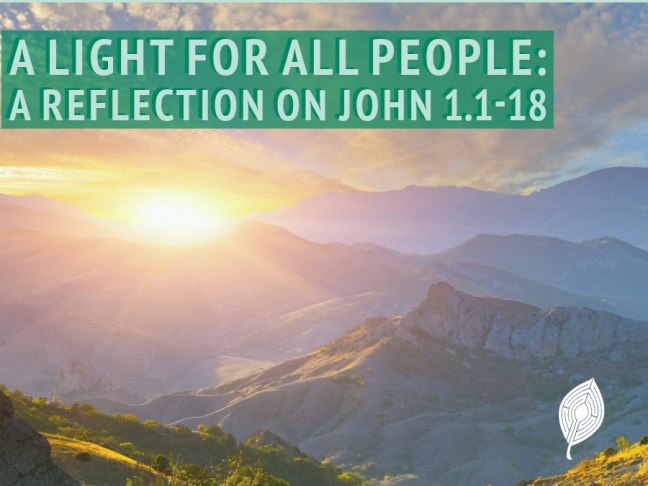
Longtime readers will know that one of my favourite images when discussing theology, faith, and the life of the Church is light. Not only is it the guiding metaphor of the upcoming feast of Epiphany (which is on Tuesday, though many churches choose to celebrate it today), but I think it actually works for the whole liturgical year: In Advent we wait for light to shine into our dark world; at Epiphany and all its daughter feasts (of which Christmas is historically one, though of course it has since eclipsed its mother in brightness and cultural importance) we celebrate the many ways that light has come; during Lent we turn that light inward in self-examination and repentance; at Easter celebrate that darkness cannot overcome the light; and at Pentecost and during the long season that follows, we celebrate our empowerment by that light and mission to take it out into the world.
Today, on this second Sunday and eleventh day of Christmas, our Gospel reading introduces this image of light as it relates to the coming of Jesus. From the wonderful prologue of the Gospel according to St. John, it reads:
In the beginning was the Word, and the Word was with God, and the Word was God.
He was in the beginning with God.
All things came into being through him, and without him not one thing came into being. What has come into being
in him was life, and the life was the light of all people.
The light shines in the darkness, and the darkness did not overtake it.
There was a man sent from God whose name was John.
He came as a witness to testify to the light, so that all might believe through him.
He himself was not the light, but he came to testify to the light.
The true light, which enlightens everyone, was coming into the world.
He was in the world, and the world came into being through him, yet the world did not know him. (John 1.1-9)
The divine Word — the wisdom, blueprint, or plan underlying all of creation and the life within it — is here called “the light of all people,” which “shines in the darkness.” This is the light which the prophets, including John the Baptist, the final prophet of the old order, proclaimed and testified. The light was “in the world” but the world chose to walk in the shadows, remaining ignorant of it. And so:
The Word became flesh and lived among us, and we have seen his glory, the glory as of a father’s only son, full of grace and truth. … From his fullness we have all received, grace upon grace. The law indeed was given through Moses; grace and truth came through Jesus Christ. No one has ever seen God. It is the only Son, himself God, who is close to the Father’s heart, who has made him known. (John 1.14-18)
Here we have the perfect transition between the message of Christmas — that the light has invaded our dark world — and the message of Epiphany: The light is shining forth, revealing to us God’s heart and God’s ways. But the thing about light is that the brighter it shines, the darker the shadow that gets created. We see this not only in the often violent reaction against Jesus’ ministry in the Gospels, but also throughout history and in our daily news cycle. And so, walking in the light — the way of Jesus, that is of love, compassion, grace, and hard truths — is always a choice in a world so often dominated by the opposite of these things: by indifference, hatred, judgment, and comfortable lies.
The message of hope for us today is that the light has come. The challenge for us today is to choose to walk in it.
I pray that we will choose that light today, tomorrow, and always. Amen.
 Matthew Root
One thought on “A Light for All People: A Reflection on John 1.1-18”