
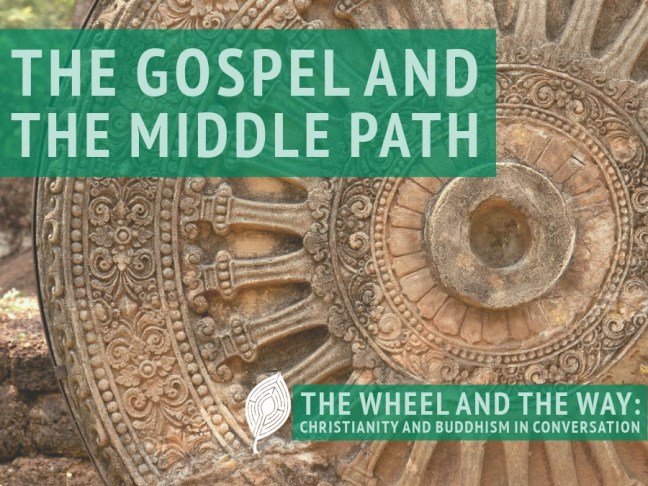
Of the basic teachings of Siddhartha Gautama, known as the Buddha one of the most influential for Buddhist thought and life is what is called the ‘middle way’ or ‘middle path’. This was the epiphany that true freedom and wisdom is to be found neither in the life of indulgence knew knew in the palace nor in his life of extreme austerity in the wilderness, but in a lifestyle somewhere in between them. And it changed everything for him. Today we’ll look at this teaching a bit more closely and then see what corollaries exist, or not, within Christianity.
The Buddha’s Middle Path
As mentioned above, the discovery of the middle path was a central part of the Buddha’s journey of enlightenment. He had left the comfortable wealth of his father’s palace to pursue a life among the ascetic gurus prevalent in his time and place, but after years of practicing extreme asceticism, he found that he wasn’t any closer to enlightenment. Instead, it had all left him just emaciated and weak. And in this state he realized that neither indulgence nor austerity were helpful and that a middle path was the way of wisdom and liberation. Both of these are worth unpacking.
A middle path is wise because there are dangers in extreme positions. Over-indulging can make us unhealthy, sluggish, greedy and grasping, and insensitive to the needs of others. But deprivation can lead us to those exact same dangers. The same can be said for philosophical, religious, or political beliefs. We saw last time that when it came to the question of of the existence of the self, the Buddha refused to provide an answer. He feared that both answers to the question were misleading and unhelpful: ’Yes’ would give the self a solidity that its changeable nature does not warrant; but ‘no’ would be nihilistic. Later Buddhists applied this principle to any dualism, including subject/object, part/whole, compassion/practicality, and the cycle of reincarnation / freedom from it, either upholding both ends in the kind of positive-positive polarity I’ve previously applauded, or, when such an approach is not possible, simply by refusing to answer.
A middle path is also liberating, because extreme positions lead us to be defined by them. Hedonism (the commitment to pursuing pleasure) traps us to things like food and drink, possessions, and sex. But if we reject these things entirely, we’re still in some way controlled by them. To be truly free, we need to be free to eat the sandwich or not to eat it.
Christian Response
Unlike the other posts in the series so far, it’s impossible to find a direct parallel to the middle path in Jesus’s teaching. But that doesn’t mean it isn’t to be found in our tradition. Ecclesiastes’ “for every thing there is a season” teaching hits on it, refusing to categorize anything, even grief, as bad, but rather appropriate in its own time. And even if we don’t exactly see the ‘middle way’ in Jesus’ teachings, we do see a religious pragmatism that is grounded in a similar desire for genuine freedom, rejecting both extravagance and greed on the one hand and legalism and purity culture on the other. He also used something like the middle path’s avoidance of extreme positions when the religious authorities attempted to trap him: His “Give unto Caesar what is Caesar’s” teaching and his refusal to play into the Sadducees’ logic puzzle around the resurrection of the dead come to mind.
The idea of freedom is also a focus in Paul’s use of the Stoic language of ‘the passions’ that has come up already in this series. The idea that a life of holiness looks less like adherence to strict codes of conduct and more like freedom from the things inside us that have power or attachment over us is all over the New Testament, and became even more of a focus in later Christian ascetic teaching. (It was actually in this ancient Christian asceticism, in which I participated in my time in the Eastern Orthodox Church, where I first encountered the teaching of the middle path. So I when I first encountered the Buddha’s teaching, I recognized it from my Christian background!) We saw the middle path come up often the other year in my Lenten series on the teaching of the Desert Fathers, for example, in the stories of Abba Eulogius and Abba Sisoes. About the former, I concluded:
The point of spiritual disciplines is to free us from being controlled by things like food, drink, sleep, or sex. The deep truth that seekers have had to uncover time and time again, across time and cultures and religious traditions, is that being driven to extremes of denying these drives is just as much a sign of one’s lack of freedom as thoughtlessly chasing after them: Wanting to eat nothing is just as much evidence that you’re obsessed with food as gorging yourself is. If there is a correct path, it’s the middle path of moderation.
And for the latter, I concluded by praying:
May God grant us all to find the middle path between self-consciousness and recklessness, between caring too much about ourselves and too little. And may we always live in awe of God — God’s greatness, goodness, mercy, and love — instead of in awe of others’ judgement. Amen.
So, while the middle path is not exactly a teaching of Christ, it is nonetheless present in our Christian traditions, because it’s simply a genuine and true perception into the human condition.
Conclusions
The fact that the teaching would be discovered independently should not be surprising. After all, the Buddha’s teaching was not grounded in revelation to divine secrets but in a realization of the world and human nature as they are. So it stands to reason that Christians, and people from all cultures, would in their own ways discover similar things. In this case, truth, goodness, and wellbeing are never to be found in extremes, but in finding a path in between them. It was true in ancient times and it’s true today — even and especially in our divided culture in which extremism seems to be winning.
I’ll end this reflection with some words I wrote a few years ago about the importance of true freedom in the Christian life:
So many of us in the ‘free’ West are still bound in our hearts and minds, still defined by the principalities and powers at work in us — whether they are the energies of oppression and restriction or the energies of privilege and Mammon. Until we are freed from these things, according to the wisdom traditions of East and West alike, we are not truly free.…
This kind of freedom is what human maturity and growth look like. The apostle Paul said, “It is for freedom that [Christ] has set us free.” The tautology is often mocked, but he has a point. Freedom is an incredible gift, but it comes with an awesome responsibility: the responsibility to be truly free. Not to be free from, but to be free for.
Political freedoms are incredibly important, but unless we’re also free from being controlled by our own appetites, desires, and drives — the passions in the old sense of the term — it’s a false freedom. As the Scriptures tell us, Christian freedom is not about doing whatever we want, but about the freedom to love others, including our ‘enemy’, well.
 Matthew Root
3 thoughts on “The Gospel and the Middle Path”