

For the trip from Hadrian’s Wall down to Manchester, where I would end my trip, we decided to go via the Lake District, a place whose beauty has inspired anything from the construction of ancient stone circles to the great literature of the likes of Austen, Wordsworth, and Coleridge (which in turn inspired Taylor Swift to write a song about the area).

While we had a bit of a time crunch that prohibited too much stopping and poking around, I’m so glad I got to visit this part of the country. The natural beauty is nothing short of astounding and it’s no wonder it’s had such a long history of inspiring human creativity and achievement. It’s a perfect example of the transcendence of bigness, or vastness. It’s not that they are particularly high peaks or large lakes, but in the way they dominate the field of vision. This came into particularly vivid focus at the Castlerigg stone circle just outside Keswick.
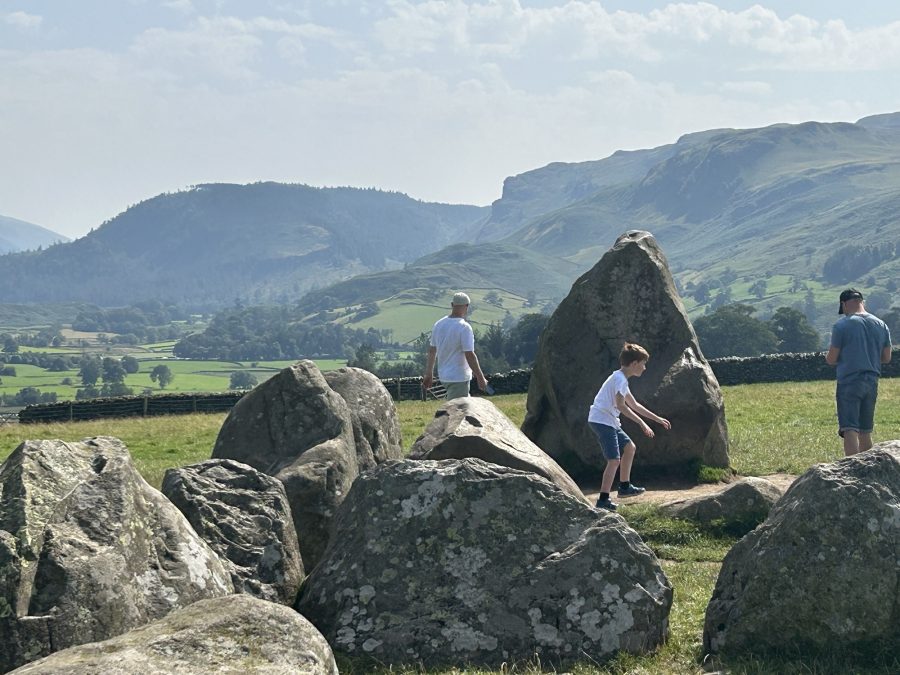
I’d often heard that the henge tradition (building monumental sites in concentric rings of timber or stone circular structure, ditch, and earthworks) tended to mimic the surrounding landscape, but I can’t imagine it being more striking than at Castlerigg. The site is on a low circular hill surrounded by a valley, with a perfect circle of peaks beyond that, so it genuinely felt like the stone circle was echoing and participating in the area’s grandeur. It’s the kind of place where you can’t help but give up any illusions of self-importance and just say ‘Wow.’ Just as we saw last time, such encounters are humbling but also inspiring and vivifying: being confronted with our smallness within the world makes our existence seem all the more special. As C.S. Lewis wonderfully put it:
We also have need beyond measure of all that He has made. Love me, my brothers, for I am infinitely necessary to you and for your delight I was made. Blessed be He! …
We also have no need of anything that is made. Love me, my brothers, for I am infinitely superfluous, and your love shall be like His, born neither of your need nor of my deserving, but a plain bounty. Blessed be He! (Perelandra)

There’s also something to be said about places that don’t just inspire, but which we know have inspired for aeons. There’s a kind of human solidarity in this. Yes, neolithic builders, I see you and hear you across the millennia. Yes, Jane Austen, I would share Elizabeth’s “excessive disappointment” at not being able to visit. Yes, Wordsworth, I know exactly what you were going on about, with your visions of “wander[ing] lonely as a Cloud / That floats on high o’er Vales and Hills.” Yes, Taylor Swift, “Those Windermere peaks [do] look like a perfect place to cry.” It’s this kind of solidarity that allows us to talk about ‘the transcendent’ as something somehow real, as subjective as it may be. When a phenomenon isn’t just in my head but in all of our heads, we have to start taking it seriously as something that exists in the world, something we must accept and, if not explain at least acknowledge.
 Matthew Root
One thought on “Take Me to the Lakes”