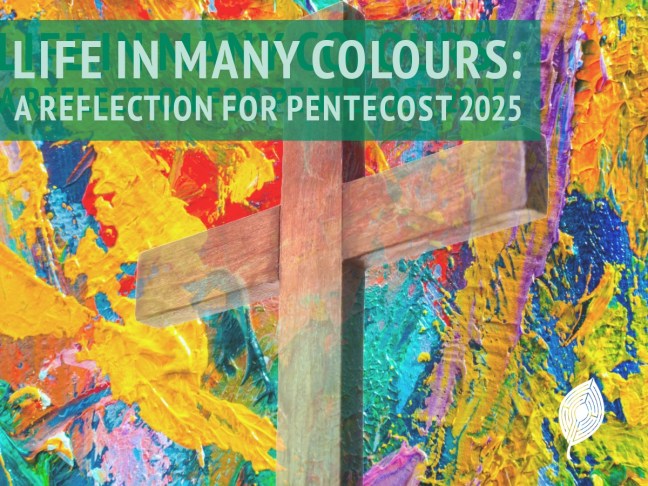
I’m often reminded of (and mention here!) that old The Onion cartoon about the Trinity downsizing, laying off the Holy Spirit because of a lack of clarity on its role. It’s funny because it’s sadly true. Many Christians have only the vaguest idea about what the Holy Spirit does. Last year, I wrote a whole series on this, and right now I’m revisiting an old series on vocation, which also touches extensively on the theme of the Spirit. And as these things swirl around in my mind, I couldn’t help but think of both the diversity of roles the Spirit is said to play and its diversifying roles it gives each and every one of us. If basic human social life makes us wear drab conformity like a heavy overcoat, the Spirit turns that clothing into an amazing coat-of-many-colours. And it’s this that I’d like to reflect upon today.
There’s a theological saying that goes, “Christ unites, the Spirit diversifies.” While it’s oversimplified — there is no act of God that is not Trinitarian, involving the full, joyous cooperation and participation of Father, Son, and Holy Spirit — I think the saying offers a helpful way to conceptualize the roles of the “two hands of the Father,” as St. Irenaeus of Lyons called them. Christ makes us one: in Christ, our differences of culture, race, class, sex and gender are marginalized, as we are all brought into the center of full — incarnational, cruciform, prophetic, and healing — humanity. We are all one as adopted siblings in Christ, through the power of the Spirit of Adoption, as today’s reading from Romans puts it. And yet, none of that undoes our diversity. And, the Spirit further diversifies us by empower us to live out unique vocations, tailored to our God-given gifts, but also to the particularities of our social circumstances and life experiences. Let’s quickly think through both parts of this today.
In the ancient Church, Pentecost was often imagined as the ‘undoing of Babel’s curse’. But Pentecost did not undo Babel by making everyone speak the same language, by enforcing conformity. Rather, it did so by allowing everyone to hear God’s message in their own language. In the same way, the presence of the Holy Spirit in our lives and hearts, does not remove our particular identity markers; rather, it informs, heals, and redeems them, changing them and transforming them in the process. In Christ, I don’t ‘cease’ to be a white man — centuries of history, cultural norms, and systems prevent that from being a possibility — but through the power of the Holy Spirit, my ‘whiteness’ and ‘maleness’ are inherently transformed; these markers of privilege become tools I am called to use for the lifting up of the marginalized. On the flip side, as much as religious conservatives and my young-adult self would like it to be otherwise, ‘in Christ’ I don’t cease being gay; but again, my queerness is not left unchanged or unchallenged. Rather, through the power of the Holy Spirit, it too is redeemed, and something that is socially marginalized becomes, on the one hand, a tool for me to better understand and empathize others on the margins, and, on the other, a spanner in the machine of ‘normal’ social systems and structures, revealing them to be far less certain, secure, and most importantly, sacred, as their advocates would have us believe.
The Spirit also diversifies through its gifts. We’ll look at this again later in the revisited series on vocation. But, as Paul wrote:
To each is given the manifestation of the Spirit for the common good. To one is given through the Spirit the utterance of wisdom and to another the utterance of knowledge according to the same Spirit, to another faith by the same Spirit, to another gifts of healing by the one Spirit, to another the working of powerful deeds, to another prophecy, to another the discernment of spirits, to another various kinds of tongues, to another the interpretation of tongues. All these are activated by one and the same Spirit, who allots to each one individually just as the Spirit chooses. (1 Corinthians 12.7-11)
And when we combine these two kinds of diversity — our diversity of self and circumstance and our diversity of gifts — we get an unimaginable diversity of callings and vocations. We saw this time and time again in the Lenten series on the Ways of the Saints: Being holy does not make us all the same, quiet, dull, and conformist. Holiness is infinite! The life of the Spirit is therefore awesome and radical, and, yes, unimaginably diverse. This is what the work of the Spirit is, yesterday, today, and for ever, amen!
And so, as we celebrate the coming of the Holy Spirit today, let us give thanks for out infinitely creative God, and for the amazing, technicolour life God provides us in and through the Spirit.
Come, Holy Spirit come!
 Matthew Root