
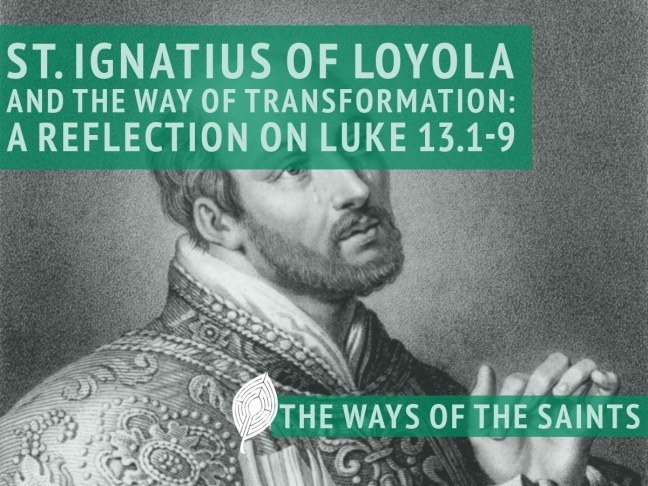
Most of the time, whether it’s because his words are legitimately gentle or just because I’ve grown too accustomed to them, Jesus come across to me as a gentle fellow, a soothing balm for a weary soul. But every now and then, I’ll come across a passage that jolts me out of my complacency. He may be gentle and kind, but our Lord took his message very seriously. There was urgency behind it, an urgency we’d do well to remember and feel ourselves, especially during this season of Lent. Our Gospel for today is one such passage. His disciples are talking about the latest scandal perpetrated by Rome, but Jesus is having none of it. “Repent!” he tells them: In a world full of violence and calamities, nothing is certain; so change your heart and change your ways. That message of transformation is never far from Jesus’ lips, but I’m not sure it ever comes across as urgently as it does here. So today I’ll be looking at the parable he tells in response to this, and, in keeping with my Lenten series on the Ways of the Saints, also touch on the life of St. Ignatius of Loyola, a man who took a commitment to personal transformation for the sake of the Gospel to heart.
After his shocking response to his disciples’ political gossip, Jesus illustrates his intent with a parable:
A man had a fig tree planted in his vineyard; and he came looking for fruit on it and found none. So he said to the gardener, “See here! For three years I have come looking for fruit on this fig tree, and still I find none. Cut it down! Why should it be wasting the soil?” He replied, “Sir, let it alone for one more year, until I dig round it and put manure on it. If it bears fruit next year, well and good; but if not, you can cut it down.” (Luke 13.6-9)
The point is clear: God expects us to bear good fruit and the time has long since passed for us to do just that. As John the Baptist put the same idea:
Bear fruit worthy of repentance. Do not presume to say to yourselves, “We have Abraham as our ancestor”; for I tell you, God is able from these stones to raise up children to Abraham. Even now the axe is lying at the root of the trees; every tree therefore that does not bear good fruit is cut down and thrown into the fire. (Matthew 3.8-10; cf. 3.12 and Luke 3.17)
There is no time for comfort or complacency. The time is now to bear the good fruit we were created to bring into the world. As long-time readers will know, this is for me the heart of the Gospel message. And so I’ve written numerous series on just this idea, of what bearing good fruit looks like and how we might transform our lives to do just that. So there’s no need for me to do that again. But what I’d like to do instead today is highlight the life and way of St. Ignatius Loyola, a man who dedicated his life to transformation in Christ, not just his own, but others’ as well.
Iñigo López de Oñaz y Loyola, the future St. Ignatius, was born in 1491 in the Basque country of Spain. Much like St. Francis before him, he was a strongheaded and passionate youth. He dreamed of military glory and winning the hearts of beautiful women, and was known for his love of beautiful clothing. But everything changed for him when he was struck down in battle and confined to bed for a long recovery. During his convalescence he began to read the Lives of the Saints and the Life of Christ, since this was the only reading material available in the house. He began to daydream just as much about imitating the miraculous exploits of the Saints has he did about military or romantic conquests. In time, he noticed that his religious imaginings left him feeling joyful and at peace, while the more earthly ones left him feeling depressed and frustrated. He took this as a cue that the former thoughts were better for him than the latter, a lesson in discernment that he would take to heart.
Much more could be said about his spiritual journey — it reads like a bit of a comedy of errors — but eventually he found firm spiritual footing and undertook studies at the University of Paris. There, with a group of close friends, he founded the Society of Jesus, or the Jesuit Order, devoted to teaching and Christian service wherever it was needed. But as the Order’s founder, he came to see spiritual formation as the key to everything. And so he developed his Spiritual Exercises, a series of tools for spiritual discernment and formation. These included such wonderful tools as Gospel Contemplation and the Examination of Conscience, which are widely used today across a wide spectrum of the Christian world. The point of the Exercises is to bring the whole person before God, honestly and openly. And by doing this, to be transformed by God, in Christ, through the power of the Holy Spirit.
What St. Ignatius understood — and what makes his way so valuable for us today — is that Christianity is at its core all about having our lives changed by our encounter with Jesus Christ. If we are not being ever more conformed to the way of Jesus, what even is the point? He understood the urgency present in today’s Gospel reading: the time for transformation is now. The time for repentance is now. The time to bear good fruit in our lives is now. And luckily for us, he didn’t just take these insights into his own life, but created tools — real, useful tools that actually work — to help us in this. And for that I am profoundly grateful.
“He who goes about to reform the world must begin with himself, or he loses his labor.” – St. Ignatius of Loyola
 Matthew Root
3 thoughts on “St. Ignatius of Loyola and the Way of Transformation: A Reflection on Luke 13.1-9”