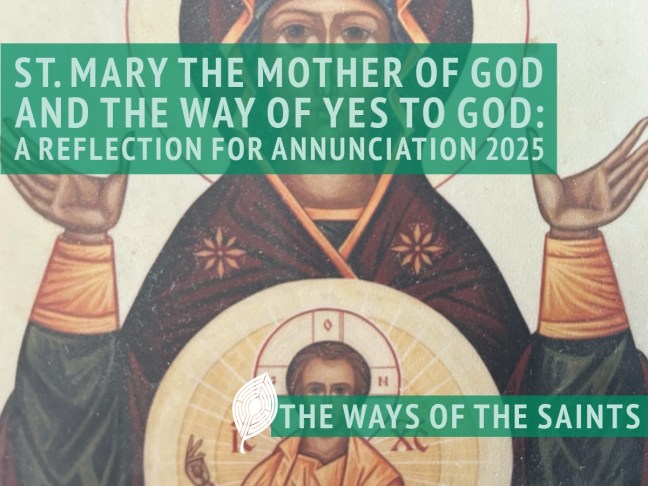
Today is the feast of the Annunciation, when we remember the appearance of the angel Gabriel to Mary telling her of God’s plans for her life, and through her the world. The Greek name goes even harder, translating to “The Evangelization of the Theotokos,” or “The Proclamation of the Good News to the Mother of God.” But as cool as these names for the feast may be, they only tell half the story. For as much as the angel proclaimed the Gospel to Mary, what’s at least equally important is that Mary heard and accepted the angel’s message. Mary said “Yes.”
Let’s remind ourselves of the story:
In the sixth month [of Elizabeth’s pregnancy], the angel Gabriel was sent by God to a town in Galilee called Nazareth, to a virgin engaged to a man whose name was Joseph, of the house of David. The virgin’s name was Mary. And he came to her and said, “Greetings, favoured one! The Lord is with you.” But she was much perplexed by his words and pondered what sort of greeting this might be. The angel said to her, “Do not be afraid, Mary, for you have found favour with God. And now, you will conceive in your womb and bear a son, and you will name him Jesus. He will be great, and will be called the Son of the Most High, and the Lord God will give to him the throne of his ancestor David. He will reign over the house of Jacob forever, and of his kingdom there will be no end.” Mary said to the angel, “How can this be, since I am a virgin?” The angel said to her, “The Holy Spirit will come upon you, and the power of the Most High will overshadow you; therefore the child to be born will be holy; he will be called Son of God. And now, your relative Elizabeth in her old age has also conceived a son; and this is the sixth month for her who was said to be barren. For nothing will be impossible with God.” Then Mary said, “Here am I, the servant of the Lord; let it be with me according to your word.” Then the angel departed from her. (Luke 1:26-38)
Mary said “yes”. Or more accurately, she said, “Here am I, the servant of the Lord; let it me with me according to your word.” In this, she recapitulates a long line of heroes of the Bible who also faced seemingly impossible callings with their own “Here am I”s, Abraham, Moses, Samuel, and Isaiah. But this was not a given. As I’ve noted before, we can’t underestimate the sheer immensity and danger of what the angel was telling Mary:
Even ignoring the fact that angelic visitations are by all accounts horrifying experiences, this angel is turning Mary’s entire world upside down and, truth be told, putting her life in great danger. While Gabriel’s message for Mary is certainly good news for us, its ‘goodness’ is far less certain for her. She is engaged to be married to Joseph, but she is not married yet. Saying “yes” to God’s plan will leave her an unwed, pregnant teenage girl, powerless in the world and without protections. The best outcome she could expect would have been shame and social rejection, and serious injury, if not death, at the hands of an angry mob, was certainly on the table.
And so Mary faces a real dilemma; God has put her in a very difficult spot. Accepting this news from Gabriel as Good News entails a lot of personal risk. The old saying, “If this is how God treats God’s friends, I’d hate to see how God treats God’s enemies,” comes to mind. It’s important not to lose sight of what was at stake for Mary. Saying “yes” to God meant saying “no” to another life — a life that offered a lot more security and safety, and even normalcy to it than this grand adventure Gabriel’s message sets off in her life.
And the challenge of her calling did not end when Joseph married her despite her pregnancy. I was recently asked why Mary is mentioned so often in Eastern Orthodox funeral and memorial services. I answered: Who better than Mary to understand what it means to grieve a loved one? Jesus’ birth was met with wonderful prophecies, but also with the frightening warning that “a sword will pierce [her] soul too.” The Gospels present her as something of a hovering and worrying mother — but how could she be otherwise when her beloved son was wandering off on his own, or being too bold in his criticisms of the religious establishment? When that sword was hovering over her heart at every moment? And when that terrible moment came, she did not flee, but stayed at the cross until her child, humiliated, dehydrated, and feeling abandoned by God, uttered those chilling words, “It is finished.” Who better to understand our grief indeed.
But nevertheless, Mary responded to this terrifying calling with those simple words, “Here I am.” And she reiterated that “yes” when she searched for her lost son, when she coaxed him into his public ministry, when she feared for his life, when she mourned (and no doubt railed against) his unjust murder at the hands of the powerful, and when she refused to leave the foot of the cross. And, because of this, she has become the quintessential Christian Saint, the archetype of human potential in Christ.
Of course, Mary’s vocation was unique. We aren’t all called to be the vessels of the incarnation of God! But spiritually speaking, we’re not that far off. For we are all called to carry Christ within ourselves, and to bear Christ into the world in our own unique ways. And so we all will receive our own (likely far more subtle) summons. The question is whether we will have the faith to answer, as she did, “Here am I. May it be to me according to your word.”
My soul magnifies the Lord,
and my spirit rejoices in God my Saviour,
for he has looked with favour on the lowliness of his servant.
Surely, from now on all generations will call me blessed;
for the Mighty One has done great things for me,
and holy is his name.
His mercy is for those who fear him
from generation to generation.
He has shown strength with his arm;
he has scattered the proud in the thoughts of their hearts.
He has brought down the powerful from their thrones,
and lifted up the lowly;
he has filled the hungry with good things,
and sent the rich away empty.
He has helped his servant Israel,
in remembrance of his mercy,
according to the promise he made to our ancestors,
to Abraham and to his descendants for ever.’ (St Mary, Luke 1.46-55)
 Matthew Root
4 thoughts on “St. Mary the Mother of God and the Way of Yes to God: A Reflection for Annunciation 2025”