
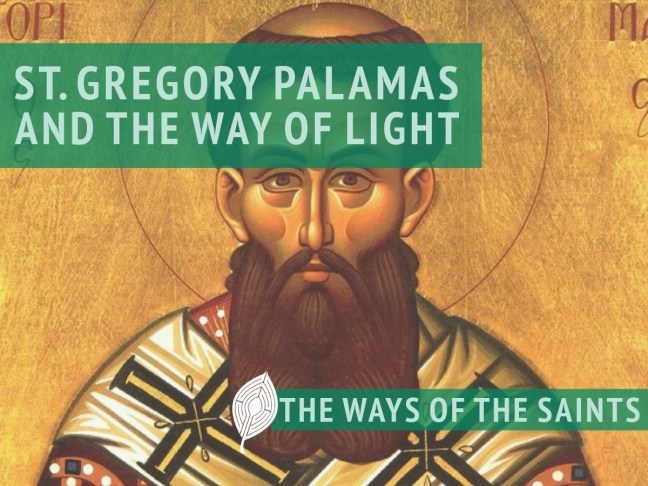
Of all the Saints of the Church, few have had a bigger role in my how I understand Christianity and the world than St. Gregory Palamas, a fourteenth-century Byzantine theologian who rose to prominence through his defense of a monastic practice known as hesychasm (’stillness’). The debate around hesychasm was complicated, but to make a very long story short, the theology that Palamas developed to defend the practice had the broader consequence of insisting that when we experience God, we are actually experiencing God. And to me that’s a worthy thing to defend. Today I’d like to look a bit at his life, his example, and how his thought might help us on our own ways of holiness.
St. Gregory Palamas was born sometime around 1296, in the heart of what remained of the Byzantine Empire. The Empire was then in the midst of one final political and cultural flourishing under the Palaiologos dynasty, which lasted from the reconquest of Constantinople from the Crusaders in 1261 until its final fall to the Turks in 1453. During his childhood, Palamas received a strong education of the Byzantine humanist style, but abandoned his studies for the monastic life in his early twenties. He wasn’t drawn back to the capital and its intrigues until 1337, when a group of clerics began attacking the practice of hesychastic prayer. Palamas’s initial defense of the monks was successful, but in typical Byzantine style, where politics and religion were deeply intertwined, his enemies quickly aligned themselves with the Patriarch, who then led a coup d’etat. Palamas’s fortunes rose and fell with the tide of the ensuing Civil War, which lasted from 1341-1347; he was regularly imprisoned and at one point was even excommunicated. During this period, several councils were held to try to discredit Palamas, but each time he was declared to be in the right. At the war’s conclusion, Palamas was entirely vindicated and was appointed as Archbishop of Thessaloniki. In addition, his theology received its final affirmation when all of the Orthodox patriarchates formally adopted it, giving it the status of official Church dogma in the Orthodox world.
But what was Palamas’s theology all about? And what relevance might it, and he, have for us today? The crux of the debate was whether, when the monks had peak religious experiences in their prayer, which they experienced as a total immersion in glorious divine light, they were truly experiencing God, or whether it was a blessing that God created but remained outside divinity. But Palamas rightly understood that the anti-hesychast position, which focused strongly on divine transcendence, had consequences that were far wider reaching than the experiences of a few monks. For, if God is too transcendent to be truly experienced in contemplative prayer, the same must also be said of any purported knowledge or experience of God — in salvation, in the sacraments, in the veneration of icons and relics, and on and on — including the ultimate union with God after death (theosis), which formed the basis of all ancient Christian theology about salvation. Essentially, in order to preserve divine transcendence, those attacking hesychasm made direct knowledge of God impossible. This was a big step away from traditional Eastern theology, which insisted, using a variety of metatphors and images, that God was both immanent and transcendent, approachable and unapproachable, visible and invisible, participable and nonparticipable, knowable and unknowable.
Palamas’ main contribution was in how he synthesized the plurality of earlier language surrounding this paradoxical experience into one, consistent teaching. In short, he needed an explanation for what grace is, and how it works. The language he found, which had origins as early as Aristotle and Philo, was to distinguish between God’s ousia (essence, substance, or being) and God’s energeiai (operations, activities or energies). As developed the language here, God’s essence remains beyond our reach, but through God’s energies, we really do truly experience and encounter God. Taking the example of our union ‘in Christ’, this could not be a union of essence, or else it would be a pantheistic fusion into divinity. Nor is it a union of hypostasis (instantiation, person), or it would obliterate human personality (which is not the Gospel teaching). It is instead a union of energies. This all may sound unnecessarily complicated, but the point is that this language ensures that, practically speaking, an encounter with God is an encounter with God, and not a created “state” or vision of something apart from God. We might say that in this teaching, God honestly and truly reveals Godself to us, but God can never be equated or reduced to that self-revelation. If this is clear as mud, an analogy that Palamas himself developed that I’ve found helpful is to compare it to the distinction between the Sun and a beam of light. The light we experience is the Sun but it doesn’t remotely exhaust what the Sun really is. A sun beam “gives warmth, light, life and increase, and sends its own radiance to those who are illuminated and manifest itself to the eyes of those who see” (150 Chapters, Chapter 68). In the same way that we may experience the sun as light, dryness, warmth, the darkening of skin, the growth (and even shriveling) of plants, etc., we likewise experience God’s energies in myriad ways, but they are one and the same energy belonging to the one and the same God.
This has been very technical, so it’s reasonable to ask what it is we might take away from the way of St. Gregory Palamas and apply to our own lives. For me three things come to mind: First of all, he showed up when he was needed, at great personal cost. He could have sat back in his monastic cell and prayed and let other people take up the challenge, but he rose to the occasion, and stayed engaged even when he was imprisoned and excommunicated. Second, his theology was both novel and deeply traditional, since it was based on synthesizing all that had come before him. I think there’s a lot of wisdom in this kind of approach, which is confident in the tradition’s resources to be able to adapt to new questions. And third, and most importantly, is to rest in the knowledge that God is knowable and bask in the Divine Light. Of course we have to watch out for misunderstanding and delusion, and so we need to be cautious about reading too much into our experiences (and more importantly our interpretations of those experiences). But that said, we can know God, and, in and through Christ in the continuing work of the Holy Spirit, God allows us to do just that. God is not some far off distant divinity, but remains right here with us, “in your mouth and in your heart for you to observe” (Deuteronomy 30.14).
O shining light of Orthodoxy,
Support and teacher of the Church,
Ideal of monks and invincible champion of theologians,
O wonderworker Gregory, boast of Thessalonika and herald of grace,
Always intercede for all of us that our souls may be saved.
Amen.
 Matthew Root
As I finished reading this, one of my cats came and flopped into a nearly sunbeam. He very much illustrated the analogy!
LikeLike
As I finished reading this, one of my cats came and flopped into a nearly sunbeam. He very much illustrated the analogy!
LikeLike