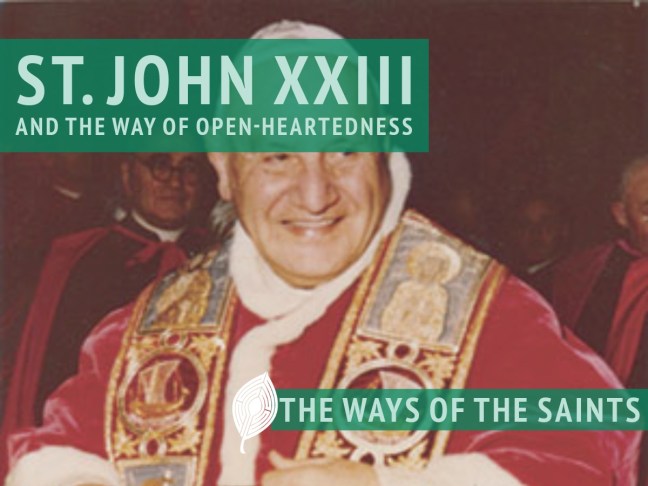
There are a lot of watershed moments in history, moments that mark a decisive ‘before’ and ‘after’. We might think of the assassination of Archduke Ferdinand, for example, which precipitated the First World War and everything that happened as a result of it, or the dropping of the atomic bombs on Hiroshima and Nagasaki. The Roman Catholic Church experienced one such moment last century in the Second Vatican Council (known colloquially as ‘Vatican II’), which revolutionized its liturgical life and shifted its theological orientation toward the world. But while the contributions of Vatican II were the work of thousands of individuals, the fact that it happened at all is really down to one man, Pope John XXIII, who was later canonized as a Saint. Today I’d like to look at what we might take away from his life for our own lives and witness.
Nothing that happened surrounding Pope John XXIII and the Second Vatican Council was inevitable. In fact, it is widely held that John XXIII was elected with the expectation that, because he was old (76 at his election), he’d be little more than a short-term, ‘caretaker’ Pope. And indeed, he was Pope for only four-and-a-half years, from October 1958 until his death in June 1963. But he surprised everyone, and what he accomplished in that short time is nothing short of inspirational.
In the first half of the twentieth century, Roman Catholicism was a deeply conservative institution. This is perhaps best symbolized by its continued use of Latin in its liturgical life (with even vernacular Bible reading not being encouraged until 1943!), but it went far beyond that. Its theology was still grounded in the scholasticism of the late middle ages, and it aligned itself squarely with the old political order throughout the West, including the fascists in Italy and Spain. One could say that it saw its role as being a bulwark against Modernism in all its forms. (For example, Pope Pius X called Modernism “the sum of all heresies.”) Attempts at theological renewal, such as the French nouvelle theologie movement, which sought to inform theology through a fresh look at the Scriptures and Church Fathers, were shut down. Many eminent theologians were placed under official suspension, including Yves Congar, Hans Küng, and Karl Rahner. And monastic Orders who advocated on behalf of the poor and working class against the interests of the wealthy we regularly denounced as trouble-makers and Communists. While there were whispers of people advocating for an official Council, it was mostly among the traditionalists, who wanted an official stamp of approval for their anti-Modernist agenda.
With this in mind, it was a shock to many when Pope John XXIII announced plans for a Second Vatican Council just three short months after his election, and even more of a shock when it became clear he didn’t intend the Council to be a slam dunk for the reactionaries, not only allowing but actively inviting the participation of theologians who’d been silenced by the old order. And during the years of planning the Council, which did not convene until 1962, he enacted a series of reforms in policy and attitude. These included:
- barring Italian clergy from interfering in elections
- opening up conversations with Communist governments in the hopes of securing religious rights for Roman Catholics in Eastern Europe
- making overtures to Jews, including referring to rabbis as his “brothers,” removing anti-Semitic language from liturgies, and making a formal confession on behalf of the Church for its historical antisemitism
- offering to mediate talks between the United States and Soviet Union
It wasn’t that Pope John XXIII was a ‘progressive’; he upheld traditional Roman Catholic teachings on social and theological issues. What he wanted to do, however, was open the doors of the Church to have important conversations properly and, where possible, to adapt the the Church’s language so it could speak to the world more effectively. The two biggest metaphors used to describe his aims for the Council were to “open the windows of the Church to let fresh air in” and to “shake off the dust” from the Church. The word he used to describe this was aggiornamento (’updating’), and it became the watchword for the work of the Council and the spirit of its official pronouncements. Aggionamento meant making space for real conversations and to remove unnecessary barriers between people and the Church, and the Church and the world. While John XXIII did not live to see the fulfillment of this vision, the Council continued with its work and approved sixteen formal documents that ushered in a new age for the Roman Catholic Church around the world. Highlights included:
- Sacrosanctum Concilium (the Constitution on the Sacred Liturgy), which enacted the most significant liturgical reform of the Western Church, including provisions for use of the vernacular, increased lay participation, and local adaptation
- Lumen Gentium (Light of the Nations), which shifted the focus of Roman Catholic life and ministry away from clericalism and towards a shared ministry of the whole people of God, and which made provision for God’s grace working through other Churches
- Unitatis Redintegratio (Restoration of Unity), which reversed previous bans on participation in ecumenical conversations, and which recognized the Roman Catholic Church’s share of culpability for Christian disunity
- Dignitatis Humanae (Of the Dignity of the Human Person), which reversed the Church’s previous rejection of the principle of religious freedom as a human right
These ideas may sound obvious to most of us today, but they marked a dramatic shift within the Roman Catholic Church and its orientation to the world.
So what can we say about the way of Pope, now Saint John XXIII? To me it’s all summed up in his famous phrase aggiornamento. I’ve long loved the language of approaching the world with an open hand instead of a clenched fist. And to my mind that’s exactly what John XXIII was all about. When we do this, we don’t lose anything important as so many people seem to think — in fact we can carry more. When we approach the world as a possible friend rather than a presumed enemy, we are able to see everything through fresher and clearer eyes. The analogies of ‘opening the windows’ and ‘shaking off the dust’ have lasted because they’re really perfect descriptors of such an approach. We don’t need to shut ourselves up for fear of the world; we only stand to benefit from a more open-hearted approach. And, it’s also the way of Christ. He didn’t reject what had gone before him (”I have not come to abolish the Law”) but was also happy to challenge long-held assumptions about what those traditions meant (”You have heard it said … but I say to you…”). And, of course, he healed ‘foreigners’, conversed with ‘heretics’, enjoyed hospitality with ‘sinners’, and cast one of his people’s perceived enemies as the hero of his most famous parable. To my mind, St. John XXIII embodied his spirit beautifully, and we would do well to embrace it ourselves.
“Never Hesitate to hold out your hand; never hesitate to accept the outstretched hand of another.” — St. John XXIII
 Matthew Root
One thought on “St. John XXIII and the Way of Open-Heartedness”