
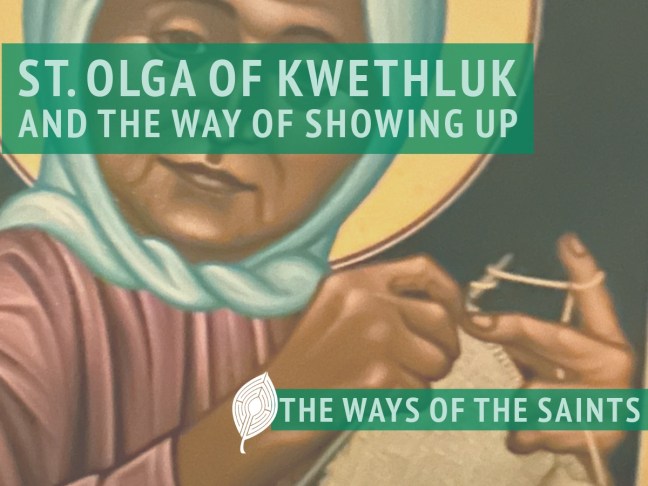
It’s easy to think of the Saints as people from the distant past, their stories more legend than reality. And yet, as Christians, we believe that the same Holy Spirit that inspired the prophets and apostles of old continues to be at work in the world — yes, in the days of the Roman Empire and throughout the middle ages, but today too. In my experience, communities that value the Communion of Saints are always on the look out for the new voices and faces of holiness in their midst. And it so happens that my brief time in the Eastern Orthodox Church was spent in a parish that was on the vanguard of veneration of one such individual: Olga Michael, who died in 1979 and ended up being officially canonized in 2023, with the official celebrations to take place later this year. Today in this Lenten series on the Ways of the Saints, I’ll be looking at this ‘new’ Saint, and her wonderful ministry of service and healing, and generally simply showing up for people.
One of the lesser known stories of Christian encounters with North American Indigenous peoples is that of the Russian mission to Alaska, which established several stable, locally-driven Orthodox communities in the decades prior to the Alaska Purchase St. Olga was born into one of these communities, in the Yup’ik village of Kwethluk along the Kuskokwim River in 1916. She married the local postmaster, who also eventually served as priest for several local communities. She delighted in her role as Matushka (a Russian term used for the priest’s wife), sewing and knitting clothing to give away, treating all of the village kids as her own, and as she grew older, accompanying her husband on his pastoral visits to encourage the women in surrounding communities. She is said to have always had the hymns of the Church on her tongue, to the point of committing entire Holy Week services to heart. She also served as a midwife for local women (including herself!), ensuring the safe delivery of many children. While perhaps remarkable for its quiet sanctity, there is nothing here so far entirely out of the ordinary. (Minus the midwifery, she actually sounds a lot like my own saintly grandmother!) Yet, at least two miracles marked the end of life. First, she was given a miraculous reprieve from a terminal cancer, shocking family members who returned from a pilgrimage to pray for her health to find her not only out of her anticipated deathbed, but outside carrying water home from the village well for her housework! When she did eventually succumb to her illness after a year’s grace, her funeral celebrations were facilitated by a strange and dramatic shift in weather that allowed many to travel to join the proceedings and for her easy her burial in unseasonably thawed ground. There was even a flock of birds that accompanied the funeral procession, weeks after the last flocks had flown South for the Winter. As Fr. Michael Oleska put it in his groundbreaking history of Orthodoxy in Alaska: “It was as if the earth itself had opened to receive this woman” (Orthodox Alaska 205). (As it happens, the story of this freak weather was independently told to a friend of mine who happened to meet a man from Kwethluk and remembered her passing.)
All this is a ‘nice story’. But while these memories of her quiet saintly life form the basis of her local veneration, on their own they probably would not have put her on the map more widely. So, why did this simple Indigenous woman become a much-loved and -venerated figure among the Eastern Orthodox of North America? As strange as it is to say, it’s because she started showing up for people, in prayer, in visions and dreams — particularly for women with sexual or reproductive traumas. The first known and most famous such incident involved a woman from the New York area, who told Fr. Oleska a moving story of a dream in which an an Indigenous woman who called herself Matushka Olga appeared to her and took her into a traditional Yup’ik earthen hut and coached her in ‘delivering’ her of the shame she was carrying from a history of childhood sexual abuse. After the delivery, she is said to have brought her back outside under the shimmering Northern Lights and said, “God can create great beauty from complete desolation.” These words are now the most strongly associated with St. Olga, featuring in hymns and icons. (The full story is stunning, but not mine to tell; interested parties can find it in various forms online.)

While not as dramatic as this story, St. Olga has appeared to many others over the past couple of decades. In 2006-07, my parish experienced a disturbing and painful run of ten consecutive miscarried pregnancies (in a community of only about 50 people). St. Olga was a great comfort to many of the women in that community during that season, and after a communal service asking for her intercessions, there were twelve healthy babies born in the next two years. And, while I certainly cannot claim any miraculous or healing encounter with St. Olga, she is the only Saint (to my knowledge) with whom I’ve had personal experiences. The first time I heard about her story, I felt her loving presence in the room with me. And later, she appeared to me in a dream in which her gentle and playful spirit shone through. So great was the presence of St. Olga in our little community that there was no question of waiting for ‘official’ canonization; she was among us and loved us, and we loved her and venerated her freely fifteen years before her canonization. And I know she has played a similar role in many other communities along the Northwest Coast, and around the world.
So what lessons might we take away from St. Olga’s story? First is absolutely her commitment to simple acts of service. Her sanctity was not found in grand gestures, but in showing up faithfully in love for those in her community. It’s telling that every story about her from those who actually knew her in life starts by speaking of her gentleness with everyone. She also united the practical and spiritual, as so powerfully revealed in her continued ministry after her death, healing both traumatized bodies and souls. What a wonderful icon of Christ she was and is:
O Blessed Matushka Olga of Alaska,
Northern Light of God’s Holy Church,
Quick to help all those in need,
All were to you as Christ our God,
New Tabitha of the Far North,
Reclothe us with true holiness,
Midwife and Deliverer of the suffering,
Labor with us for the salvation of our souls.
Amen.
 Matthew Root
2 thoughts on “St. Olga of Kwethluk and the Way of Showing Up”