
Today is Ash Wednesday, whose ceremonies mark the start of Lent in Western Christianity. Most years my focus in these posts is on the rite itself, which carries a wealth of symbolism. So if you’d like a reflection on the imposition of ashes, please see here, here, and here. But this year, I’m going to focus not on the ritual, and its accompanying Gospel reading which warns against public displays of fasting or contrition. Rather, I’m going to focus on the Epistle for today, which offers a different lens through which we can look at Lent.
The passage, which is taken from Paul’s Second Letter to the Corinthians, goes like this:
We entreat you on behalf of Christ, be reconciled to God. For our sake he made him to be sin who knew no sin, so that in him we might become the righteousness of God. As we work together with him, we urge you also not to accept the grace of God in vain. For he says, “At an acceptable time I have listened to you, and on a day of salvation I have helped you.” See, now is the acceptable time; see, now is the day of salvation! We are putting no obstacle in anyone’s way, so that no fault may be found with our ministry, but as servants of God we have commended ourselves in every way: through great endurance, in afflictions, hardships, calamities, beatings, imprisonments, riots, labours, sleepless nights, hunger; by purity, knowledge, patience, kindness, holiness of spirit, genuine love, truthful speech, and the power of God; with the weapons of righteousness for the right hand and for the left; in honour and dishonour, in ill repute and good repute. We are treated as impostors, and yet are true; as unknown, and yet are well known; as dying, and see – we are alive; as punished, and yet not killed; as sorrowful, yet always rejoicing; as poor, yet making many rich; as having nothing, and yet possessing everything. (2 Corinthians 5:20B-6:10)
There’s a lot to be said about this, so let’s break it down:
The passage starts with an exhortation to be reconciled to God. This is the heart of our faith, not to mention the heart of the Lenten season. But this reconciliation isn’t just a matter of making up after an argument. Paul has something far richer in mind. This passage directly follows these more famous words, which show just what it all entails:
So if anyone is in Christ, there is a new creation: everything old has passed away; see, everything has become new! All this is from God, who reconciled us to himself through Christ, and has given us the ministry of reconciliation; that is, in Christ God was reconciling the world to himself, not counting their trespasses against them, and entrusting the message of reconciliation to us. So we are ambassadors for Christ, since God is making his appeal through us. (5.17-20A)
So, in Paul’s mind, being reconciled to God entails a revolution of the human person in which everything is made fresh and new again. And even more, God has made us co-ministers of this. Once again we see God’s pay-it-forward economy at work, as we demonstrate that we have been reconciled with God by reconciling and sharing the message of God’s reconciliation with others. Paul, of course, wants this for his readers, and so here exhorts them them to be reconciled with God.
How is this reconciliation accomplished? Through Christ, about whom Paul writes: God “made him to be sin who knew no sin, so that in him we might become the righteousness of God” This is the original, and less pithy, version of the favourite patristic saying that in Christ, “God became man that we might become god.” Christ, who as the eternal Logos or Word of God and therefore by nature sinless, took on the form of sinful humanity so as to sanctify that humanity, aligning it and reconciling it once again with that perfect, sinless image of God.
And in this ministry of reconciliation, we are not just subjects but God’s colleagues, fellow workers. While the ‘we’ here likely refers specifically to Paul and his fellow apostles, it’s clear from the passage as a whole that in the fractal way of the Christian faith, it applies to all who are ‘in Christ’. We put our own energies into all this in good faith that God’s energies are already at work in us and the world at large.
The passage ends with a listing, in a unique format, of the attitudes and behaviours that befit this shared work with God:
- *through great endurance, in afflictions, hardships, calamities, beatings, imprisonments, riots, labours, sleepless nights, hunger“
- “by purity, knowledge, patience, kindness, holiness of spirit, genuine love, truthful speech, and the power of God; with the weapons of righteousness for the right hand and for the left;”
- “in honour and dishonour, in ill repute and good repute. We are treated as impostors, and yet are true; as unknown, and yet are well known; as dying, and see – we are alive; as punished, and yet not killed; as sorrowful, yet always rejoicing; as poor, yet making many rich; as having nothing, and yet possessing everything.”
First Paul lists the difficult circumstances of ministry that require perseverance in faith; then he lists the virtues one must adopt in the life in Christ; and third, the combines the two. Yes, there is dishonour, but there is honour too. Yes, they are weighed down with sorrows, but there is much joy too. Yes, there is financial sacrifice, but there is also a spiritual wealth that is shared with many. And in all this, we remain pure in heart, patient, kind, loving, and honest, relying on the power of God. This is, of course, a perfect description of Jesus’ own way of being in the world, and therefore, of the way of being we are to cultivate in our own lives. And, therefore, the we of being we cultivate during Lent.
To put all this in the language of archetypes introduced last week, what all this is saying is that Christ is the one essential Christian archetype; here in this passage, Paul appropriates and applies this archetype for himself and the other apostles, and then exhorts his readers to appropriate it for themselves too. And what I love most about holiness is that it never looks the same in any two people. The one Christ archetype has been embodied in myriad ways by men and women of good faith across the ages, who can inspire us to embody it too in our own unique ways.
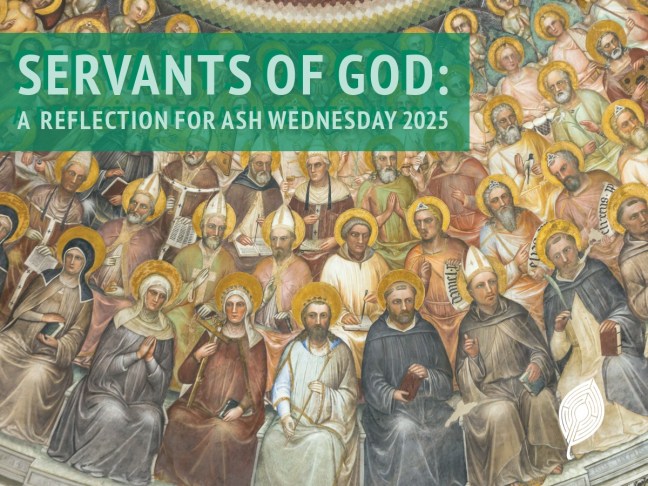
And so, this year, my Lenten series will explore the Lives of the Saints, or more specifically the “Ways” of the Saints (to use a Latin pun, this will be the Viae Sanctorum instead of Vitae Sanctorum). Every day, I’ll be offering a brief reflection on what we might learn from the way one important figure from Christian history manifested Christ in our world, to inspire us to do so too, since it is our turn, and that ministry of reconciliation has now been entrusted to us.
Wishing you a beautiful and bright Lent!
 Matthew Root
3 thoughts on “Servants of God: A Reflection of Ash Wednesday 2025”